Researchers learn why robots get stuck in the sand -- and how to keep them going (Video)
February 9, 2009
SandBot

Enlarge

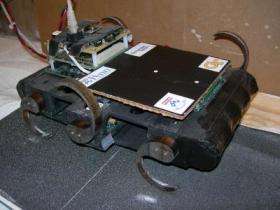
By studying the physics of movement on granular media, Georgia Tech researchers revealed that robots attempting to move across sandy terrain should move their legs more slowly, especially if the sand is loosely packed. Credit: Image courtesy of Daniel Goldman

(PhysOrg.com) -- Today's advanced mobile robots explore complex terrains across the globe and even on Mars, but have difficulty traversing sand and other granular media like dirt, rubble or slippery piles of leaves.

A new study published February 10 in the journal Proceedings of the National Academy of Sciences takes what may be the first detailed look at the problem of robot locomotion on granular surfaces. Among the study's recommendations: robots attempting to move across sandy terrain should move their legs more slowly, especially if the sand is loosely packed.

"We have discovered that when a robot rotates its legs too fast or the sand is packed loosely enough, the robot transitions from a rapid walking motion to a much slower swimming motion," said Daniel Goldman, an assistant professor in the School of Physics at the Georgia Institute of Technology. This project was funded by the Burroughs Wellcome Fund and the U.S. Army Research Laboratory.

The physics of movement on granular media has been largely unexplored systematically, so Goldman and his team set out to systematically investigate the performance of a small six-legged device called SandBot. The robot was designed by Haldun Komsuoglu and Daniel Koditschek at the University of Pennsylvania.

This video is not supported by your browser at this time.

This video shows that by optimizing the rotational motion of the robot's limbs, SandBot is able to walk quickly across the granular media. Video courtesy of Daniel Goldman

"This is new territory because researchers have not examined the interaction between an animal's foot and sand like they have a whale or duck's flipper and water," said Goldman. "Sand is a uniquely challenging terrain because it can shift quite easily from solid to fluid to solid and requires different locomotion strategies."

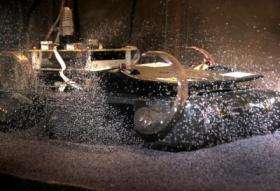
To conduct controlled experiments, Georgia Tech physics graduate student Chen Li built a trackway for SandBot to run along. The trackway consists of an eight-foot-long poppy seed-filled container with tiny holes in the bottom through which air can be blown. The air pulses elevate the granules and cause them to settle into a loosely packed solid state, allowing the researchers to closely control the density of the material.

"We used poppy seeds as the granular material because they were large enough not to get into the SandBot motors but light enough to be manipulated with our air blowers," explained Goldman. "We have done experiments with small glass beads, which more closely approximate desert sand, and found no qualitative change in the results."

In the desert, typical volume fractions for granular media range from 55 to 64 percent. For the study's initial experiments, the researchers packed the poppy seeds to a volume fraction of 63 percent, placed SandBot onto the surface and set its c-shaped legs to rotate five times per second. The little robot, which could bounce quickly across hard ground, became completely stuck in the granular material after just a few steps.
SandBot
Enlarge

In this poppy seed-filled trackway, Georgia Tech researchers conducted controlled experiments to study why robots have difficulty traversing sand and other granular media like dirt, rubble or slippery piles of leaves. Image courtesy of Daniel Goldman

The researchers discovered that the problem was the rotational motion of the robot's limbs. The SandBot moves its limbs in an alternating tripod gait and during a rotation, each limb moves fast while it is in the air and slow while it is in the ground. The researchers found that the robot could walk across the sand quickly - at a speed of one body length per second - if the rotation frequency was fixed and three parameters were adjusted: the durations of the slow and fast phases and the angle at which the limb changed from slow to fast.

"A systematic study of the motion then revealed that changes in volume fraction of less than one percent resulted in either rapid motion or slower swimming," added Goldman. "We saw similar sensitivity when we changed the limb rotation frequency."

To study this phenomenon further, Goldman and Paul Umbanhowar of Northwestern University developed a simple kinematic model of penetration and slip of a curved limb on granular media. The model results showed that the relationship of the speed to the volume fraction and frequency of leg rotation was largely controlled by the degree to which the robot limbs penetrated into the sand with each step.

The higher the limb frequency and the looser the granular material, the deeper the robot sank into the granular material. Thus the length of the step the robot could take was shortened and when the step size became too short, the robot took its next step into ground disturbed by the previous step. This triggered a catastrophic loss of speed and a shift from walking to continuous paddling through the poppy seeds.

Goldman believes that this study's experiments and model describing the basic behavior of motion on granular media will help biologists understand how animals appear to move effortlessly across a diversity of complex substrates.

He also plans to use the information to help roboticists design devices with the appropriate feet and limb motion to move well in complex terrain - including sand. Future robots may have the ability to sense the type of material they are walking across, allowing them to adjust their limb motion accordingly. Such smart robots would advance the exploration of other planets, as well as search-and-rescue missions in disaster settings.

Source: Georgia Institute of Technology

4.2 /5 (6 votes)  

Filter


Move the slider to adjust rank threshold, so that you can hide some of the comments.


Display comments: newest first

SDMike
Feb 09, 2009

Rank: 4 / 5 (1)
Changing foot size/shape would work too and might be more effective.
columbiaman
Feb 10, 2009

Rank: not rated yet
I think the idea for this research is to find the most efficient way for the robot to move without having to change the legs of the robot. They want to be able to have one robot move easily on solid and granular surfaces instead of just one or the other.
deatopmg
Feb 10, 2009

Rank: 4 / 5 (1)
why not treads like a tank? They seem to do perfectly well on both.
SDMike
Feb 10, 2009

Rank: not rated yet
inflatable feet - don't change the legs. By using air or fluid pressure in capillaries one could have considerable control over the shape, size, and flex characteristics of an inflatable foot. This would give the robot great flexibility over a huge variety of surfaces at a wide variety of speeds - even liquids of various densities. Such a device might even improve human mobility especially over sand and snow.
DozerIAm
Feb 11, 2009

Rank: 4 / 5 (1)
SDMike has a point in his first point (sorry not keen on using hydraulics as a solution but I liked the theme). It need not involve swapping feet - they could use a material that can manipulate its shape with either articulation (as our current fleet of "stealth" fighters adjust their shape or via composite materials and a current (http://www.physor...6.html).
Rank 4.2 /5 (6 votes)
Relevant PhysicsForums posts
  • feed hold button on CNC lathe
    created19 hours ago
  • Mechanics of Solids ( Final exam question) please help!
    created21 hours ago
  • RFAC in Fortran
    createdFeb 09, 2012
  • dynamics 2/32
    createdFeb 08, 2012
  • dynamics
    createdFeb 08, 2012
  • Vibration Absorbtion Problem
    createdFeb 08, 2012
  • More from Physics Forums - General Engineering

More news stories

New Kindle Touch is an impressive e-reader

When it comes to reading digital books, tablets are all the rage. But there's a lot to like about simple e-readers, which over the past year have become both a lot cheaper and a lot less clunky.

Electronics / Consumer & Gadgets

created 14 hours ago | popularity 5 / 5 (2) | comments 1

Apple to debut 'iPad 3' in March: report

Apple will unveil a new version of its market-ruling iPad table computer in March, according to a report in Dow Jones-owned technology blog All Things D.

Electronics / Consumer & Gadgets

created 14 hours ago | popularity 2.1 / 5 (18) | comments 0

Google to make home entertainment system: report

Google will mirror Apple's winning hardware-software formula with an Android-powered entertainment system that wirelessly streams content through homes, the Wall Street Journal reported on Thursday.

Electronics / Consumer & Gadgets

created 8 hours ago | popularity 4.5 / 5 (2) | comments 0

Barriers fall between TV, Internet

You say TV, I say Internet. Toe-mate-o, toe-mah-to.

Electronics / Consumer & Gadgets

created 10 hours ago | popularity not rated yet | comments 0

Intel packs performance and reliability into its latest SSD 520 series

Intel Corporation announced today its fastest, most robust client/consumer solid-state drive (SSD) to date, the Intel Solid-State Drive 520 Series (Intel SSD 520), a 6 gigabit-per-second (gbps) SATA III SSD ...

Electronics / Hardware

created Feb 07, 2012 | popularity 5 / 5 (1) | comments 3


'Dark plasmons' transmit energy

Microscopic channels of gold nanoparticles have the ability to transmit electromagnetic energy that starts as light and propagates via "dark plasmons," according to researchers at Rice University.

FDA-approved drug rapidly clears amyloid from the brain, reverses Alzheimer's symptoms in mice

Neuroscientists at Case Western Reserve University School of Medicine have made a dramatic breakthrough in their efforts to find a cure for Alzheimer's disease. The researchers' findings, published in the journal Science, show t ...

Hydrogen from acidic water: Researchers develop potential low cost alternative to platinum for splitting water

A technique for creating a new molecule that structurally and chemically replicates the active part of the widely used industrial catalyst molybdenite has been developed by researchers with the Lawrence Berkeley ...

Ultraviolet protection molecule in plants yields its secrets

Lying around in the sun all day is hazardous not just for humans but also for plants, which have no means of escape. Ultraviolet (UV) radiation from the sun can damage proteins and DNA inside cells, leading ...

Anyone can learn to be more inventive, cognitive researcher says

There will always be a wild and unpredictable quality to creativity and invention, says Anthony McCaffrey, a cognitive psychology researcher at the University of Massachusetts Amherst, because an "Aha moment" is rare and ...

Soraa LED light may dim 50-watt halogen rivals

(PhysOrg.com) -- Soraa, a Fremont, California company founded in 2008, this week launched its first product, a light that uses LEDS (light emitting diodes). The "Soraa LED MR16 lamp" is the "perfect" replacement ...