How an Antarctic worm makes antifreeze and what that has to do with climate change
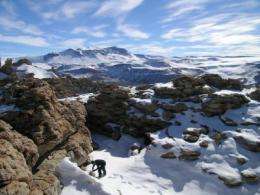
Two Brigham Young University researchers who just returned from Antarctica are reporting a hardy worm that withstands its cold climate by cranking out antifreeze. And when its notoriously dry home runs out of water, it just dries itself out and goes into suspended animation until liquid water brings it back to life.
Identifying the genes the worm uses to kick in its antifreeze system can be useful information - similar genes found in other Antarctic organisms are currently being used to engineer frost-resistant crops.
But BYU's Byron Adams, associate professor of molecular biology, and his Ph.D. student Bishwo Adhikari are carrying on their love affair with microscopic nematode worms for a different reason.
They spent Christmas near the South Pole to help determine how the fate of a half-millimeter worm can actually impact an entire ecosystem, and how that information can serve as an important baseline for understanding climate change's impact on more complex systems, such as a farmer's field in the United States.
Their latest study, published Monday in the journal BMC Genomics, used samples Adams gathered during previous trips to the world's most inhospitable continent. He's lived at McMurdo Station seven times and hitched helicopter rides to gather soil from Antarctica's freezing, bone-dry valleys, where only a handful of microscopic animals can survive. The ones that do make for a convenient laboratory for observing how minor changes in the environment can have a big impact on an ecosystem.
Previous research co-authored by Adams showed that another species of nematode plays a large role in the amount of carbon cycled through the soil, a process that is one of the essential building blocks of life on Earth. At the same time, fluctuations in temperature are diminishing the worm's population. That's the kind of climate change impact that researchers want to better understand so they can predict what will happen next.
Adams and Adhikari are taking that one step further with their analysis of the genes of their latest subject, a species of nematode that lives in wetter areas of Antarctica's interior.
Until Adhikari sequenced its genes, nobody knew that it had developed an antifreeze system.
"I was really surprised - the antifreeze gene is not like anything in other nematodes," he said.
When water inside a living thing freezes, ice crystals pierce cell walls and kill them. That's what causes "frostbite." It turns out that the worm creates a protein that probably prevents the ice from forming sharp crystals or coats them so they don't puncture anything.
The new paper also reports the genes that the worm uses to put its life on "pause" when ground water dries up.
This particular species' unique genetic response to its environment means it is likely going to flourish as Antarctica gets wetter, Adams says, while other nematode species diminish. That's how this molecular-level research ties back into predicting how the composition and distribution of soil species will change in response to climate change.
"Understanding how the soil functions independent of plants allows us a baseline that we can later add plants to," Adams explained. "These are rudimentary first steps - the long-term goal is to be able to extend our findings to more complex ecosystems, particularly managed ecosystems. Growers want to know how climate change is going to affect their ability to grow crops. Right now we don't really know. Understanding how this works in a simple ecosystem is the first step in being able to make those predictions."
Source: Brigham Young University


