Diverse 'connectomes' hint at genes' limits in the nervous system
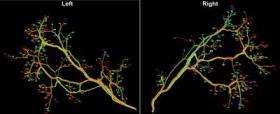
February 10, 2009 Connectomes of a Left-Right Pair of Interscutularis Muscles

Enlarge

Axons in the connectomes of the left and right interscutularis muscles of a 1-month old animal were color-coded based on the rank-order of their motor unit sizes (the number of muscle fibers innervated by each axon) in each connectome. Thus each axon and its contralateral counterpart can be identified in the connectomes, and subsequently their morphologies can be compared. Credit: Ju Lu/Harvard University

Genetics may play a surprisingly small role in determining the precise wiring of the mammalian nervous system, according to painstaking mapping of every neuron projecting to a small muscle mice use to move their ears. These first-ever mammalian "connectomes," or complete neural circuit diagrams, reveal that neural wiring can vary widely even in paired tissues on the left and right sides of the same animal.

Scientists at Harvard University and the Massachusetts Institute of Technology describe the work this week in the journal PLoS Biology, accompanied by vivid images depicting neurons that are strikingly treelike, but also tremendously varied.

"We had expected to find a great degree of neural symmetry in the same mouse's two interscutularis muscles, but this isn't even close to true," says Jeff W. Lichtman, professor of molecular and cellular biology in Harvard's Faculty of Arts and Sciences.
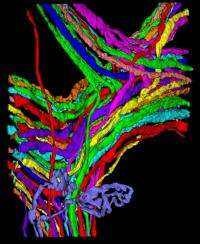
Example of a Reconstructed Image Stack
Enlarge

In order to understand how each nerve cell integrates into the functional organization of a neural circuit, it is necessary to obtain the complete wiring diagram (connectome) of the circuit by tracing out all the neural processes in the sample. We used confocal laser scanning microscopy to image all the axons that innervate a small ear muscle in transgenic mice that express fluorescent protein in motor neurons. Shown here is one of the reconstructed image stacks containing branches of ~ 10 axons. Each axon was traced out in a semi-automated image processing program and rendered in 3D with a distinct color. This image stack is representative of the hundreds of image stacks from which the entire connectome was reconstructed. Credit: Ju Lu/Harvard University

"It looks like the mammalian nervous system may be a bit like a football game," he adds. "Even when the rules are the same, every single outcome is unique."

Curiously, the connectome of the mouse interscutularis -- a muscle also found in dogs, rats, and other mammals that readily move their ears -- reveals that some of its neurons are as much as 25 percent longer than is necessary. This casts doubt on a longstanding assumption among neuroscientists that neural wiring length is generally minimized to conserve space, energy, and resources.

"This well-known hypothesis that wiring length should be minimized has been in the scientific literature for decades," says Ju Lu, a postdoctoral researcher in molecular and cellular biology at Harvard. "It's very surprising, frankly, to find so much excess wiring in the mammalian nervous system."

Lichtman and Lu's work represents only the second connectome to date, following one for the worm Caenorhabditis elegans. While their task initially appeared manageable -- the entire interscutularis muscle is but a few millimeters in length -- teasing out the muscle's tangle of about 15 intricately branched and intertwined axons proved fiendishly complex.

"It's a bit like taking a giant plate of spaghetti and, without unraveling it, trying to figure out which strand goes where," says Lu. "Except in this case, each strand of spaghetti has up to 37 branches."

Working with mice containing a gene that causes motor neurons to fluoresce, Lichtman and Lu used an automated microscope to gather tens of thousands of images. These images were analyzed with semi-automated tracing tools, although the need for frequent corrections and manual editing by Lu slowed the pace of the mapping to a scant half-millimeter per hour.

Connectomes from a mouse's two interscutularis muscles depict dramatically different neural circuitry even within mirror-image tissues from the same animal.

"Comparison of each neuron and its counterpart on the opposite side of the animal revealed that each connectome was unique," Lichtman says, "demonstrating wiring diagrams that differ substantially in form, even within a common genetic background."

Lichtman says the research suggests the mammalian nervous system is in some ways unexpectedly primitive, its freeform structure lacking the regimentation seen in insects and worms. But, he adds, this seeming randomness may be advantageous.

"This may explain why humans and other mammals can quickly adapt their behaviors to a changing environment," Lichtman says. "We may be less perfected in our genetic evolution, but our flexible neural wiring may allow us to undergo behavioral evolution at a very rapid rate."

Such variation in the nervous system, he adds, could help explain why different humans, each equipped with the same neural building blocks, excel at tasks ranging from dancing to mathematical computations, and from crossword puzzles to bowling.

Source: Harvard University


print this article email this article download pdf blog this article bookmark this article     Stumble it Digg this share on Facebook retweet share on Reddit add to delicious
Rate this story - 5 /5 (4 votes)

Rank Filter

Move the slider to adjust rank threshold, so that you can hide some of the comments.


Display comments: newest first

  • lengould100 - Feb 10, 2009
    • Rank: not rated yet
    A wierd result. It'll be interesting to see if this conclusion is confirmed, and if the conclusion then drawn withstands scrutiny. I'm sure they must have considered it, but what are the odds that a particular set of genetics may precisely encode left and right muscular controls separately and differently for different purposes, like "left-handedness" etc.?
  • KBK - Feb 10, 2009
    • Rank: not rated yet
    What else are they wrong about???

    Think about that for a few seconds within the context of all other sciences as well.

    Many entire edifices of science need be torn down and re-started, is the final result-when something new is found-instead of the usual desire to slam square pegs into round holes. We see children doing this as they sit on the floor at home or in day-care-every day.

    Never fail to understand that this established pattern still sits there--in the mind even in the tenured scientist at the age of 60. It is just waiting to be activated at it's base root, which is emotion. Oh. Emotion and the autonomous system rules the base formation of logic. Fancy that.

    These things are done --as the proponents do not want to change their ways. Too emotionally difficult.

    Too bad that science is SUPPOSED to be logic.
  • dan42day - Feb 10, 2009
    • Rank: not rated yet
    I'm not impressed.

    As lengould100 pointed out handedness could explain some of the dissimilarities, the right and left sides of the nervous system are obviously wired differently.

    Also, this process doesn't appear to require precise wiring. More critical processes could still be much more precisely controlled.

    As for the apparently messy wiring, the extra meandering could be to reduce stress on the wires caused by the flexibility of the surrounding tissue. Just look at the wiring harness between your car body and the door.

February 10, 2009 all stories

Comments: 3

5 /5 (4 votes)
  • Stumble this up

  • Digg this

  • share this

  • hide
  • Related Stories


  • hide
  • Relevant PhysicsForums posts

Other News

Largest gene study of childhood IBD identifies 5 new genes

Medicine & Health / Genetics

created 3 hours ago | popularity not rated yet | comments 0

In the largest, most comprehensive genetic analysis of childhood-onset inflammatory bowel disease (IBD), an international research team has identified five new gene regions, including one involved in a biological pathway ...


Researchers find potential treatment for Huntington's disease (w/ Video)

Medicine & Health / Research

created 4 hours ago | popularity not rated yet | comments 0

Investigators at Burnham Institute for Medical Research, the University of British Columbia's Centre for Molecular Medicine and Therapeutics and the University of California, San Diego have found that normal synaptic activity ...


Heart and bone damage from low vitamin D tied to declines in sex hormones

Medicine & Health / Research

created 3 hours ago | popularity not rated yet | comments 0

Researchers at Johns Hopkins are reporting what is believed to be the first conclusive evidence in men that the long-term ill effects of vitamin D deficiency are amplified by lower levels of the key sex hormone estrogen, ...


Young athletes need dual screening tests for heart defects, study suggests

Medicine & Health / Health

created 3 hours ago | popularity not rated yet | comments 0

To best detect early signs of life-threatening heart defects in young athletes, screening programs should include both popular diagnostic tests, not just one of them, according to new research from heart experts at Johns ...


Postmortem genetic tests after sudden death may provide less expensive way to identify risk

Medicine & Health / Research

created 3 hours ago | popularity not rated yet | comments 0

Targeted postmortem testing to identify genetic mutations associated with sudden unexplained death (SUD) is an effective and less expensive way to determine risk to relatives than comprehensive cardiac testing of first degree ...