Swift, Fermi probe fireworks from a flaring gamma-ray star (Video)
February 10, 2009 Swift, Fermi probe fireworks from a flaring gamma-ray star

Enlarge

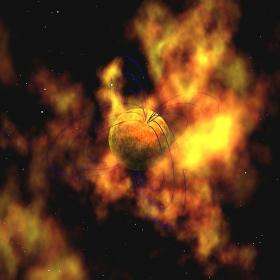
Astronomers think soft gamma-ray repeaters are magnetars -- neutron stars with a super-strong magnetic field (blue arcs in this artist's concept). Credit: NASA/Goddard Space Flight Center Conceptual Image Lab

(PhysOrg.com) -- Astronomers using NASA's Swift satellite and Fermi Gamma-ray Space Telescope are seeing frequent blasts from a stellar remnant 30,000 light-years away. The high-energy fireworks arise from a rare type of neutron star known as a soft-gamma-ray repeater. Such objects unpredictably send out a series of X-ray and gamma-ray flares.

"At times, this remarkable object has erupted with more than a hundred flares in as little as 20 minutes," said Loredana Vetere, who is coordinating the Swift observations at Pennsylvania State University. "The most intense flares emitted more total energy than the sun does in 20 years."

The object, which has long been known as an X-ray source, lies in the southern constellation Norma. During the past two years, astronomers have identified pulsing radio and X-ray signals from it. The object began a series of modest eruptions on Oct. 3, 2008, then settled down. It roared back to life Jan. 22 with an intense episode.

Because of the recent outbursts, astronomers will classify the object as a soft-gamma-ray repeater -- only the sixth known. In 2004, a giant flare from another soft-gamma-ray repeater was so intense it measurably affected Earth's upper atmosphere from 50,000 light-years away.
NASA's Swift, Fermi probe fireworks from a flaring gamma-ray star
Enlarge

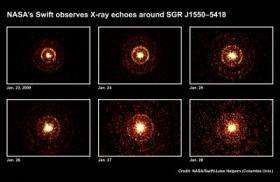
Swift's X-Ray Telescope captured an apparent expanding halo around the flaring neutron star SGR J1550-5418. The halo formed as X-rays from the brightest flares scattered off of intervening dust clouds. Credit: NASA/Swift/Jules Halpern (Columbia Univ.)

Scientists think the source is a spinning neutron star, which is the superdense, city-sized remains of an exploded star. Although only about 12 miles across, a neutron star contains more mass than the sun. The object has been cataloged as SGR J1550-5418.

While neutron stars typically possess intense magnetic fields, a subgroup displays fields 1,000 times stronger. These so-called magnetars have the strongest magnetic fields of any known object in the universe. SGR J1550-5418, which rotates once every 2.07 seconds, holds the record for the fastest-spinning magnetar. Astronomers think magnetars power their flares by tapping into the tremendous energy of their magnetic fields.

"The ability of Fermi's gamma-ray burst monitor to resolve the fine structure within these events will help us better understand how magnetars unleash their energy," said Chryssa Kouveliotou, an astrophysicist at NASA's Marshall Space Flight Center in Huntsville, Ala. The object has triggered the instrument more than 95 times since Jan. 22.

FLV player

Gamma-Ray Fireworks Now Erupting from Rare Stellar Object

Using data from Swift's X-ray telescope, Jules Halpern at Columbia University captured the first "light echoes" ever seen from a soft-gamma-ray repeater. Images acquired when the latest flaring episode began show what appear to be expanding halos around the source. Multiple rings form as X-rays interact with dust clouds at different distances, with closer clouds producing larger rings. Both the rings and their apparent expansion are an illusion caused by the finite speed of light and the longer path the scattered light must travel.

"X-rays from the brightest bursts scatter off of dust clouds between us and the star," Halpern said. "As a result, we don't really know the distance to this object as well as we would like. These images will help us make a more precise measurement and also determine the distance to the dust clouds."

NASA's Wind satellite, the joint NASA-Japan Suzaku mission, and the European Space Agency's INTEGRAL satellite also have detected flares from SGR J1550-5418.

Source: NASA's Goddard Space Flight Center


print this article email this article download pdf blog this article bookmark this article     Stumble it Digg this share on Facebook retweet share on Reddit add to delicious
Rate this story - 4.6 /5 (5 votes)

Rank Filter

Move the slider to adjust rank threshold, so that you can hide some of the comments.


Display comments: newest first

  • RAL - Feb 11, 2009
    • Rank: not rated yet
    "measurably affected Earth's upper atmosphere from 50,000 light-years away."

    Almost mind boggling. Great article, picture, video too.
  • earls - Feb 11, 2009
    • Rank: 4 / 5 (1)
    "neutron stars with a super-strong magnetic field"

    ...
  • yep - Feb 18, 2009
    • Rank: not rated yet
    a new way to look at stars
    http://www.holosc...x49g6gsf

February 10, 2009 all stories

Comments: 3

4.6 /5 (5 votes)
  • Stumble this up

  • Digg this

  • share this

  • hide
  • Related Stories

  • Very High Energy Gamma Rays
    created Sep 25, 2009 | popularity not rated yet | comments 0
  • Geriatric pulsar still kicking
    created Feb 26, 2009 | popularity not rated yet | comments 0
  • Astronomers find unexpected 'heartbeats' in star
    created Aug 23, 2006 | popularity not rated yet | comments 0
  • Pulsar gives insight on ultra dense matter and magnetic fields
    created Dec 14, 2004 | popularity not rated yet | comments 0
  • Carbon Atmosphere Discovered on Neutron Star
    created Nov 04, 2009 | popularity not rated yet | comments 0


  • hide
  • Relevant PhysicsForums posts

  • Question about 2-body gravity
    created Nov 24, 2009
  • life on Mars
    created Nov 24, 2009
  • Semi-major axis from cartesian co-ordinates
    created Nov 23, 2009
  • Primary Mirror grinding
    created Nov 23, 2009
  • dark energy can escape black holes.
    created Nov 23, 2009
  • Are there green, purple and pink stars?
    created Nov 22, 2009
  • More from Physics Forums - General Astronomy

Other News

Ships warned about icebergs headed for New Zealand (AP)

Ships warned about icebergs headed for New Zealand

Space & Earth / Earth Sciences

created 9 minutes ago | popularity not rated yet | comments 0

(AP) -- Ships are on alert and maritime authorities are monitoring the movements of hundreds of menacing icebergs drifting toward New Zealand in the southern Pacific Ocean, officials said.


Cutting greenhouse pollutants could directly save millions of lives worldwide

Space & Earth / Environment

created 1hour ago | popularity 1 / 5 (2) | comments 0

Tackling climate change by reducing carbon dioxide and other greenhouse emissions will have major direct health benefits in addition to reducing the risk of climate change, especially in low-income countries, according to ...


Small faults in Southeast Spain reduce earthquake risk of larger ones

Small faults in Southeast Spain reduce earthquake risk of larger ones

Space & Earth / Earth Sciences

created 1hour ago | popularity not rated yet | comments 0

A team of Spanish scientists, studying recent, active deformations in the Baetic mountain range, have shown that the activity of smaller tectonic structures close to larger faults in the south east of the ...


It's not just dirt!

Space & Earth / Environment

created 1hour ago | popularity 5 / 5 (1) | comments 0

Soil is the linchpin of the environment, where atmosphere, biosphere, and hydrosphere meet. Despite that, many students see soil as "just dirt" - a place to grow plants, but nothing more. Soil science educators are challenged ...


Mars Reconnaissance Orbite

Mars Reconnaissance Orbite Team Plans Uplink of Protective Files

Space & Earth / Space Exploration

created 4 hours ago | popularity 5 / 5 (1) | comments 0

(PhysOrg.com) -- The team operating NASA's Mars Reconnaissance Orbiter plans to uplink protective files to the spacecraft next week as one step toward resuming the orbiter's research and relay activities.