Study says 'middle class' coral reef fish feel the economic squeeze
February 10, 2009
East African Village

Enlarge

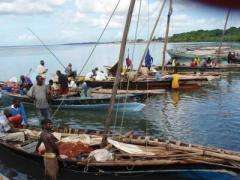
According to a recent study by WCS and other organizations, coral reefs next to "middle class" communities in Eastern Africa have the lowest fish levels. In contrast, reefs next to villages of low and high socio-economic levels had higher fish levels. Credit: (c) Tim McClanahan

The economy isn't just squeezing the middle class on land, it's also affecting fish.

According to a study by the Wildlife Conservation Society (WCS) and other organizations, researchers discovered a surprising correlation between "middle class" communities in Eastern Africa and low fish levels. Curiously, areas with both low and high socio-economic levels had comparatively higher fish levels.

Appearing in the latest edition of Current Biology, the study examined reef systems, human population densities, and socio-economics among villages in 30 fished and unfished study sites in five countries along Africa's Indian Ocean coast.

The study is by Josh Cinner of James Cook University (JCU), Tim McClanahan of the Wildlife Conservation Society (WCS), Tim Daw of the University of East Anglia, Nick Graham of JCU, Joseph Maina of WCS, and Shaun Wilson and Terry Hughes of JCU.

In a comparison between villages, researchers found that communities with intermediate levels of infrastructure had the lowest fish levels in their adjacent reef systems—up to four times lower than sites of low and high levels of development.

"This is a significant finding on how socio-economics can influence reef fisheries in surprising ways," said Dr. Tim McClanahan, a WCS coral researcher and co-author of the study. "It also shows the importance of combining ecology with social science for conservation planning on a regional scale."

The explanation, said researchers, lies in the interplay between traditional customs and how growth influences the social fabric of communities. In poor communities, many of which rely heavily on marine resources, fishing levels are kept in check by local cultural institutions and taboos and a reliance on traditional, low-tech fishing methods. Increases in wealth often reduce a community's dependence on fishing, but it can also increase the number of motorized fishing vessels and fishing gear such as handlines.

Economic growth during the early stages can also erode cultural restrictions on overfishing, according to the authors. The net result: fewer fish. Among the countries studied, Kenya in particular, has experienced a sharp decline in cultural restraints and a subsequent increase in unrestrained and destructive fishing techniques.

The most affluent communities, by contrast, become less dependent on marine resources and more diversified economically, with more salaried positions and economic opportunities. Wealthier communities also possess higher levels of technology—larger boats that enable fishermen to fish on the open sea—and an increased awareness on the importance of coral reefs on ecological health.

The U-shaped curve in fish biomass with respect to socioeconomic levels approximates what is known as an environmental "Kuznet curve," which is adapted from a graphical model that measures economic inequalities in developing countries driven by the extent of a countries economic influence.

Predictably, the research also found that fish levels were always negatively but not strongly affected by high human population density. And protected marine sites with no fishing had fish levels three times higher than sites where fishing was permitted.

Source: Wildlife Conservation Society


Rank 3 /5 (2 votes)
Relevant PhysicsForums posts
  • Do some geologists actually act a lot like Randy Marsh?
    createdFeb 11, 2012
  • Discrepancy between oxygen and carbon-dioxide levels
    createdFeb 09, 2012
  • where gems are found in the world
    createdFeb 09, 2012
  • Wind Waves in Reservoir ~ Wind run-up and Wind set-up
    createdFeb 08, 2012
  • Balance of oxygen in the atmosphere
    createdFeb 01, 2012
  • The case for a methanol-based economy
    createdJan 30, 2012
  • More from Physics Forums - Earth

More news stories

Salvage workers begin pumping fuel from Italian shipwreck

Salvage workers Sunday began pumping fuel from the shipwrecked Italian cruise liner Costa Concordia, a day ahead of schedule, officials said.

Space & Earth / Environment

created 5 hours ago | popularity not rated yet | comments 0

Latin America mining boom clashes with conservation

Latin America is experiencing a mining boom as prices rise fuelled by a hike in global demand, but the region is also being hit by a wave of violent protests, strikes and rallies by environmentalists.

Space & Earth / Environment

created 13 hours ago | popularity 5 / 5 (1) | comments 1

Political leaders play key role in how worried Americans are by climate change: study

More than extreme weather events and the work of scientists, it is national political leaders who influence how much Americans worry about the threat of climate change, new research finds.

Space & Earth / Environment

created Feb 06, 2012 | popularity 5 / 5 (6) | comments 73

NASA budget will axe Mars deal with Europe: scientists

US President Barack Obama's budget proposal to be submitted next week for 2013 will cut NASA's budget by 20 percent and eliminate a major partnership with Europe on Mars exploration, scientists said Thursday.

Space & Earth / Space Exploration

created Feb 10, 2012 | popularity 5 / 5 (3) | comments 58

Humans may have helped the decline of African rainforests 3000 years ago

(PhysOrg.com) -- Large areas of rainforests in Central Africa mysteriously disappeared over three thousand years ago, to be replaced by savannas. The prevailing theory has been that the cause was a change ...

Space & Earth / Environment

created Feb 10, 2012 | popularity 4.1 / 5 (14) | comments 21 | with audio podcast report


Scientists discover molecular secrets of 2,000-year-old Chinese herbal remedy

For roughly two thousand years, Chinese herbalists have treated Malaria using a root extract, commonly known as Chang Shan, from a type of hydrangea that grows in Tibet and Nepal. More recent studies suggest that halofuginone, ...

Overeating may double risk of memory loss

New research suggests that consuming between 2,100 and 6,000 calories per day may double the risk of memory loss, or mild cognitive impairment (MCI), among people age 70 and older. The study was released today and will be ...

New method to examine batteries -- MRI from the inside

There is an ever-increasing need for advanced batteries for portable electronics, such as phones, cameras, and music players, but also to power electric vehicles and to facilitate the distribution and storage of energy derived ...

A mitosis mystery solved: How chromosomes align perfectly in a dividing cell

Although the process of mitotic cell division has been studied intensely for more than 50 years, Whitehead Institute researchers have only now solved the mystery of how cells correctly align their chromosomes during symmetric ...

Lab study raises questions over nano-particle impact

Tests involving chickens have raised questions about the impact on health from engineered nano-particles, the ultra-fine grains commonly used in drugs and processed foods, scientists said on Sunday.

Starve a virus, feed a cure? Findings show how some cells protect themselves against HIV

A protein that protects some of our immune cells from the most common and virulent form of HIV works by starving the virus of the molecular building blocks that it needs to replicate, according to research published online ...