Role of protein in tumor growth is highlighted by researcher using 3-D model
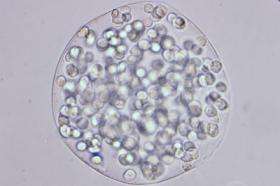
(PhysOrg.com) -- By observing the behavior of cancer cells grown in both two and three dimensions, Cornell assistant professor of biomedical engineering Claudia Fischbach-Teschl has demonstrated that a previously underestimated protein secreted by cancer cells could be a key factor in allowing cancer to grow and spread in the body.
The experiments, detailed in the Jan. 13 issue of the Proceedings of the National Academy of Sciences (PNAS, 106:2), looked at how cancer cells binding to the material that surrounds them, called the extracellular matrix, regulate the secretion of proteins called angiogenic factors. These proteins allow tumors to develop blood-vessel networks and eventually metastasize, or spread to other parts of the body.
Fischbach-Teschl found that when cultured in different ways, the cancer cells behaved differently, and the differences led to new questions about which angiogenic factors are more important in the progression of cancer. Notably, the protein interleukin-8 (IL-8) was secreted 35 times more heavily in three-dimensional cell cultures than when grown on flat, two-dimensional cultures prepared from the same material.
"Our research focus is to understand how cells are interacting with their environment," said Fischbach-Teschl, who began the work as a postdoctoral associate at Harvard University under co-author David J. Mooney and finished the experiments at Cornell. "And when we talk about environment, it's not only that cells are interacting with neighboring cells, but also with their surrounding matrix."
In her Weill Hall lab, Fischbach-Teschl creates realistic, 3-D experimental models that mimic how tumors grow in the body, and she compares them with tumor studies using traditional petri dishes, or in two dimensions. She has found that tumor cells grown in more realistic culture environments are generally more aggressive than the ones grown in conventional plastic dishes. They also secrete different levels of angiogenic factors.
In the experiments described in the PNAS paper, her lab cultured cancer cells three dimensionally using beads of a hydrogel called alginate. To further re-create conditions in the body, the researchers added peptides called RGDs to the alginate beads, which are normally found in the extracellular matrix and bind to receptors on cell surfaces. This caused the cancer cells to interact with the alginate beads, mimicking what happens in the body when cancer cells stick to surrounding material.
The researchers found that the cancer cells produced the exceptionally high amounts of IL-8 only when they were able to attach to the RGDs. In control cultures without the peptides, the IL-8 secretion was much lower.
Previous research had shown that another angiogenic factor called vascular endothelial growth factor (VEGF) was secreted heavily in two-dimensional tumor cell cultures. In fact, a cancer drug approved by the Food and Drug Administration works by specifically blocking VEGF secretions. But that same secretion did not occur at the same rate in the more realistic three-dimensional culture systems.
The experiments show that IL-8, not VEGF, could be the more important chemical to signal blood vessels to grow around the cancer, allowing it to flourish in the body. The researchers further note that IL-8 may contribute to the spread of cancer.
The paper was also highlighted in the Jan. 20 edition of Science Signaling (2:54) as an "Editor's Choice."
Provided by Cornell University


