Avoiding the hothouse and the icehouse
February 11, 2009 Last Ice Age

Enlarge

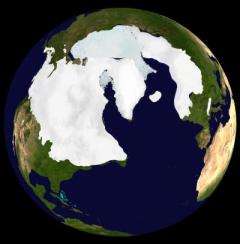
The picture shows the maximum ice distribution on the northern hemisphere during the last ice age. By controlling emissions of fossil fuels we may be able to delay the start of the next ice age for 500,000 years, new research shows. Credit: Dr. Martin Jakobsson, Stockholm Geo Visualization Lab

By controlling emissions of fossil fuels we may be able to greatly delay the start of the next ice age, new research from the Niels Bohr Institute at University of Copenhagen concludes. The results have been published in the scientific magazine, Geophysical Research Letters.

From an Earth history perspective, we are living in cold times. The greatest climate challenge mankind has faced has been surviving ice ages that have dominated climate during the past million years. Therefore it is not surprising that back in the relatively cold 1970's prominent scientists like Soviet Union climatologist Mikhail Budyko greeted man-made global warming from CO2 emissions as a way to keep us out of future ice ages. And there are still those around who feel that continued high fossil fuel emissions are good for this reason. But is the extreme global warming that would result from this a reasonable, and indeed necessary, price to pay to keep ice ages at bay?

In a paper published in the scientific journal Geophysical Research Letters 'Long time management of fossil fuels to limit global warming and avoid ice age onsets', Professor Gary Shaffer of the Niels Bohr Institute, University of Copenhagen, and also leader of the research team at the Danish Center for Earth System Science (DCESS), outlines a way to keep the Earth out of both Hot- and Icehouses for a half a million years into the future.

Building up ice sheets

Ice ages start when conditions at high northern latitudes allow winter snowfall to persist over the summer for enough years to accumulate and build ice sheets. Such conditions depend mainly on summer solar radiation there and atmospheric CO2 concentration. This radiation is modulated on time scales of 20.000, 40.000 and 100.000 years by changes in the Earth's orbit and orientation. Critical summer solar radiation for initiating ice sheet growth can be significantly lower for higher atmospheric CO2 with its greenhouse warming effect.

Professor Shaffer made long projections over the next 500,000 years with the DCESS Earth System Model to calculate the evolution of atmospheric CO2 for different fossil fuel emission strategies. He also used results of a coupled climate-ice sheet model for the dependency on atmospheric CO2 of critical summer solar radiation at high northern latitudes for an ice age onset.

The results show global warming of almost 5 degrees Celsius above present for a "business as usual" scenario whereby all 5000 billion tons of fossil fuel carbon in accessible reserves are burned within the next few centuries. In this scenario the onset of next ice age was postponed to about 170,000 years from now.

Carbon can postpone ice age

However, for a management scenario whereby fossil fuel use was reduced globally by 20% in 2020 and 60% in 2050 (compared to 1990 levels), maximum global warming was less than one degree Celsius above present. Similar reductions in fossil fuel use have been proposed by various countries like Germany and Great Britain.

In this scenario, combustion pulses of large remaining fossil fuel reserves were then tailored to raise atmospheric CO2 content high and long enough to parry forcing of ice age onsets by summer radiation minima as long as possible. In this way our present equable interglacial climate was extended for about 500,000 years, three times as long as in the "business as usual" case.

Valuable climate regulation

"It appears to be well established that the strong ice ages the Earth has experienced over the past million years were ushered in by declining levels of atmospheric CO2. Our present atmospheric CO2 level of about 385 parts per million is already higher than before the transition to these ice ages" Professor Shaffer notes and adds that "The Earth's orbit is nearly circular at present meaning that the present minimum in summer radiation at high northern latitudes is not very deep. We have already increased atmospheric CO2 enough to keep us out of the next ice age for at least the next 55,000 years for this orbital setup".

He concludes that "Fossil fuel reserves may be too valuable for regulating climate far into the future to allow the reserves to be consumed within the next few centuries. The price of extreme global warming to avoid ice ages is a high and indeed unnecessary price to pay."

More information: Geophysical Research Letters: http://www.agu.org/pubs/crossref/2009/2008GL036294.shtml

Source: University of Copenhagen


Rate this story - 2.7 /5 (14 votes)

Rank Filter

Move the slider to adjust rank threshold, so that you can hide some of the comments.


Display comments: newest first

  • Bob_Kob - Feb 11, 2009
    • Rank: 2.5 / 5 (8)
    See, the earth will work itself out. If global warming kicks in too much, she will activate ice age to cancel it out.
  • Roach - Feb 11, 2009
    • Rank: 3 / 5 (6)
    I'm speachless, they address conflicting arguements and use them both as arguements supporting global warmings existance?
    "From an Earth history perspective, we are living in cold times."
    and
    "The Earth's orbit is nearly circular at present meaning that the present minimum in summer radiation at high northern latitudes is not very deep. "
  • Velanarris - Feb 11, 2009
    • Rank: 3.5 / 5 (6)
    Let's step away from the Global warming inclusion in this abstract and look at the doublespeak being used.

    The results show global warming of almost 5 degrees Celsius above present for a "business as usual" scenario whereby all 5000 billion tons of fossil fuel carbon in accessible reserves are burned within the next few centuries. In this scenario the onset of next ice age was postponed to about 170,000 years from now.
    We have some clear problems with this statement.
    1) the DCESS model does not account for any external sources, such as solar radiance and doesn't make any particular note of the nitrogen cycle and it's subsequent effects on land coverage, or ocean chemistry content. I understand this model is one of the more advanced Earth modeling systems, and since I'm not a modeling expert I may be in the wrong here, but Shaffer himself explains the model and it's calibration in http://www.dcess....2008.pdf

    2)
    "It appears to be well established that the strong ice ages the Earth has experienced over the past million years were ushered in by declining levels of atmospheric CO2. Our present atmospheric CO2 level of about 385 parts per million is already higher than before the transition to these ice ages"
    Now one can argue that CO2 is not a primary driver of climate but a strong indicator of a climate trend as well as a secondary forcing on climate. Reasoning for this is that the end of the last ice age was preceeded by a gradual warming of the oceans as evidenced by sediment records up to 1000 years prior. A warming ocean would cause outgassing of CO2 in solution, conversely a cooling ocean would absorb and dissolve more atmospheric CO2. Meaning that the CO2 level isn't causative but indicative of a temperature change in the observational record.
  • rubberman - Feb 11, 2009
    • Rank: 5 / 5 (3)
    This also assumes that no other major event such as a super volcano eruption or asteroid impact occur to cause a major cooling event...
  • albert - Feb 11, 2009
    • Rank: 2.6 / 5 (5)
    I don't understand why the term "fossil fuels" are still being used. Coal, oil and natural gas do not have their origins in "fossils"...this is a word used by big oil originally to have us believe that supply is limited. It is not. There is enough oil for another thousand years according to top oil researchers. Their story never makes mainstream.
  • SDMike - Feb 11, 2009
    • Rank: 3.7 / 5 (3)
    With increasing Mumbo we find the Jumbo seems more plausible. I'm building a big boat with a heater and an air conditioner!
  • Velanarris - Feb 12, 2009
    • Rank: 3 / 5 (2)
    I don't understand why the term "fossil fuels" are still being used. Coal, oil and natural gas do not have their origins in "fossils"...
    Yes they do. As for the second half of your comment, no there is not.
  • moebiex - Feb 14, 2009
    • Rank: 3 / 5 (2)
    This strikes me as a more constructive perspective than either of the pro/anti global warming camps take. If we (humanity) wants to be here for a long(ish) time, we are going to have to figure out how to manage things on these multi-generational and even millenial scales. We might also employ more intensive carbon cycling as we adopt more biofuels as part of an integrated strategy.
  • lengould100 - Feb 24, 2009
    • Rank: not rated yet
    moebiex has it right on. How the heck can you fools rate such a comment anything but a 5?

    Velenarius:
    the end of the last ice age was preceeded by a gradual warming of the oceans as evidenced by sediment records up to 1000 years prior. A warming ocean would cause outgassing of CO2 in solution

    Reason that out a little further. Anything which is capable of warming the oceans will also cause emissions of methane from clathrates on cont. shelves, and from high-lat. peat bogs. Methane then a) increases temperatures further and b) causes increased releases of CO2 (as you identify) from oceans, which both go into a GHG caused further warming feedback loop until a new stability is achieved. CO2 increases at and after initial warming, but methane, that's the bad one.

    Recent article this site, research vessel crossing artic north of Russia documented vast areas of ocean with methane bubbling directly to ocean surface.

    The levels of CO2 increases we're presently adding to atmosphere should be capable of more significant effects than the small Milankovitch orbital variations which have controlled ice ages through past 600,000 years.
  • Velanarris - Feb 24, 2009
    • Rank: 5 / 5 (1)
    Reason that out a little further. Anything which is capable of warming the oceans will also cause emissions of methane from clathrates on cont. shelves, and from high-lat. peat bogs.
    Not necessarily. Remember, methane clathrates are typically found at depth and aren't necessarily in solution. We're talking gasses in aqueous solution here, not just sub-surface oceanic presence.

    In regards to the CO2 vs Milankovich cycle:

    Milankovich cycles are most likely a far greater causation than CO2 as Milankovich cycles deal directly with the source of the energy rather than with the objects that retain that energy for extended periods of time.

    Without the sun CO2 does nothing. Good points though, and very valid for further research and exploration.

February 11, 2009 all stories

Comments: 10

2.7 /5 (14 votes)

  • hide
  • Related Stories

  • USF Study Shows First Direct Evidence of Ocean Acidification
    created Jan 20, 2010 | popularity not rated yet | comments 0
  • Like a hungry teen, life on Earth had big growth spurts
    created Oct 27, 2009 | popularity not rated yet | comments 0
  • Solar Variability: Striking a Balance with Climate Change
    created May 08, 2008 | popularity not rated yet | comments 0
  • Global warming could accelerate from thawing Siberian permafrost
    created Jun 16, 2006 | popularity not rated yet | comments 0
  • How to avoid severe climate change discussed at CO2 conference
    created Sep 21, 2005 | popularity not rated yet | comments 0


  • hide
  • Relevant PhysicsForums posts

  • Carbon Dioxide emissions question
    created Feb 08, 2010
  • Photosynthesis vs. carbonization
    created Feb 07, 2010
  • Sheep's footprints
    created Feb 05, 2010
  • How did Victorians estimate the ages of fossils?
    created Feb 03, 2010
  • How can we defeat pollution as individuals?
    created Jan 29, 2010
  • Formation of lava fields on Lanzarote
    created Jan 27, 2010
  • More from Physics Forums - Earth

Other News

URI researcher calls for global effort to monitor marine pollutants

Space & Earth / Environment

created 43 minutes ago | popularity not rated yet | comments 1

A University of Rhode Island researcher who studies chemical pollutants in the marine environment has called on colleagues around the world to establish a global monitoring network to verify that the chemicals banned by the ...


A new 3-D map of the interstellar gas within 300 parsecs from the sun

A new 3D map of the interstellar gas within 300 parsecs from the Sun

Space & Earth / Astronomy

created 2 hours ago | popularity 5 / 5 (3) | comments 0 | with audio podcast

(PhysOrg.com) -- Astronomy & Astrophysics is publishing new 3D maps of the interstellar gas in the local area around our Sun. A French-American team of astronomers presents new absorption measurements toward ...


Rho Ophiuchus cloud

Professor: We have a 'moral obligation' to seed universe with life

Space & Earth / Astronomy

created 10 hours ago | popularity 3.7 / 5 (19) | comments 31 | with audio podcast report

(PhysOrg.com) -- Eventually, the day will come when life on Earth ends. Whether that’s tomorrow or five billion years from now, whether by nuclear war, climate change, or the Sun burning up its fuel, the last ...


New international satellite observations help assess future earthquake risk in Haiti

New international satellite observations help assess future earthquake risk in Haiti

Space & Earth / Earth Sciences

created 3 hours ago | popularity not rated yet | comments 0

Virginia Key, Florida--Scientists at the University of Miami have analyzed images based on Synthetic Aperture Radar (SAR) observations taken before and just after Haiti's earthquake, on January 12. The images ...


Better weather forecasts with a map showing atmospheric vapour

Space & Earth / Space Exploration

created 4 hours ago | popularity not rated yet | comments 0

Weather forecasts, satellite navigation in cars and the inspection of dikes or natural gas fields: these applications using satellite data would all be even more accurate if we knew more about the distribution of water vapour ...