New High Frequency Amplifier Harnesses Millimeter Waves in Silicon for Fast Wireless
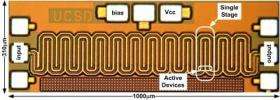
(PhysOrg.com) -- New imaging and high capacity wireless communications systems are one step closer to reality, thanks to a millimeter wave amplifier invented at the University of California, San Diego and unveiled on Feb 11, 2009 at the prestigious International Solid-State Circuits Conference (ISSCC) in San Francisco, Calif.
The new silicon-based amplifier marks progress toward high capacity wireless communications systems that will operate at millimeter wave frequencies (70-110GHz) and could provide data transfer rates as fast as 10 Gigabits per second over a kilometer. Toward this goal, the new amplifier provides both high gain (the ability to increase the volume of a signal) and high bandwidth (the ability to do it over a broad range of tones). It has a direct transmission line path from the input to the output that carries electromagnetic waves—undisrupted—across the surface of a silicon chip. Amplification "stages" along this transmission line boost the signal power by monitoring the signal amplitude and generating feedback in just trillionths of a second, feedback that injects additional energy in phase to the signal. The amplifier provides record-breaking gain of 26-30dB at 100GHz and allows wave propagation along the chip surface.
James Buckwalter, an assistant professor in the Department of Electrical and Computer Engineering at UC San Diego's Jacobs School of Engineering, invented the amplifier and named it the Cascaded Constructive Wave Amplifier.
"Cascaded constructive wave amplification is a new circuit architecture that can push silicon into new operating regimes near the fundamental limits of Moore's Law and allow the ultra high data rates that the millimeter wavelength range of the electromagnetic spectrum offers," explained Buckwalter.
The millimeter wavelength range of the electromagnetic spectrum is relatively unexplored for commercial use, in part, because it has been difficult and expensive to build the necessary high frequency amplifiers. Many of today's millimeter wave amplifiers, for example, require exotic and expensive semiconductor materials.
"We're exploring how silicon can play a role at frequencies exceeding 100 Gigahertz. Silicon has the advantage of allowing inexpensive integration of microwave and now perhaps millimeter wave components," said Buckwalter.
A is for Amplification
Today's Wi-Fi and WiMax systems operate at a frequency of 2.5-5GHz and are capable of handling megabits of information per second. "If you want higher data rates, you need to find ways to transmit information wirelessly at rates faster than what is available at 2.5 Gigahertz. This new amplifier is aimed at opening millimeter wave frequency bands, where much more bandwidth are available and where higher data transfer rates, as fast as 10 Gigabits per second over a kilometer, are possible," explained Buckwalter.
Point-to-point wireless communication is a low-cost approach to getting optical fiber speeds. "You could use this amplification method to boost signal strength of a 100 Gigahertz signal from the transmitter in your ISP and also at the receiver in your home to detect the signal," explained Buckwalter.
Feedback Tames the Wave
"The really cool thing about this chip is that it's the first time traveling waves have been amplified along an uninterrupted transmission line...we've found a new architecture that allows higher gain than what people supposed for waves traveling near the speed of light on silicon chips," said Buckwalter.
The periodic amplification stages along the transmission line are crucial to the amplification process. They monitor waves as they propagate through the transmission line and spontaneously inject energy into the wave without interrupting its propagation down the transmission line.
In particular, the strength of the wave is constantly monitored at the output side of each amplification stage. Feedback is provided through a fast transistor that feeds energy into the input of the transmission line and hits the wave with that energy 2.5 trillionths of a second later—a quarter of the wave's period. In this way, the wave is constantly being strengthened as it moves uninhibited through each of the amplification stages along the transmission line.
This new amplifier design is distinctly different from existing amplifier technologies. The new Cascaded Constructive Wave Amplifier provides high gain—the signal gain increases exponentially with the number of amplification stages—without absorbing and regenerating the wave energy. The cascaded amplifiers that are found in all cell phones also have high gain——but they absorb and regenerate signals.
"We've taken a wave that travels along the surface of the silicon near the speed of light and found a way to amplify the signal strength without interrupting the wave," said Buckwalter. "We have found a way to tame millimeter waves on silicon."
More information: ISSCC 2009 Paper: "A 26dB Gain, 100GHz Si/SiGe Cascaded Constructive Wave Amplifier," by James Buckwalter and Joohwa Kim from the Department of Electrical and Computer Engineering from the UC San Diego Jacobs School of Engineering.
Source: University of California - San Diego


