Removing wrinkles with RHAMM
Hollywood stars of a certain age take note: Research at Berkeley Lab suggests that a protein linked to the spread of several major human cancers may also hold great potential for the elimination of wrinkles and the rejuvenation of the skin. If this promise bears fruit, the protein, called RHAMM, could one day replace injections with neurotoxins that carry such unpleasant side-effects as muscle paralysis and loss of facial expressions.
RHAMM stands for Receptor for Hyaluronan Mediated Motility. Mina Bissell, a cell biologist with the Lawrence Berkeley National Laboratory (Berkeley Lab) and a leading authority on breast cancer, was collaborating with Eva Turley, an oncology professor at the University of Western Ontario and leading authority on tissue polysaccharides, on a study of the role that RHAMM plays in regulating the signaling of adipocytes (fat cells) during the repairing of tissue wounds from injuries such as skin cuts, heart attacks and stroke. Earlier research by Turley, who discovered RHAMM, had shown that over-expression of this protein points to a poor patient outcome for such human cancers as breast, colon, rectal and stomach.
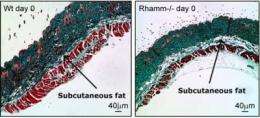
In the course of their collaborative study, Bissell and Turley, working with mice, discovered that blocking the expression of the RHAMM protein - either by deleting its gene, or through the introduction of a blocking reagent - can be used to selectively induce the generation of fat cells to replace those lost in the aging process. At the same time blocking RHAMM expression also reduces deposits of unhealthy visceral fat.
"This technique could be developed as a means of providing a non-surgical approach for normalizing skin appearance after reconstructive surgery, for wrinkle reduction, and for face lifts and figure enhancement," said Bissell.
Said Turley, "Unlike neurotoxin agents, which have to be injected periodically, a localized injection of a RHAMM inhibitor should produce long-lasting skin volumizing effects and would not involve muscle paralysis, which means there would be no loss of expression if it were to be injected into the face."
There are compounds now on the market that promote the production of adipocyte cells and result in increased subcutaneous fat, however, these adipocyte-promoting factors also increase the production of visceral fat. The mouse studies led by Bissell and Turley have shown that blocking RHAMM expression significantly increases subcutaneous fat while decreasing visceral fat. This suggests that blocking RHAMM should also have a beneficial effect on patients with obesity-related diseases, cardiovascular disease or diabetes. Another unique advantage of RHAMM is that its expression in normal adult human tissues is restricted.
"Therefore, anti-RHAMM agents should have low toxicity and according to preliminary animal studies, could be beneficial to patients with a tumor or inflammation-related disease," said Turley.
Potential applications of RHAMM modulation in addition to wrinkle reduction include normalizing skin appearance after reconstructive or cosmetic surgery, e.g., grafted tissue on burn victims. It has also been shown to have a beneficial effect on tumors and inflammatory diseases in mice.
Source: Lawrence Berkeley National Laboratory


