A new kind of counting: Scientists develop computer algorithm to solve previously unsolvable counting problems
February 11, 2009 A new kind of counting: Scientists develop computer algorithm to solve previously unsolvable counting problems

Enlarge

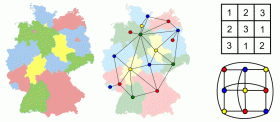
Left and center: A map of Germany with corresponding representation as a network. Top right: A simplified sudoku with three rows of three boxes. Bottom right: The representation as a network. "1" is represented in "red", "2" in "blue" and "3" in "yellow". Image: Max Planck Institute for Dynamics and Self-Organization

(PhysOrg.com) -- How many different sudokus are there? How many different ways are there to color in the countries on a map? And how do atoms behave in a solid? Researchers at the Max Planck Institute for Dynamics and Self-Organization in Göttingen and at Cornell University (Ithaca, USA) have now developed a new method that quickly provides an answer to these questions.

In principle, there has always been a way to solve them. However, computers were unable to find the solution as the calculations took too long. With the new method, the scientists look at separate sections of the problem and work through them one at a time. Up to now, each stage of the calculation has involved the whole map or the whole sudoku. The answers to many problems in physics, mathematics and computer science can be provided in this way for the first time. (New Journal of Physics, February 4, 2009)

Whether sudoku, a map of Germany or solid bodies - in all of these cases, it’s all about counting possibilities. In the sudoku, it is the permitted solutions; in the solid body, it is the possible arrangements of atoms. In the map, the question is how many ways the map can be colored so that adjacent countries are always shown in a different color. Scientists depict these counting problems as a network of lines and nodes. Consequently, they need to answer just one question: How many different ways are there to color in the nodes with a certain number of colors? The only condition: nodes joined by a line may not have the same color. Depending on the application, the color of a node is given a completely new significance. In the case of the map, "color" actually means color; with sudoku the "colors" represent different figures.
A new kind of counting: Scientists develop computer algorithm to solve previously unsolvable counting problems
Enlarge

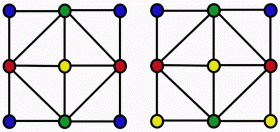
Two of 1152 different ways to color the nodes of the same lattice. Nodes connected by a line may not have the same color. Image: Max Planck Institute for Dynamics and Self-Organization

"The existing algorithm copies the whole network for each stage of the calculation and only changes one aspect of it each time," explains Frank van Bussel of the Max Planck Institute for Dynamics and Self-Organization (MPIDS). Increasing the number of nodes dramatically increases the calculation time. For a square lattice the size of a chess board, this is estimated to be many billions of years. The new algorithm developed by the Göttingen-based scientists is significantly faster. "Our calculation for the chess board lattice only takes seven seconds," explains Denny Fliegner from MPIDS.

This is how it’s done: With the new method, the researchers move through the network node by node. As if the computer program were short-sighted, it only ever looks at the next node point and not at the whole network. At the first node point, it cannot finalize the color selection as it would have to know how all the other nodes are connected to each other. However, instead of answering this question, the program notes down a formula for the first lattice point which contains this uncertainty as an unknown quantity. As it progresses through the network, all the connections become visible and the unknown quantities are eliminated. Having arrived at the final node point, the program’s knowledge of the network is complete.

This new method can be used on much more complicated cases than the existing standard algorithm. "We can now answer many questions in physics, graph theory and computer science that have hitherto been practically unsolvable," says Marc Timme from MPIDS. "For example, our method can be applied to antiferromagnetic solids," he adds. In these solid bodies, every atom has an internal rotational pulse, called spin, which can have different values. Usually, adjacent atoms exhibit different spins. It is now possible to calculate the number of possible spin arrangements, which will allow physicists to draw conclusions about the fundamental characteristics of the thermodynamics of solid bodies.

More information: Marc Timme, Frank van Bussel, Denny Fliegner, and Sebastian Stolzenberg, Counting Complex Disordered States by Effiecient Pattern Matching: Chromatic Polynomials and Potts Partition Functions, New Journal of Physics 11 (2009), 023001, February 4th, 2009, http://www.iop.org/EJ/abstract/1367-2630/11/2/023001/

Provided by Max-Planck-Institute


print this article email this article download pdf blog this article bookmark this article     Stumble it Digg this share on Facebook retweet share on Reddit add to delicious
Rate this story - 4.8 /5 (33 votes)

Rank Filter

Move the slider to adjust rank threshold, so that you can hide some of the comments.


Display comments: newest first

  • vivcollins - Feb 11, 2009
    • Rank: not rated yet
    How long before this hits CFD I wonder
  • magpies - Feb 11, 2009
    • Rank: 2.3 / 5 (3)
    Why is this new?
  • Husky - Feb 11, 2009
    • Rank: not rated yet
    A new word for the dictionary: quantumchromomathematics ?
  • Adriab - Feb 11, 2009
    • Rank: not rated yet
    Ah the world of dynamic programming. If we can't solve problem A, but can solve problem B, just find a way to map B to A.

    Trading storage for speed is a viable option now that memory is cheap.
  • h0dges - Feb 11, 2009
    • Rank: 3.3 / 5 (3)
    Exciting stuff.
  • Soylent - Feb 12, 2009
    • Rank: not rated yet
    Trading storage for speed is a viable option now that memory is cheap.


    Doesn't always work well; memory grows ever more distant from the processor(with the exception of integrated memory controllers).

    When you're doing something that defeats the usual tricks of caching, out of order execution, speculative reads etc. (like pointer chasing or something) it's going to take upwards of 100-200 clock cycles to get the requested piece of data and you could have executed a lot of instructions in that time.
  • KBK - Feb 12, 2009
    • Rank: not rated yet
    It also presents a new methodological attack scenario for security encryption breach programming, ie the breaking of previously 'secure code'.

    256 bit? Not good enough........

    That's the way the essence of 'reality' tends to be. You can't have one side of the coin-without the other. Both situations emerge, relatively speaking-at the same time.

    Sorry. That's the way she goes...
  • mogmich - Feb 12, 2009
    • Rank: not rated yet
    Maybe uncertainty in nature (Quantum Mechanics) is there for the same reason: in order to make an otherwise impossible calculation possible?
  • Damon_Hastings - Feb 12, 2009
    • Rank: not rated yet
    I am a computer programmer, and I am befuddled by this. How is this algorithm new? The description of the algorithm is fairly vague here -- the phrase "notes down a formula" is especially frustrating. Computers don't generally note down entire "formulas", so it's anyone's guess what this actually means.

    I don't see any explanation of how this new algorithm differs from the standard backtracking (node-by-node) algorithm which was given in my computer science textbook in college 20 years ago, and which does *not* copy the entire matrix at each step, and which was quite slow anyway. Could the author of this article please explain the difference? The article refers to "looking at separate sections of the problem" which sounds tantalizingly like parallelization (which would indeed be a real improvement) -- but then goes on to describe what sounds like a standard backtracking algorithm with no parallelization.

    The standard backtracking algorithm is listed as the first result from a google search on "map coloring backtracking algorithm". (Okay, well, that implementation does copy the entire matrix each time, but it would be rather trivial to add in an "undo" stack to allow undoing modifications which were made directly to the original matrix rather than a copy. They only left that optimization out of this example for simplicity, since this is a teaching manual for an introductory programming class.)
  • BeastOfBodmin - Feb 15, 2009
    • Rank: not rated yet
    From magpie:
    > Why is this new?

    From Damon_Hastings:
    > I don't see any explanation of how this new algorithm differs from the standard backtracking ...

    Have you read the actual paper linked to at the bottom of the article?
  • Damon_Hastings - Feb 16, 2009
    • Rank: 5 / 5 (1)
    From Damon_Hastings:
    > I don't see any explanation of how this new algorithm differs from the standard backtracking ...

    Have you read the actual paper linked to at the bottom of the article?


    That article is not written for even a well-educated computer programmer. It dives quickly and deeply into quantum mechanics, of all things. The "zero-temperature partition function of the Potts antiferromagnet" (whatever that is) seems to be the key to the whole thing.

    To understand the dense, narrow-niche jargon would require several years of training in QM and apparently a few exotic fields of math, as well. But I don't really need a deep understanding anyway, just a basic overview. For that, a more efficient way to get a basic overview would be to just call the author and interview him. And then maybe I could summarize my basic overview into an article which I could publish on, oh, I don't know, maybe some popular science news website where others could benefit from my work without having to call the author themselves.

    Personally, I don't think I should have to take a course in quantum mechanics to understand a new computer algorithm on map-coloring. But I don't know, maybe the author decided that no one without a QM degree could even understand a basic overview of this new algorithm, and that's why he left it out and instead gave a basic overview of *all* backtracking map-coloring algorithms.
  • paulcurran - May 10, 2009
    • Rank: not rated yet
    The Potts antiferromagnet is equivalent to the chromatic polynomial. The chromatic polynomial is a polynomial of a graph which counts the number of distinct ways it can be colored. Colorings are counted as distinct even they differ only by permutation of colors.

    I read the article and while hard at times I was able to follow it. Granted I had some courses in QM, but that was over 20 years ago.

    If this type of material is to become critical one day for programmers, one really doesn't need to study quantum mechanics. However I can see where studying the methods of QM would be very advantageous. But at one time calculus was seen as a rather esoteric topic but it is now seen as a topic that many need to know. Perhaps one day the mathematics of QM would be seen in the same light.

February 11, 2009 all stories

Comments: 12

4.8 /5 (33 votes)
  • Stumble this up

  • Digg this

  • share this

  • hide
  • Related Stories

  • What is the function of lymph nodes?
    created May 26, 2009 | popularity not rated yet | comments 0
  • 'Six Degrees of Kevin Bacon' game provides clue to efficiency of complex networks
    created Nov 17, 2008 | popularity not rated yet | comments 0
  • UMC Announces Industry's First 28nm SRAMs
    created Oct 27, 2008 | popularity not rated yet | comments 0
  • Discovery is mated with external fuel tank
    created Sep 25, 2007 | popularity not rated yet | comments 0
  • Exploring Caves With Hopping Microbots
    created Dec 12, 2005 | popularity not rated yet | comments 0


  • hide
  • Relevant PhysicsForums posts

  • Calculating FT using matlab quad function
    created 6 hours ago
  • Definition of Ordered Pair
    created 9 hours ago
  • mean nearest neighbor distance in 3d
    created Nov 24, 2009
  • Column Vectors Product
    created Nov 24, 2009
  • A proof in powers
    created Nov 23, 2009
  • help with inverse function
    created Nov 23, 2009
  • More from Physics Forums - General Math

Other News

Ancient Greek Temple

Houses of the rising sun: Research sheds new light on Ancient Greeks

Other Sciences / Archaeology & Fossils

created 9 hours ago | popularity 5 / 5 (1) | comments 3

New research at the University of Leicester has identified scores of Sicilian temples built to face the rising Sun, shedding light on the practices of the Ancient Greeks.


Explained: The Discrete Fourier Transform

Explained: The Discrete Fourier Transform

Other Sciences / Mathematics

created 12 hours ago | popularity 4.2 / 5 (16) | comments 8

(PhysOrg.com) -- In 1811, Joseph Fourier, the 43-year-old prefect of the French district of Isčre, entered a competition in heat research sponsored by the French Academy of Sciences. The paper he submitted ...


Study: Race, class and gender shape religion's effect on American voters

Other Sciences / Social Sciences

created 4 hours ago | popularity not rated yet | comments 0

(PhysOrg.com) -- How Americans vote is strongly linked to their religious identities, but it is not an independent influence that transcends race, socio-economic class and gender, reports a new Cornell study.


Biology, training and profit sharing make best traders

Biology, training and profit sharing make best traders

Other Sciences / Mathematics

created 12 hours ago | popularity 5 / 5 (1) | comments 1

(PhysOrg.com) -- Cambridge researchers have identified a group of traders consistently able to outperform the market, even during the credit crisis.


UQ archaeology digs into the life behind Pompeii

Other Sciences / Archaeology & Fossils

created 4 hours ago | popularity 3 / 5 (2) | comments 0

(PhysOrg.com) -- Brisbane may be 2000 years and half-a-world away from Pompeii, but it hasn’t stopped a UQ archaeologist from digging up some hidden treasures.