Next generation digital maps are laser sharp
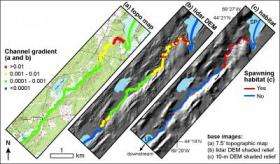
Restoring habitat for spawning species of fish, such as Atlantic salmon, starts with a geological inventory of suitable rivers and streams, and the watershed systems that support them. But the high-tech mapping tools available to geologists and hydrologists have had their limits.
Now, lasers beamed from planes overhead are adding greater clarity to mapping streams and rivers and interpreting how well these bodies of water can help maintain or expand fish stocks, according to a new study.
"It's kind of like going from your backyard telescope to the Hubble telescope," says Boston College Geologist Noah P. Snyder. "Restoring fish habitat is just one example. For the fisherman, backpacker, forester, land use planner or developer - anyone who uses map data - this new technology is the next revolution in mapping."
Airborne laser elevation (or lidar) surveys provide a 10-fold improvement in the precision with which topographical features are measured, Snyder reports in the current edition of Eos, the weekly journal of the American Geophysical Union.
Lidar represents the latest technology to improve digital topographical maps - known as digital elevation models, or DEMs. Pulsing laser beams released by a lidar device from a plane overhead bounce off of rocks, trees, soil, even water, and send signals back to the device, which makes topographical calculations based on the time it takes the laser signal to return at the speed of light.
Hundreds of beams produce a dynamic topographical picture, Snyder says. In the case of streams and rivers, the technology means that channel features such as water surface, bank edges, floodplains, even the slope of a stream, can be measured, he reports in the journal.
In addition, lidar provides new types of data about the vegetation that covers a particular watershed, such as the height and density of the tree canopy, Snyder says.
"We can look at much finer scale features in streams using a remote mapping technique, as opposed to field work over the entire lengths of streams," says Snyder, chairman of the steering committee of the National Center for Airborne Laser Mapping. "Digitally, we can now connect topographical features to habitat characteristics or the habitat that needs to be restored."
That means geologists and other earth scientists will be able to digitally search large swaths of lidar-mapped territory for a particular feature of interest - like salmon habitat or particularly steep sections of streams - then narrow down likely candidates for field study.
"I don't think this will replace field investigations, but it will allow us to better focus our field investigations," says Snyder, an expert in river geology, with a particular focus on restoration.
DEM technology, which digitized topographical maps in the early 1990s, led to breakthroughs in research ranging from the relationship between hillside and stream processes to the response of rivers to climate change. But the technology did reveal some limits, such as difficult profiling relatively smooth landscapes.
Traditional DEMs offer a resolution that provides one measure of elevation value for every 10-square meters of ground. Lidar mapping offers one measure of elevation value for each square meter, reports Snyder, whose research was funded by the National Science Foundation.
The amount of land currently mapped using lidar is gradually expanding. The state of Connecticut is the only stated entirely mapped via lidar. Pennsylvania has embarked on a lidar mapping project. Researchers, government agencies and private companies are increasingly using the technology to speed the creation of the next generation of maps, Snyder says.
More information: Snyder's article, "Studying Stream Morphology With Airborne Laser Elevation Data" appears in the current edition (Feb. 10, 2009) of Eos, the weekly journal of the American Geophysical Union. www.agu.org .
Source: Boston College


