All work and no play makes for troubling trend in early education
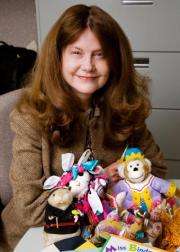
Parents and educators who favor traditional classroom-style learning over free, unstructured playtime in preschool and kindergarten may actually be stunting a child's development instead of enhancing it, according to a University of Illinois professor who studies childhood learning and literacy development.
Anne Haas Dyson, a professor of curriculum and instruction in the U. of I. College of Education, says playtime for children is a "fundamental avenue" for learning, and attempts by parents and educators to create gifted children by bombarding them with information is well-intentioned but ultimately counterproductive.
"That approach doesn't appreciate the role of play and imagination in a child's intellectual development," Dyson said. "Play is where children discover ideas, experiences and concepts and think about them and their consequences. This is where literacy and learning really begins."
What Dyson calls the "banning of the imagination" in schools may be influenced by what some critics have called the "Baby Genius Edutainment Complex," a cottage industry of mind-enrichment products developed specifically for infants and toddlers and marketed to anxious parents eager to give their children's cognitive abilities an early boost.
"I see this 'Einstein in the crib' trend as a societal reduction of children to the means for fulfilling parents' desires for intellectual distinction," Dyson said.
"Children learn the way we all learn: through engagement, and through construction. They have to make sense of the world, and that's what play or any other symbolic activity does for children."
While Dyson does see some value in teaching the ABCs to children in pre-kindergarten, she thinks that trying to accelerate learning actually works against a child's development. Kindergarten and preschool, she said, should be a place for children to experience play as intellectual inquiry, before they get taken over by the tyranny of high-stakes testing.
"I'm certainly not opposed to literacy in the early grades," Dyson said, "but the idea that we can eliminate play from the curriculum doesn't make sense. Kids don't respond well to sitting still in their desks and listening at that age. They need stimulation."
Dyson said that having an early-childhood curriculum reduced to isolated test scores or other measurable pieces of information doesn't take into account a child's interests or an ability to imagine, problem solve or negotiate with other children, all of which are important social and intellectual qualities.
"All tests tell us is how many letters and how many sounds children know," she said. "I think there should be this grand societal conversation about what's intellectually motivating and exciting for our children."
Dyson doesn't believe there should be any sort of compromise in the amount of learning by rote and play that children experience, especially in preschool and kindergarten.
"We have to intellectually engage kids," she said. "We have to give them a sense of their own agency, their own capacity, and an ability to ask questions and solve problems. So we have to give them more open-ended activities that allow them the space they need to make sense of things."
So what can parents and educators do to stimulate children?
"I think parents ought to engage with their children," Dyson said.
"Follow the child's interests in people, objects, places, and activities, and talk with them. It's social interaction that creates a link between the child and an ongoing activity. Help them learn how to articulate themselves and participate in the world."
One thing that parents may worry too much about is the television shows their children watch. She said that parents should be attentive to what their children watch and make judgments about the appropriateness of the material, but more important, they need to talk with their children about what they see.
"I think we want children to grow up media-literate," Dyson said, "but we don't want to dismiss the sources of their pleasure only because it doesn't appeal to our adult sensibilities. Contemporary childhoods are mediated in large part by the media, and it can be very informative for kids."
Dyson said that the media inform children's play and even their early writing efforts. For example, a 5-year-old Dyson knows who is just learning about written language and the alphabet can already spell "Hannah," thanks to Hannah Montana, the popular Disney show character.
"Knowledge of media gets kids a lot of social cachet because their peers watch it, too," Dyson said. "And a lot of social bonding between children who normally wouldn't have much in common occurs when they watch the same shows."
Dyson is a co-author of the forthcoming book "Children, Language, and Literacy: Diverse Children in Diverse Times," which discusses the nature of contemporary early-childhood programs and children's language learning.
Source: University of Illinois at Urbana-Champaign


