Behavioral studies show baboons and pigeons are capable of higher-level cognition
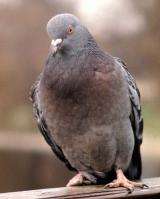
February 12, 2009 Pigeon

Pigeon

It's safe to say that humans are smarter than animals, but a University of Iowa researcher is investigating the extent of that disparity in intelligence.

And, it may not be as great a gap as you suspect, according to UI psychologist Ed Wasserman, who presents his findings at the American Association for the Advancement of Science (AAAS) meeting today in Chicago.

One cognitive capacity that is vital to human intelligence is the ability to determine whether two or more items are the same or different - a skill the famous American psychologist William James called the very "backbone" of our thinking. If you have two pennies in your left hand and a nickel and a dime in your right hand, then you can correctly report that the two coins in your left hand are the "same" and that the two coins in your right hand are "different." You can also make similar judgments with any collection of items.

Wasserman's research shows that baboons and pigeons can do that, too. A recent study by Wasserman and UI graduate student Dan Brooks found that both pigeons and people can learn same-different discriminations with visual stimuli that never repeat from trial to trial, thus proving that simple memorization cannot explain this cognitive feat.

In other studies, Wasserman and his colleagues at other research centers took the matter a step further, posing the question: Can animals learn the relations between relations? The answer appears to be "yes."

Wasserman and his associates discovered that both baboons and pigeons also understand the relations between relations - something that only humans were believed to appreciate. For example, the relation between A and A and the relation between B and B is the same: same equals same. So, too, is the relation between A and B and the relation between C and D: different equals different. But, the relation between A and A and the relation between C and D is different: same does not equal different.

Using joysticks and computerized visual images, Wasserman and colleagues Joel Fagot of the French CNRS (National Center for Scientific Research) and Mike Young of Southern Illinois University at Carbondale found that baboons also exhibit this level of cognition by solving the so-called relational matching-to-sample problem. Here, the baboons indicated which of two testing arrays of pictures involved the same relationship as the sample array that they had recently been shown. In a follow-up study, Wasserman and colleague Bob Cook of Tufts University repeated the experiment with pigeons; the pigeons learned to peck a computerized touchscreen to accomplish the same feat as the baboons.

"The newsworthiness of our baboon experiment was to show that nonhuman primates are capable of higher-order relational learning. Understanding the relation between relations was previously believed to be a kind of cognition that sets humans apart from all other animals," Wasserman said. "The follow-up discovery - that pigeons too are capable of such higher-order relational learning - affirmed our suspicion that we've really established a finding of broad evolutionary significance."

Despite obvious anatomical differences, this behavioral evidence confirms Charles Darwin's proposal that "the difference in mind between man and the higher animals, great as it is, certainly is one of degree and not of kind."

The notion that there might only be a quantitative - not a qualitative - disparity between human and animal intelligence may make people uneasy, Wasserman said.

"What we're really trying to understand is the extent to which cognition is general throughout the animal kingdom. The evidence that we collect constantly surprises us, suggesting that we're not alone in many of these cognitive abilities," Wasserman said. "Why we would believe that humans alone have such capabilities is a peculiar and unfortunate arrogance. That's one reason why I enjoy studying animals; the smarter we discover them to be, the more humble we should be."

In addition to keeping human egos in check by proving we're not the only smart creatures on earth, this research may have practical applications, Wasserman said.

Some of the methods he uses to study baboons and pigeons can be deployed to study human cognition. Currently, Wasserman and colleague Leyre Castro in the UI Department of Psychology are collaborating with Amanda Owen of the UI Communication Sciences and Disorders Department to apply these animal-testing methods to studying the cognitive performance of children with language impairments.

"Because we must invent entirely nonverbal methods to study cognition in animals, these same methods may have particular promise for studying children with communicative disorders, like Specific Language Impairment and Autism," Wasserman said. "These methods may prove to have unique diagnostic and therapeutic significance."

Source: University of Iowa


print this article email this article download pdf blog this article bookmark this article     Stumble it Digg this share on Facebook retweet share on Reddit add to delicious
Rate this story - 5 /5 (4 votes)

Rank Filter

Move the slider to adjust rank threshold, so that you can hide some of the comments.


Display comments: newest first

  • NeilFarbstein - Feb 12, 2009
    • Rank: 1 / 5 (2)
    Pidgeons are stupid, they are real suckers for a con
    job.
  • KBK - Feb 12, 2009
    • Rank: not rated yet
    Many people have heard of the story of
    Clever Hans' the horse who was supposedly intelligent.

    I just read up on it..specifically..WITH AN OPEN MIND. Not a closed one.

    Apparently, there is a HUGE back story, and the results we all know ----are pure bullshit.

    Look it up and see for yourself.
  • jeffsaunders - Feb 13, 2009
    • Rank: not rated yet
    Never heard of Hans the Clever Horse.

    Have heard of Ed the Talking Horse. But, A horse, of course, can't really talk, of course.

    Having just read the Wikipedia story about Hans, I can see the horse was even smarter than they thought. He could probably play Poker quite well.

    The article described how the horse was observing Human Body Language, and then delivering the result that his trainer wanted, without the trainer being aware that he was giving away these very same clues.

    Perhaps he should have been employed as a psychologist, as it is clear the horse was smarter than his trainer, on some levels at least.

    Which, I think, is, part of what this article is about. Not that animals may be able to out socratize Socrates, but, that we are not unique in our cognitive, or brain structure - just unique in our brain size ratio. Other animals have bigger brains but ours has the largest ratio. Well someone has to come first, and every one can come first in something.

    I have seen some people do some pretty dumb things and I have seen some dogs do some pretty dumb things but I have seen some animals across a wide range of species do some things which seemed pretty smart too.

    I think we should think of all animals on Earth as being our distant cousins and be done with it. (Some a little more distant than others - but hey, they may have something else going for them.)

    We may have the bigger brain ratio so we put that down as being important. But when we compare individual with individual there are times when other attributes seem more important. Like bigger muscles, running fast, tackling better, Hitting balls further or more accurately - things like that.

    So on this scale we are dummer than a fish (they swim fast). Dummer than most large animals (They run faster). Dummer than another large group of animals (they are stronger). We are smarter than a lot of animals when it comes to Endurance. But extremely lacking in other attributes like vision, hearing, speed, versatility and so it goes on.

    Taking all this in to account, I still eat meat, even if the animal is a distant cousin. I don't consider it cannibalism - but I can see why some might be deluded into that line of reasoning. And I can see why some people thing that because they have a pet that is a dog and because they treat their dog like it is a person therefore all people should treat all dogs like they are people.

    As I stated earlier some people are pretty dumb when it comes to reasoning arguments too.
  • NOM - Feb 15, 2009
    • Rank: not rated yet
    Pidgeons are stupid, they are real suckers for a con job.
    You'd know all about con jobs Neil.

February 12, 2009 all stories

Comments: 4

5 /5 (4 votes)
  • Stumble this up

  • Digg this

  • share this

  • hide
  • Related Stories

  • Village bird study highlights loss of wildlife knowledge from one
    created Feb 13, 2009 | popularity not rated yet | comments 0
  • Seed dispersal in mauritius -- dead as a dodo?
    created May 07, 2008 | popularity not rated yet | comments 0
  • Inside the First Bird, Surprising Signs of a Dinosaur
    created Oct 08, 2009 | popularity not rated yet | comments 0
  • Was mighty T.rex 'Sue' felled by a lowly parasite?
    created Sep 29, 2009 | popularity not rated yet | comments 0
  • Evidence Points to Conscious 'Metacognition' in Some Nonhuman Animals
    created Sep 14, 2009 | popularity not rated yet | comments 0


Other News

Iowa State University researcher discovers key to vital DNA, protein interaction

Researchers discover key to vital DNA, protein interaction

Biology / Other

created 5 hours ago | popularity not rated yet | comments 0

(PhysOrg.com) -- A researcher at Iowa State University has discovered how a group of proteins from plant pathogenic bacteria interact with DNA in the plant cell, opening up the possibility for what the scientist ...


Scientists successfully reprogram blood cells

Biology / Cell & Microbiology

created 9 hours ago | popularity 5 / 5 (2) | comments 0

Researchers have transplanted genetically modified hematopoietic stem cells into mice so that their developing red blood cells produce a critical lysosomal enzyme -preventing or reducing organ and central nervous system damage ...


UK starts study on using human DNA in animals

Biology / Biotechnology

created 6 hours ago | popularity not rated yet | comments 0

(AP) -- British scientists begin a new study on Tuesday to consider how human DNA is used in animal experiments and to determine what the boundaries of such controversial science might be.


Study shows that some malignant tumors can be shut down after all

Biology / Cell & Microbiology

created 13 hours ago | popularity 5 / 5 (3) | comments 1

Oncologists have had their hands tied because more than half of all human cancers have mutations that disable a protein called p53. As a critical anti-cancer watchdog, p53 masterminds several cancer-fighting operations within ...


New discovery allows scientists for the first time to experimentally annotate genomes

New discovery allows scientists for the first time to experimentally annotate genomes

Biology / Biotechnology

created 8 hours ago | popularity 5 / 5 (3) | comments 0

Over the last 20 years, the sequencing of the human genome, along with related organisms, has represented one of the largest scientific endeavors in the history of mankind. The information collected from genome ...