New high-res map suggests little water inside moon
February 12, 2009
New high-res map suggests little water inside moon

Enlarge

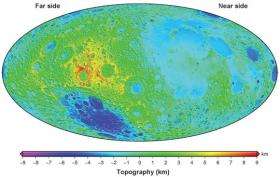
An international team of researchers has created the most detailed map of the Moon yet, using the laser altimeter (LALT) instrument on board the Japanese Selenological and Engineering Explorer satellite. C.K. Shum, professor of earth sciences at Ohio State University, is a member of the LALT science team and a co-author of a paper appearing in the February 13 issue of the journal Science. Image © Science/AAAS

(PhysOrg.com) -- The most detailed map of the Moon ever created has revealed never-before-seen craters at the lunar poles. The map is also revealing secrets about the Moon's interior -- and hinting about Mars's interior as well. C.K. Shum, professor of earth sciences at Ohio State University, is part of the international research team that published the map in the February 13 issue of the journal Science.

"The surface can tell us a lot about what's happening inside the Moon, but until now mapping has been very limited," Shum said. "For instance, with this new high-resolution map, we can confirm that there is very little water on the Moon today, even deep in the interior. And we can use that information to think about water on other planets, including Mars."

Using the laser altimeter (LALT) instrument on board the Japanese Selenological and Engineering Explorer (SELENE) satellite, the researchers mapped the Moon at an unprecedented 15-kilometer (9-mile) resolution.

The principal investigator of the LALT instrument is Hiroshi Araki of the National Astronomical Observatory of Japan, and he is the lead author of the study. Shum is a member of the LALT science team.

The map is the first to cover the Moon from pole to pole, with detailed measures of surface topography, on the dark side of the moon as well as the near side. The highest point -- on the rim of the Dririchlet-Jackson basin near the equator -- rises 11 kilometers (more than 6.5 miles) high, while the lowest point -- the bottom of Antoniadi crater near the south pole -- rests 9 kilometers (more than 5.5 miles) deep.

In part, the new map will serve as a guide for future lunar rovers, which will scour the surface for geological resources.

But Araki and his colleagues did something more with the map: they measured the roughness of the lunar surface, and used that information to calculate the stiffness of the crust.

If water flowed beneath the lunar surface, the crust would be somewhat flexible, but it wasn't. The surface was too rigid to allow for any liquid water, even deep within the Moon.

Earth's surface is more flexible, by contrast, with the surface rising or falling as water flows above or below ground. Even our planet's plate tectonics is due in part to water lubricating the crust.

And Mars? On a scale of surface roughness, it falls somewhere between the Earth and the Moon, which indicates that there may have once been liquid water, but that the surface is now very dry.

No surprise there.

But Mars' roughness coupled with the complete absence of plate tectonics suggests that if there is water in the red planet's interior, it is not located near the surface, where it could lubricate the crust, Shum explained.

The LALT map is the most detailed lunar map ever created. The last three Apollo missions mapped part of the surface in the early 1970s, and the 1994 Clementine mission in offered a resolution between 20-60 kilometers in certain locations, but not the entire surface.

The SELENE mission offers 15-kilometer resolution consistently over the entire surface, because it features two smaller sub-satellites which closely track the main satellite.

"This design significantly improved our ability to model gravity fields on the moon, and let us compute the main satellite's orbit more accurately than was possible before, especially over the far side the Moon. That led to more accurate measurement of the lunar topography using LALT," Shum said.

The map revealed several small craters at the north and south poles that hadn't been seen before. For example, a 15-kilometer-wide crater can be seen inside the much larger de Gerlache crater at the south pole.

Source: Ohio State University

4.6 /5 (7 votes)  

Filter


Move the slider to adjust rank threshold, so that you can hide some of the comments.


Display comments: newest first

DGBEACH
Feb 13, 2009

Rank: not rated yet
Using the laser altimeter (LALT) instrument on board the Japanese Selenological and Engineering Explorer (SELENE) satellite, the researchers mapped the Moon at an unprecedented 15-kilometer (9-mile) resolution

The highest point -- on the rim of the Dririchlet-Jackson basin near the equator -- rises 11 kilometers (more than 6.5 miles) high, while the lowest point -- the bottom of Antoniadi crater near the south pole -- rests 9 kilometers (more than 5.5 miles) deep.

If their map has a resolution of 15kms, then how can these measurements (11 kms and 9 kms) be noticed on it?
barakn
Feb 13, 2009

Rank: 1 / 5 (1)
The 15 km resolution is a horizontal resolution. The vertical resolution is not stated, but presumably much smaller.
Rank 4.6 /5 (7 votes)
Related Stories
Relevant PhysicsForums posts
  • Never ending outer space.....
    createdFeb 11, 2012
  • Neutron Star fragments?
    createdFeb 11, 2012
  • stationary or not?
    createdFeb 11, 2012
  • Scale of the Universe
    createdFeb 10, 2012
  • Titan's lack of impact craters
    createdFeb 09, 2012
  • Real pictures of black hole eating a star?
    createdFeb 08, 2012
  • More from Physics Forums - General Astronomy

More news stories

Latin America mining boom clashes with conservation

Latin America is experiencing a mining boom as prices rise fuelled by a hike in global demand, but the region is also being hit by a wave of violent protests, strikes and rallies by environmentalists.

Space & Earth / Environment

created 22 hours ago | popularity 5 / 5 (1) | comments 1

Salvage workers begin pumping fuel from Italian shipwreck

Salvage workers Sunday began pumping fuel from the shipwrecked Italian cruise liner Costa Concordia, a day ahead of schedule, officials said.

Space & Earth / Environment

created 14 hours ago | popularity 5 / 5 (2) | comments 0

Political leaders play key role in how worried Americans are by climate change: study

More than extreme weather events and the work of scientists, it is national political leaders who influence how much Americans worry about the threat of climate change, new research finds.

Space & Earth / Environment

created Feb 06, 2012 | popularity 5 / 5 (8) | comments 76

NASA budget will axe Mars deal with Europe: scientists

US President Barack Obama's budget proposal to be submitted next week for 2013 will cut NASA's budget by 20 percent and eliminate a major partnership with Europe on Mars exploration, scientists said Thursday.

Space & Earth / Space Exploration

created Feb 10, 2012 | popularity 5 / 5 (4) | comments 58

Humans may have helped the decline of African rainforests 3000 years ago

(PhysOrg.com) -- Large areas of rainforests in Central Africa mysteriously disappeared over three thousand years ago, to be replaced by savannas. The prevailing theory has been that the cause was a change ...

Space & Earth / Environment

created Feb 10, 2012 | popularity 4.1 / 5 (14) | comments 21 | with audio podcast report


Japan's Fukushima reactor may be reheating: operator

Temperature readings at one of the crippled Fukushima nuclear reactors have risen above Japan's stringent new safety standard but there was no immediate danger, its operator said Sunday.

Integrated pest management recommendations for the southern pine beetle

The southern pine beetle, Dendroctonus frontalis Zimmermann, is a chronic insect pest within pine forests in the southeastern United States. Under favorable environmental and host conditions, it is an agg ...

Botox developer rues missing out on billions

Botox developer Alan Scott says he rues the day he handed over rights to the best-selling wrinkle-smoothing drug to a US company for just $4.5 million, saying he might have become a billionaire.

Cognitive impairment in older adults often unrecognized in the primary care setting

A new study published in the Journal of the American Geriatrics Society reveals that brief cognitive screenings combined with offering further evaluation increased new diagnoses of cognitive impairment in older veterans two to ...

AT&T customers surprised by 'unlimited data' limit

(AP) -- Mike Trang likes to use his iPhone 4 as a GPS device, helping him get around in his job. Now and then, his younger cousins get ahold of it, and play some YouTube videos and games.

Australian women reject 'I love u' texts

Australian women may have embraced the digital era, but they prefer a face-to-face declaration of affection to an "I love u" text and find men addicted to their mobile phones a major turnoff.