Aerosols -- their part in our rainfall
February 12, 2009 Dr. Leon Rotstayn, CSIRO Australia

Enlarge

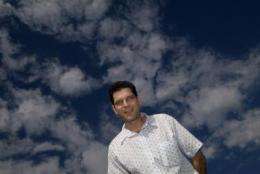
This is CSIRO atmosphere expert Dr. Leon Rotstayn. Photo by: Bruce Miller

Aerosols may have a greater impact on patterns of Australian rainfall and future climate change than previously thought, according to leading atmospheric scientist, CSIRO's Dr. Leon Rotstayn.

"We have identified that the extensive pollution haze emanating from Asia may be re-shaping rainfall patterns in northern Australia but we wonder what impact natural and human-generated aerosols are having across the rest of the country," Dr Rotstayn said.

Aerosols are fine particles suspended in the atmosphere. Sources of human-generated aerosols include industry, motor vehicles and vegetation burning. Natural sources include volcanoes, dust storms and ocean plankton. Human-generated aerosols have long been known to exert a cooling effect on climate. This has partly masked the warming effect of increasing greenhouse gases. As aerosol pollution is predicted to decrease over the next few decades, unmasking of the greenhouse effect may lead to accelerated global warming.

However, in an address tomorrow to the International Conference on Southern Hemisphere Meteorology and Oceanography in Melbourne, Dr Rotstayn said aerosols are much more than a "negative greenhouse gas" because they can actively force changes in winds and ocean currents by altering the distribution of solar heating at the earth's surface.

"Recent climate modelling at CSIRO shows that there may be important effects on Australian climate due to aerosol pollution from the Northern Hemisphere. These include an increase of rainfall in north-western Australia, and an increase of air pressure over southern Australia, which may have contributed to less rainfall there.

"New simulations with the CSIRO climate model also show big improvements in the simulation of El Niņo and the associated natural rainfall variability over eastern Australia, when natural and human-generated aerosols are included in the model. Natural aerosol includes Australian dust, which may be the key factor that improved our simulation. A realistic simulation of natural rainfall variability is essential if a climate model is to be used to improve our understanding of Australian rainfall changes.

Dr Rotstayn said that further research into how aerosols are influencing climate and rainfall patterns across Australia is critical to scientists' ability to more accurately predict the longer-term effects of climate change.

"It is crucial to quantify the relative roles of different drivers of recent Australian rainfall changes. A rainfall decline attributed to natural variability will be a passing phenomenon, and changes forced by human-generated aerosols are likely to be more short-term than changes forced by increasing greenhouse gases. The implications for decision makers will be very different, depending on whether the drivers are long-term or short-term," Dr Rotstayn said.

Source: CSIRO Australia


print this article email this article download pdf blog this article bookmark this article     Stumble it Digg this share on Facebook retweet share on Reddit add to delicious
Rate this story - 2.7 /5 (3 votes)

Rank Filter

Move the slider to adjust rank threshold, so that you can hide some of the comments.


Display comments: newest first

  • Velanarris - Feb 12, 2009
    • Rank: 5 / 5 (1)
    "unmasking of the greenhouse effect may lead to accelerated global warming."

    "shows that there may be important effects"

    "which may have contributed to less rainfall there."

    "which may be the key factor"

    "are likely to be"

    Settled science and sound theories don't deal in may be's and likely's.

    It is good to hear about the level of refinement they got out of the model. That's something to applaud, and aside from the uncertanties in the abstract, it appears they have a good hypothesis here.
  • GrayMouser - Feb 16, 2009
    • Rank: not rated yet
    Back during the Vietnam War the USAF tried cloud seeding to increase the rainfall in North Vietnam. It didn't work. Even now cloud seeding, for increased precipitation, is controversial.

February 12, 2009 all stories

Comments: 2

2.7 /5 (3 votes)
  • Stumble this up

  • Digg this

  • share this

  • hide
  • Related Stories


  • hide
  • Relevant PhysicsForums posts

  • cycles
    created Nov 08, 2009
  • The Origin of the term 'fossil' fuels
    created Nov 05, 2009
  • co2
    created Nov 03, 2009
  • Early Earths Sulfidic Ocean Conditions
    created Oct 30, 2009
  • More from Physics Forums - Earth

Other News

L-R: Chiwetel Ejiofor, Amanda Peet and John Cusack at the premiere of "2012"

NASA on crusade to debunk 2012 apocalypse myths

Space & Earth / Space Exploration

created 1hour ago | popularity not rated yet | comments 0

The world is not coming to an end on December 21, 2012, the US space agency insisted Monday in a rare campaign to dispel widespread rumors fueled by the Internet and a new Hollywood movie.


Antarctica glacier retreat creates new carbon dioxide store

Antarctica glacier retreat creates new carbon dioxide store

Space & Earth / Earth Sciences

created 6 hours ago | popularity 4.3 / 5 (3) | comments 0

Large blooms of tiny marine plants called phytoplankton are flourishing in areas of open water left exposed by the recent and rapid melting of ice shelves and glaciers around the Antarctic Peninsula. This ...


NASA satellites make a movie and get rainfall, wind info on Ida

NASA satellites make a movie and get rainfall, wind info on Ida (w/ Video)

Space & Earth / Earth Sciences

created 1hour ago | popularity not rated yet | comments 0

NASA satellites are amazing examples of technology. The TRMM satellite peers into tropical cyclones and can tell how much rain is falling per hour and where. QuikScat uses microwave technology to measure Ida's ...


NASA's GOES Project offers real-time hurricane alley movies

NASA's GOES Project offers real-time hurricane alley movies

Space & Earth / Earth Sciences

created 1hour ago | popularity not rated yet | comments 0

People love to get the big picture of hurricane alleys, and thanks to the GOES Project at NASA's Goddard Space Flight Center in Greenbelt, Md., they can now get real-time satellite animations of the eastern ...


NASA's TRMM Satellite sees most of Ida's heaviest rain stayed off coasts

NASA's TRMM Satellite sees most of Ida's heaviest rain stayed off coasts

Space & Earth / Earth Sciences

created 2 hours ago | popularity not rated yet | comments 0

NASA and the Japanese Space Agency's Tropical Rainfall Measuring Mission (TRMM) satellite flew over Ida and captured her rainfall when she passed by Nicaragua, Honduras and Belize this weekend. TRMM data revealed ...