Major step for drug discovery and diagnostics
February 12, 2009 Swimsuit for Proteins

Enlarge

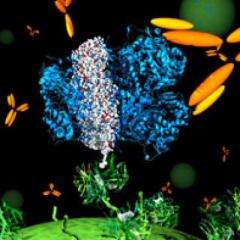
This is an antibody recognizing a membrane protein dressed in an amphipol attached to a solid surface. Credit: Delphine Charvolin

Researchers from Nano-Science Center, University of Copenhagen and National Centre for Scientific Research, France have developed a general method to study membrane proteins. This method can be used to screen several thousand proteins, and it will reduce the way from development to useful drugs substantially. Already now the pharmaceutical industry is interested and participate in a European consortium that is under construction. The research results are published in the prestigious scientific journal, PNAS.

Membrane proteins are located at the surface of cells and they have a very important role in the communication between the cells in our body. Defective membrane proteins are involved in diseases such as cancer, cardiovascular diseases and neurological diseases, just to mention at few. The researchers have developed a system, where they tie a tag to the protein that attach it to a surface and make it possible to investigate it in the laboratories.

Until now membrane proteins have been difficult to study when they are away from their natural environment in the cell, where there a belt of lipids surrounds them. This belt is essential for their survival and proper function.

Swimsuits for proteins with a tag

"With our new method we can study membrane proteins faster and more accurate using less material than before. We are using a kind of swimsuit for the proteins called amphipols. The amphipol substitute for the lipids, surround the membrane protein, and make it soluble in water while keeping its function intact. We attach a tag to the amphipol that will assemble to a surface like a key-lock system. When we have attached the proteins to a surface they can be adapted to several measuring instruments," says Associated Professor Karen Martinez, Department of Neuroscience and Pharmacology and Nano-Science Center at University of Copenhagen.

The researchers have tested their method on several different proteins and the results are very promising. When looking for new drugs, the researchers wants to study the interaction between membrane proteins and other molecules - e.g. potential drugs. It can also be used for the detection of virus, bacteria and parasites. A European consortium that is currently under construction, involving approximately 15 different laboratories, including both private companies and universities, will exploit the perspectives of this promising method.

"Our results indicate that the function of the tested proteins is not affected by the immobilisation. This makes it a general method that can be used for studying any membrane protein to virtually any surface. Membrane proteins involved in various diseases can be tested and our results can already now be used in the pharmaceutical industry to screen for new drugs and for diagnostics," says Dr. Jean-Luc Popot, head of the group at National Centre for Scientific Research and, in collaboration with R. Audebert and C. Tribet, the inventor of amphipols.

More information: Link to paper in PNAS: http://www.pnas.org/content/106/2/405.full?sid=788e0726-2328-40e9-925f-23c88188862f

Source: University of Copenhagen


print this article email this article download pdf blog this article bookmark this article     Stumble it Digg this share on Facebook retweet share on Reddit add to delicious
Rate this story - not rated yet


February 12, 2009 all stories

Comments: 0

not rated yet
  • Stumble this up

  • Digg this

  • share this

  • hide
  • Related Stories

  • Explained: RNA interference
    created 2 hours ago | popularity not rated yet | comments 0
  • Polycystins : proteins that regulate the cellular barometer
    created Nov 05, 2009 | popularity not rated yet | comments 0
  • Tiny injector to speed development of new, safer, cheaper drugs
    created Nov 04, 2009 | popularity not rated yet | comments 0
  • Scientists obtain clearer view of how eye lens proteins are sorted
    created Nov 03, 2009 | popularity not rated yet | comments 0
  • This is your brain on fatty acids
    created Oct 30, 2009 | popularity not rated yet | comments 0


  • hide
  • Relevant PhysicsForums posts

  • How to prevent another stroke?
    created 17 hours ago
  • Swine flu vaccination
    created Nov 10, 2009
  • Improving the brain through chemistry
    created Nov 07, 2009
  • Sleep / REM Sleep and homeostasis
    created Nov 07, 2009
  • More from Physics Forums - Medical Sciences

Other News

baby mice

Early life stress has effects at the molecular level

Medicine & Health / Neuroscience

created 1hour ago | popularity 5 / 5 (2) | comments 0

(PhysOrg.com) -- A new study of mice suggests that stress and trauma in early life can have an impact on the genes and result in behavioral problems later in life.


Australian bid to 'regrow' breasts after cancer surgery

Medicine & Health / Cancer

created 3 hours ago | popularity not rated yet | comments 0

Australian scientists said Thursday they were to trial a revolutionary treatment which would allow women to regrow their breasts after cancer surgery.


High fat diet increases inflammation in the mouse colon

Medicine & Health / Health

created 1hour ago | popularity not rated yet | comments 0

(PhysOrg.com) -- In mice fed a diet high in fat and low in fiber, vitamin D and calcium -- the so-called Western diet -- expression of a series of genes collectively associated with immune and inflammatory responses was altered. ...


'Nature or nurture' study reveals 'musical genes' (w/ Video)

Medicine & Health / Genetics

created 1hour ago | popularity not rated yet | comments 0

(PhysOrg.com) -- If you've ever wondered why a close group of friends might like completely different types of music, blame their genes. A study by Nokia and Kings' College London into the musical tastes of nearly 4,000 twins ...


Faulty body clock may make kids bipolar

Medicine & Health / Psychology & Psychiatry

created 4 hours ago | popularity not rated yet | comments 0

Malfunctioning circadian clock genes may be responsible for bipolar disorder in children. Researchers writing in the open access journal BMC Psychiatry found four versions of the regulatory gene RORB that were associated with p ...