Strong winds over the keel
February 12, 2009 The Carina Nebula

Enlarge

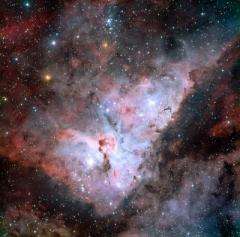
Color-composite image of the Carina Nebula, revealing exquisite details in the stars and dust of the region. Several well known astronomical objects can be seen in this wide field image: to the bottom left of the image is one of the most impressive binary stars in the Universe, Eta Carinae, with the famous Keyhole Nebula just adjacent to the star. The collection of very bright, young stars above and to the right of Eta Carinae is the open star cluster Trumpler 14. A second open star cluster, Collinder 228 is also seen in the image, just below Eta Carinae. North is up and East is to the left. The field of view is 0.55 x 0.55 degrees, covering a 144 x 144 light-year region at the distance of the nebula. Credit: ESO

The large and beautiful image displays the full variety of this impressive skyscape, spattered with clusters of young stars, large nebulae of dust and gas, dust pillars, globules, and adorned by one of the Universe's most impressive binary stars. It was produced by combining exposures through six different filters from the Wide Field Imager (WFI), attached to the 2.2 m ESO/MPG telescope at ESO's La Silla Observatory, in Chile.

The Carina Nebula is located about 7500 light-years away in the constellation of the same name (Carina; the Keel). Spanning about 100 light-years, it is four times larger than the famous Orion Nebula and far brighter. It is an intensive star-forming region with dark lanes of cool dust splitting up the glowing nebula gas that surrounds its many clusters of stars.

The glow of the Carina Nebula comes mainly from hot hydrogen basking in the strong radiation of monster baby stars. The interaction between the hydrogen and the ultraviolet light results in its characteristic red and purple colour. The immense nebula contains over a dozen stars with at least 50 to 100 times the mass of our Sun. Such stars have a very short lifespan, a few million years at most, the blink of an eye compared with the Sun's expected lifetime of ten billion years.

One of the Universe's most impressive stars, Eta Carinae, is found in the nebula. It is one of the most massive stars in our Milky Way, over 100 times the mass of the Sun and about four million times brighter, making it the most luminous star known. Eta Carinae is highly unstable, and prone to violent outbursts, most notably the false supernova event in 1842. For just a few years, Eta Carinae became the second brightest star in the night sky and produced almost as much visible light as a supernova explosion (the usual death throes of a massive star), but it survived. Eta Carinae is also thought to have a hot companion that orbits around it in 5.54 years, in an elliptical orbit. Both stars have strong winds, which collide, leading to interesting phenomena. In mid-January 2009, the companion was at its closest distance to Eta Carinae. This event, which may provide a unique insight into the wind structure of the massive stars, has been followed by a flotilla of instruments on several of ESO's telescopes.

Source: ESO


print this article email this article download pdf blog this article bookmark this article     Stumble it Digg this share on Facebook retweet share on Reddit add to delicious
Rate this story - 4.3 /5 (4 votes)

Rank Filter

Move the slider to adjust rank threshold, so that you can hide some of the comments.


Display comments: newest first


February 12, 2009 all stories

Comments: 1

4.3 /5 (4 votes)
  • Stumble this up

  • Digg this

  • share this

  • hide
  • Related Stories

  • Hubble captures outstanding views of mammoth stars
    created Nov 25, 2008 | popularity not rated yet | comments 0
  • Hubble's Celestial Landscape
    created Oct 02, 2008 | popularity not rated yet | comments 0
  • 1843 stellar eruption may be new type of star explosion
    created Sep 10, 2008 | popularity not rated yet | comments 0
  • Brightest Star in the Galaxy Has New Competition
    created Jul 15, 2008 | popularity not rated yet | comments 0
  • The little man and the cosmic cauldron
    created May 27, 2008 | popularity not rated yet | comments 0


  • hide
  • Relevant PhysicsForums posts

  • The shape of our solar system's orbits.
    created Nov 07, 2009
  • Above or Below the Line of Nodes
    created Nov 07, 2009
  • Supernova vs. Nova?
    created Nov 07, 2009
  • Supernova's Gamma Rays and Comets
    created Nov 06, 2009
  • More from Physics Forums - General Astronomy

Other News

Antarctica glacier retreat creates new carbon dioxide store

Antarctica glacier retreat creates new carbon dioxide store

Space & Earth / Earth Sciences

created 15 minutes ago | popularity not rated yet | comments 0

Large blooms of tiny marine plants called phytoplankton are flourishing in areas of open water left exposed by the recent and rapid melting of ice shelves and glaciers around the Antarctic Peninsula. This ...


Deep creep means milder, more frequent earthquakes along Southern California's San Jacinto fault

Deep creep means milder, more frequent earthquakes along Southern California's San Jacinto fault

Space & Earth / Earth Sciences

created 21 hours ago | popularity 4.5 / 5 (4) | comments 0

With an average of four mini-earthquakes per day, Southern California's San Jacinto fault constantly adjusts to make it a less likely candidate for a major earthquake than its quiet neighbor to the east, the ...


Success in 'space elevator' competition (AP)

Success in 'space elevator' competition (Update 3)

Space & Earth / Space Exploration

created Nov 05, 2009 | popularity 4.3 / 5 (33) | comments 51

(AP) -- A robot powered by a ground-based laser beam climbed a long cable dangling from a helicopter on Wednesday to qualify for prize money in a $2 million competition to test the potential reality of the ...


In a Galaxy Far, Far Away...

In a Galaxy Far, Far Away...

Space & Earth / Astronomy

created Nov 06, 2009 | popularity 4.8 / 5 (5) | comments 15

(PhysOrg.com) -- Astronomers have published the discovery of the farthest known object in the cosmos: a star that exploded when the universe was only 630 million years old -- only 4.6% of its current age. ...


'Dropouts' pinpoint earliest galaxies

'Dropouts' pinpoint earliest galaxies

Space & Earth / Astronomy

created Nov 06, 2009 | popularity 4.2 / 5 (10) | comments 13

Astronomers, conducting the broadest survey to date of galaxies from about 800 million years after the Big Bang, have found 22 early galaxies and confirmed the age of one by its characteristic hydrogen signature ...