High-tech tests allow anthropologists to track ancient hominids across the landscape
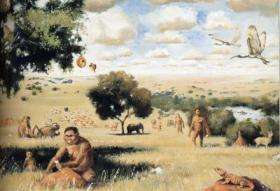
Dazzling new scientific techniques are allowing archaeologists to track the movements and menus of extinct hominids through the seasons and years as they ate their way across the African landscape, helping to illuminate the evolution of human diets.
Piecing together relationships between the diets of hominids several million years ago to that of early and modern humans is allowing scientists to see how diet relates to the evolution of cognitive abilities, social structures, locomotion and even disease, said University of Colorado at Boulder anthropology Professor Matt Sponheimer. Sponheimer organized a session titled "The Evolution of Human Diets" at the annual American Association for the Advancement of Science meeting Feb. 12-15 in Chicago.
Sponheimer specializes in stable isotope analysis, comparing particular forms of the same chemical element, like carbon, present in fossil remains to help reconstruct past lives of hominids. Zapping hominid teeth with lasers, for example, frees telltale carbon gases from the enamel, allowing scientists to pinpoint the types of plants consumed by the hominids and the environments where they lived, said Sponheimer, who also relies on the microscopic wear of ancient hominid teeth for data on food consumption.
"Darwin surmised more than 150 years ago in 'The Descent of Man' that changes in the subsistence or environment of human ancestors likely led to the advent of modern humans," Sponheimer said. "Dietary resources can be a force for evolution."
One hominid genus under study by Sponheimer is the 2 million-year-old Paranthropus, a short, upright member of the australopithecine family that includes the Ethiopian fossil, Lucy. Discovered in 1974, Lucy, believed to be roughly 3 million years old, is regarded by many anthropologists as the matriarch of modern humans.
A 2006 study by Sponheimer of Paranthropus robustus documented its diverse diet, clouding the notion that it was driven to extinction by its picky eating habits. And a 1999 study led by Sponheimer indicated 3-million-year-old australopithecines may have even have been catching and eating small animals.
"Paranthropus is sometimes referred to as a nutcracker because its flat teeth and powerful jaw muscles appear designed to eat hard foods," he said. "But some research suggests that the most mechanically challenging foods like nuts were eaten only at limited times of the year. "In addition, foods not previously considered to have been consumed in significant quantities, like sedges, grasses, seeds and perhaps even animal foods, were a significant part of the Paranthropus diet."
Roughly 2.5 million years ago, the australopithicenes are thought to have split into the genus Homo and the now-extinct genus Paranthropus, including South Africa's Paranthropus robustus and East Africa's Paranthropus boisei, said Sponheimer. Research presently under way at CU-Boulder indicates that while Paranthropus robustus and Paranthropus boisei are almost indistinguishable anatomically, they may have had very different diets.
Other intriguing research under way by Sponheimer and his colleagues hints that some female australopithecines, including members of the Paranthropus genus, died in different geographic areas than where they were born. The researchers are comparing such data to social patterns of chimpanzees, in which females generally migrate away from their original ranges and move into new areas -- the opposite of behavior charted in most other primates, said Sponheimer.
"Textbooks treat these ancient hominids as static piles of fossil bones," said Sponheimer. "We treat them as biological organisms moving across the landscape. It's entirely possible that many things we thought we knew about them were wrong, and pages of textbooks will have to have to be re-written."
More information: For more information on Sponheimer's research efforts visit www.colorado.edu/Anthropology/sponheimer/ . The NSF site featuring Sponheimer's work is at www.nsf.gov/news/special_repor … rchaeology/teeth.jsp .
Source: University of Colorado at Boulder


