Exploring hidden life’s abundance
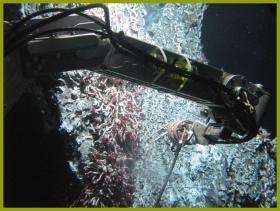
(PhysOrg.com) -- Two miles below the surface of the Sargasso Sea lies a depression in the Earth’s crust filled with sediment and, scientists believe, teeming with life — exotic, microscopic, and very likely never before seen by human eyes.
Called the North Pond Basin, the site — researchers at Harvard and beyond believe — can provide a window onto a vast world of subterranean microscopic life that extends kilometers below the Earth’s surface and which, according to rough estimates, could rival life above the surface in both diversity and sheer mass.
Assistant Professor of Organismic and Evolutionary Biology Peter Girguis is working with colleagues around the world in a new collaboration to explore that subsurface life. If abundance estimates are close to accurate, understanding that life will not only add greatly to scientific knowledge, it will also enhance understanding of the cycling of chemicals, nutrients, and water between the Earth, the air, and the sea.
“I’m excited about what we’re doing,” Girguis said. “It’s a compelling story about how little we know about the Earth’s biosphere.”
The conventional wisdom concerning life on the ocean floor is that it largely consists of strange creatures that exist solely on dead things that drift down from the better-lit ocean above. It was only about a decade ago, Girguis said, that researchers began to look for life in drill cores taken to understand sea bed geology.
And they found it in abundance.
“There are a lot more microbes in marine sediments than people thought,” Girguis said. “The thing I find astonishing is that … it’s possible there’s more biomass in the deep sea sediments, in the form of microbes, than the total biomass on all the continents.”
Despite appearances to the contrary, the boundary between the sea and the sediment below is not as discrete as people may believe. Seawater saturates the sediment and flows even to the roots of the continents, picking up minerals and heat and returning to the sea through vents that dot the mid-ocean ridges and plate boundaries.
So much water passes through this subsurface system, Girguis said, that it is possible that the entire volume of the ocean circulates through it every 5,000 to 10,000 years.
“That’s all the water in the oceans. That means there’s a reasonable chance that these microbes are influencing ocean chemistry,” Girguis said.
Working on the sea floor — and beneath it — presents huge logistical problems. Instruments must be able to withstand enormous pressure — 2 tons per square inch, the equivalent of the pressure exerted by a 1-inch diameter rod with a small car balanced on top — as well as pitch dark. Though much of the ocean floor is cold, that’s not the case around hydrothermal vents. There the water is superheated to more than 300 degrees Celsius and kept from boiling by the pressure. The water, made corrosive by the minerals it carries, eats away at aluminum, iron, and even stainless steel.
Such extreme conditions are extraordinarily difficult to duplicate in a lab. Samples from the ocean depths are transformed by the reduction in pressure by the time they reach the surface. As the pressure declines, gases held in solution by the pressure bubble out and bleed off. Microbes present in the sample metabolize different elements, changing it by the time it reaches the ship.
The only way to truly understand conditions at the sea floor, Girguis said, is to create instruments designed to take measurements there. Girguis and research associate Scott Wankel, who describe themselves as “part biologist and part engineer,” have created a miniature mass spectrometer that can fit into a bottle 8 inches in diameter and 3 feet long.
“We have to put electronics in a pressure housing. We make bottles of titanium to put the instruments in. We put the cap on it, send it to the bottom, and hope the O-rings don’t fail because then we wind up with a can full of water,” Girguis said.
One particular challenge is designing a way for the instrument to collect and analyze samples without compromising its structure. Girguis and Scott Wankel designed a membrane inlet that sits on a rigid framework of plastic and titanium. The membrane is permeable to gas, which allows gas to cross into a vacuum chamber on the other side, where it is analyzed. Wankel tested the instrument on Pacific hydrothermal vents last summer in a dive on the deep-diving submersible Alvin.
“In this lab I want to address some of the technical challenges to deep sea exploration by designing tools and systems that allow us to make measurements that we weren’t able to make before,” Girguis said. “There are two drivers for us. One is to get our science done at that site in the Atlantic; the second is to develop technology to share with the broader community to further [our] understanding of the deep subsurface biosphere.”
As Girguis and colleagues at other institutions wrestle with the growing sense that they’re seeing the tip of a scientific iceberg, they have come together to share information and discuss ways to see what still remains unseen. The Deep Energy Biosphere Institute (DEBI), begun by University of Southern California biology professor Katrina Edwards, provides a forum for scholars around the world interested in the subject. A significant grant from the Moore Foundation, administered by Harvard and three other universities, is funding the physical exploration.
Edwards, who said work on the sea floor presents similar challenges to exploring other planets, said exploration so far has been focused on places that are easy to access. She likened it to searching for lost car keys under a street lamp, not because that’s the likeliest place the keys might be, but because that’s where the light is.
The North Pond Basin is one place scientists would like to understand better, Girguis said. Unlike much of the ocean floor, covered by sediment that turns anoxic — oxygen-free — within a few centimeters, the sediment of the North Pond Basin appears to be oxygenated all the way down. That means it very likely hosts a unique microbial community that exploits the organic material in the sediment in ways different from the ways that anaerobic microbes do.
“Aerobic microbes are very metabolically active and can do different things than anaerobic microbes can,” Girguis said.
The work in the North Pond Basin will begin in earnest in 2010. The plan is to drill three bore holes hundreds of meters into the basin’s sediment and insert long strings of instruments that will sample conditions at intervals beneath the sea bed. The instruments would be held in place by a cap on the holes that would contain instruments and batteries to keep the operations running. The site would be visited annually for two years and then left to run on its own for three more years before the five-year project concludes.
Provided by Harvard University


