Spirit Gets Energy Boost from Cleaner Solar Panels
February 12, 2009
Spirit Gets Energy Boost from Cleaner Solar Panels

Enlarge

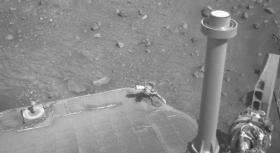
Engineering data from Spirit's power subsystem indicated that some dust blew off the rover's solar array on the following day, Sol 1812 (February 6, 2009). Image credit: NASA/JPL-Caltech

(PhysOrg.com) -- A small but important uptick in electrical output from the solar panels on NASA's Mars Exploration Rover Spirit this month indicates a beneficial Martian wind has blown away some of the dust that has accumulated on the panels.

The cleaning boosts Spirit's daily energy supply by about 30 watt-hours, to about 240 watt-hours from 210 watt-hours. The rover uses about 180 watt-hours per day for basic survival and communications, so this increase roughly doubles the amount of discretionary power for activities such as driving and using instruments. Thirty watt-hours is the amount of energy used to light a 30-watt bulb for one hour.

"We will be able to use this energy to do significantly more driving," said Colette Lohr, a rover mission manager at NASA's Jet Propulsion Laboratory, Pasadena, Calif. "Our drives have been averaging about 50 minutes, and energy has usually been the limiting factor. We may be able to increase that to drives of an hour and a half."

Spirit has driven about 9 meters (about 30 feet) since getting around a rock that temporarily blocked its progress on Jan. 31. The team's goal in coming weeks is to navigate the rover over or around a low plateau called "Home Plate" to get to an area targeted for scientific studies on the other side of Home Plate.

JPL's Jennifer Herman, a rover team engineer, found the first evidence for the new cleaning event in engineering data from the Martian day 1,812 of Spirit's mission on the Red Planet (Feb. 6, 2009) and confirmed it from the following two days' data. Before the event, dust buildup on the solar array had reached the point where only 25 percent of sunlight hitting the array was getting past the dust to be used by the photovoltaic cells. Afterwards, that increased to 28 percent.

"It may not sound like a lot, but it is an important increase," Herman said.

The last prior cleaning event that was as beneficial as this one was in June 2007. Winds cleaned off more of the dust that time, but a dust storm in subsequent weeks undid much of the benefit.

Spirit's twin rover, Opportunity, drove 135.9 meters (446 feet) on Feb. 10. Opportunity's cumulative odometry is 14.36 kilometers (8.92 miles) since landing in January 2004, including 2.58 kilometers (1.6 miles) since climbing out of Victoria Crater on Aug. 28, 2008.

Spirit and Opportunity have been operating on Mars for more than five years in exploration missions originally planned to last for three months.

Provided by NASA

Filter


Move the slider to adjust rank threshold, so that you can hide some of the comments.


Display comments: newest first

Bob_Kob
Feb 12, 2009

Rank: not rated yet
You would think they would have designed some sort of cleaning system for the panels, maybe a rudimentary window wiper as bare minimum?
DGBEACH
Feb 13, 2009

Rank: not rated yet
You would think they would have designed some sort of cleaning system for the panels, maybe a rudimentary window wiper as bare minimum

Well, the two robots could clean each other off!
moj85
Feb 13, 2009

Rank: not rated yet
Hard to think of every problem.. but yeah why wouldnt they realize that cleaning the solar panels would be extremely important?
gmurphy
Feb 13, 2009

Rank: 5 / 5 (1)
because the original mission was 90 days, not five years
Damon_Hastings
Feb 13, 2009

Rank: not rated yet
You would think they would have designed some sort of cleaning system for the panels, maybe a rudimentary window wiper as bare minimum?


I wondered about that myself. Does anyone know whether they're doing anything like that with the next rover? They could also maybe tilt the panels to enhance the wind's ability to clean them.
nilbud
Feb 16, 2009

Rank: 1 / 5 (1)
Gir will do it
Rank 5 /5 (5 votes)
Relevant PhysicsForums posts
  • Never ending outer space.....
    createdFeb 11, 2012
  • Neutron Star fragments?
    createdFeb 11, 2012
  • stationary or not?
    createdFeb 11, 2012
  • Scale of the Universe
    createdFeb 10, 2012
  • Titan's lack of impact craters
    createdFeb 09, 2012
  • Real pictures of black hole eating a star?
    createdFeb 08, 2012
  • More from Physics Forums - General Astronomy

More news stories

With climate change, today's '100-year floods' may happen every three to 20 years: research

Last August, Hurricane Irene spun through the Caribbean and parts of the eastern United States, leaving widespread wreckage in its wake. The Category 3 storm whipped up water levels, generating storm surges ...

Space & Earth / Environment

created 1 hour ago | popularity 1.8 / 5 (5) | comments 0 | with audio podcast

Alien matter in the solar system: A galactic mismatch

This just in: The Solar System is different from the space just outside it.

Space & Earth / Space Exploration

created 22 minutes ago | popularity 5 / 5 (1) | comments 0 | with audio podcast

China's pollution puts a dent in its economy

Although China has made substantial progress in cleaning up its air pollution,a new MIT study shows that the economic impact from ozone and particulates in its air has increased dramatically. ...

Space & Earth / Environment

created 41 minutes ago | popularity not rated yet | comments 0

Solastalgia's growing influence is 'bittersweet' success

If you enter ‘solastalgia’ into a Google search, the staggering number and range of results illustrates just how widely the influence of Professor Glenn Albrecht’s concept has spread. ...

Space & Earth / Environment

created 21 minutes ago | popularity not rated yet | comments 0

Earth-facing sunspot doubles in size

The latest sunspot region to traverse the face of the Sun has nearly doubled in size as it aims Earthward, as seen in the animation above from NASA’s Solar Dynamics Observatory. (Click image to play the ...

Space & Earth / Space Exploration

created 4 minutes ago | popularity not rated yet | comments 0


Researchers make better heat sensor based on butterfly wings

(PhysOrg.com) -- Scientists have long known that butterfly wings produce their iridescent colors by bouncing light around and between tiny ridges in structures made of chitin. More recently they’ve discovered ...

Manipulating genes with hidden TALENs

(PhysOrg.com) -- A better understanding of gene function in model plant and animal systems could be used to develop useful traits in livestock and crop plants, and might someday lead to developments in stem ...

Can Viagra treat childhood lymphatic disorder?

(Medical Xpress) -- A surprising potential therapy for severe, hard-to-treat malformations of the lymphatic system is now being studied at the Stanford School of Medicine and Lucile Packard Children’s Hospital: researchers ...

Don't ignore kids' snores

(Medical Xpress) -- Your ears aren’t playing tricks on you – that is the sound of snoring you hear from the bedroom of your preschooler. Snoring is common in children, but in some cases it can be a symptom of a ...

NDSU nano research could impact flexible electronic devices

A discovery by a research team at NDSU and the National Institute of Standards and Technology shows the flexibility and durability of carbon nanotube films and coatings are intimately linked to their electronic properties. ...

Thomas Edison inspires the oscar awards you don't see

Thomas Edison's invention of the first motion picture camera in 1891 inspired scientific and technological advances that he never could have imagined.