Probing Question: Can we save today's documents for tomorrow?
February 12, 2009 By Adam Eshleman
Credit Rob Williams
Even though your grandparents’ old photo albums are yellowed and grainy, they’re still there for you and your family to enjoy. But will your grandchildren be able to say the same of the digital photo albums you’re compiling today? Rapid advances in computer technology have left past hardware and software in the dust. If we’re creating documents no one will be able to access, has our Information Age created a digital dark age?
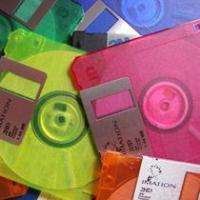
“Perhaps,” said Jackie Esposito, Penn State’s University archivist. “Electronic forms of information can and probably will be lost because we have no way of accessing older digital files and no way of preserving them,” she noted. “If you hand me a floppy disk today, I can’t find a computer to read it. But it’s only been 40 or 50 years that computers have existed. From a historical standpoint, that’s a short dark age.”
For the past two-and-a-half years, Esposito has been working with Penn State’s Digital Preservation Steering Committee to guard University records against digital oblivion. “We’re looking primarily at materials that were ‘born digital,’ meaning they were created on the computer and have lived on the computer and may never have been printed out,” she explained. “How are we going to make sure these records are still here 50 years from now? How are we going to do that if the average lifespan of hardware and software is 18 months?”
Penn State has already lost some of its non-permanent records as a result of this dilemma, she pointed out. In the early 1980s, the University began using computer systems to manage business and student records. The information was stored on magnetic tapes, which are no longer accessible due to decay and the lack of hardware to read them. Nor is Penn State alone: NASA has reported losing up to 20 percent of the information recorded by the 1976 Viking mission, data also stored on magnetic tape.
As unlikely as it may sound, preserving e-mail and text messages is one of the University’s greatest priorities right now, said Esposito. Of particular concern are electronic communications generated by high-profile figures like University President Graham Spanier. “These files will one day become important historical documents,” she noted. “If you want to look at the papers of Penn State’s first president, Evan Pugh, you come in here and I’ll give you a nice little box filled with aging papers. For Graham Spanier’s papers I’m going to send you to a server, because they were born digital. It’s a different research paradigm.”
To ensure that its digital documents are preserved for posterity, Esposito says, “We’re looking at systems that are interoperable, meaning they’ll work on any computer system. We’re looking at formats like PDF/A.” Like the now-standard PDF (for Portable Document Format) that it’s based on, a PDF/A file can capture both images and text. But unlike a standard PDF, it doesn’t require preinstalled software to be read. Instead, the software is embedded in the file itself. This means a PDF/A will be accessible across a variety of operating systems.
Unfortunately, with technology evolving at a relentless pace, preserving digital files isn’t a once and done deal, reminded Esposito. “Five years from now, I’ll have to decide what I’m doing with all those PDF/A’s to make them readable. And that decision-making process will continue 20 years down the road, by whoever’s in charge at that point in time,” Esposito said.
As for farther in the future, she’s confident that the Information Age will live up to its name. “I think 100 years from now, 30 to 40 percent of this information will be available. That’s an acceptable number. I mean, if I look at what records are available from the Middle Ages, it’s probably 5 to 10 percent of whatever was created.”
In the interim, if you really want to preserve those digital photo albums and e-mail love-notes, Esposito recommends burning them to DVD-R recordable format and making a commitment to reformatting your files once every five years or so. And if you’re using rewritable DVDs as your storage medium, it’s a good idea to burn new copies every few years, she said. DVDs last only 10 years before the information stored on them begins to corrode.
“There are definitely steps we can take to preserve documents, Esposito said, “but we haven’t come up with all the answers yet. I’d call that more of a murky age than a dark age.”
Source: By Adam Eshleman, Research/Penn State
-
Security concerns cast shadow over cloud's bright future
Jun 22, 2011 |
not rated yet |
4
-
Touch screen gamble: which technology to use
Oct 15, 2009 |
4.5 / 5 (2) |
0
-
Apple's iLife takes home photo albums to a new level
Jul 09, 2009 |
not rated yet |
0
-
Consumers can be stuck when Web sites change terms
Mar 27, 2009 |
4.8 / 5 (5) |
5
-
Fewer students turn pages of yearbooks in digital age
Feb 27, 2009 |
not rated yet |
0
-
Engineers build first sub-10-nm carbon nanotube transistor
Feb 01, 2012 |
4.9 / 5 (31) |
30
-
Something old, something new: Evolution and the structural divergence of duplicate genes
Jan 31, 2012 |
4.6 / 5 (7) |
1
-
The hidden nanoworld of ice crystals: Revealing the dynamic behavior of quasi-liquid layers
Jan 30, 2012 |
5 / 5 (3) |
1
-
Stock market network reveals investor clustering
Jan 27, 2012 |
3.9 / 5 (23) |
8
-
Of microchemistry and molecules: Electronic microfluidic device synthesizes biocompatible probes
Jan 26, 2012 |
5 / 5 (1) |
0
-
Calling function with no input argument
14 hours ago
-
Force free body diagram problem on gym equipment
14 hours ago
-
Empirical data regarding shower heads and water
22 hours ago
-
feed hold button on CNC lathe
Feb 09, 2012
-
RFAC in Fortran
Feb 09, 2012
-
dynamics 2/32
Feb 08, 2012
- More from Physics Forums - General Engineering
More news stories
Google users warned of threat to smartphone wallets
Users of Google smartphone wallets were being warned on Friday that there is a way to crack pass codes intended to thwart thieves from going on illicit shopping sprees.
6 hours ago |
5 / 5 (2) |
0
Anonymous knocks CIA website offline (Update)
The website of the Central Intelligence Agency was inaccessible on Friday after the hacker group Anonymous claimed to have knocked it offline.
8 hours ago |
5 / 5 (8) |
13
New error-correcting codes guarantee the fastest possible rate of data transmission
Error-correcting codes are one of the triumphs of the digital age. Theyre a way of encoding information so that it can be transmitted across a communication channel such as an optical fiber o ...
Technology / Computer Sciences
16 hours ago |
4.9 / 5 (8) |
6
|
New power source discovered
(PhysOrg.com) -- Researchers at the Massachusetts Institute of Technology (MIT) and RMIT University have made a breakthrough in energy storage and power generation.
Technology / Energy & Green Tech
15 hours ago |
4.8 / 5 (25) |
8
|
Small modular reactor design could be a 'SUPERSTAR'
(PhysOrg.com) -- Though most of today's nuclear reactors are cooled by water, we've long known that there are alternatives; in fact, the world's first nuclear-powered electricity in 1951 came from a reactor ...
Technology / Energy & Green Tech
16 hours ago |
4.3 / 5 (12) |
22
|
Humans may have helped the decline of African rainforests 3000 years ago
(PhysOrg.com) -- Large areas of rainforests in Central Africa mysteriously disappeared over three thousand years ago, to be replaced by savannas. The prevailing theory has been that the cause was a change ...
Complex wiring of the nervous system may rely on a just a handful of genes and proteins
Researchers at the Salk Institute have discovered a startling feature of early brain development that helps to explain how complex neuron wiring patterns are programmed using just a handful of critical genes. ...
The power of estrogen -- male snakes attract other males
A new study has shown that boosting the estrogen levels of male garter snakes causes them to secrete the same pheromones that females use to attract suitors, and turned the males into just about the sexiest ...
Putting the squeeze on planets outside our solar system
(PhysOrg.com) -- Using high-powered lasers, scientists at Lawrence Livermore National Laboratory and collaborators discovered that molten magnesium silicate undergoes a phase change in the liquid state, abruptly ...
Could Venus be shifting gear?
(PhysOrg.com) -- ESAs Venus Express spacecraft has discovered that our cloud-covered neighbour spins a little slower than previously measured. Peering through the dense atmosphere in the infrared, the ...
Fool's gold may prove an unlikely alternative to overexploited catalytic materials
Catalytic materials, which lower the energy barriers for chemical reactions, are used in everything from the commercial production of chemicals to catalytic converters in car engines. However, with current catalytic materials ...
Feb 18, 2009
Rank: not rated yet
Feb 18, 2009
Rank: not rated yet
http://www.norsam...tta.html