Research on viral origins suggests new definition of virus may be needed
February 12, 2009 by Diana Yates
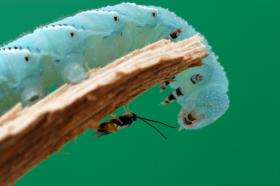
A parasitic Cotesia wasp preparing to oviposi onto a Manduca caterpillar. Rights-protected photo courtesy Alex Wild (myrmecos.net)
(PhysOrg.com) -- The strange interaction of a parasitic wasp, the caterpillar in which it lays its eggs and a virus that helps it overcome the caterpillar’s immune defenses has some scientists rethinking the definition of a virus.
In an essay in the journal Science, Donald Stoltz, a professor of microbiology and immunology at Dalhousie University, in Halifax, Nova Scotia, and James Whitfield, a professor of entomology at the University of Illinois, report that a new study also appearing in Science shows how the diverse ways in which viruses operate within and among the organisms they encounter may not be fully appreciated. The study, from a team of researchers led by the Université François Rabelais, in Tours, France, found that the genes that encode a virus that helps wasps successfully parasitize caterpillars are actually integrated into the wasps’ own chromosomes. These genes, which they show to be related to those from another known group of viruses, are an indivisible part of the wasp’s genetic heritage; they are passed down from one generation to another of parasitoid wasps.
While it is not unusual for virus DNA to become embedded in the chromosomes of their hosts, in this case the wasp is not the only “host” of the virus. The viral genes do replicate (copy themselves) inside the wasp (the permanent host), but they actually target - and act upon - the immune system of the caterpillar (a more transient host).
“The unique thing about these viruses is that the organism into whose DNA their genes are embedded in is not the same one that their genes are actually targeted to operate on,” Whitfield said. “So it’s sort of like having two hosts, except that there’s not a complete life cycle in either host.”
The virus is beneficial to the wasp and depends on the wasp for its own survival, suggesting a kind of obligate mutualism that is not normally seen in viruses, Whitfield said.
Researchers have known for about 40 years that some species of parasitoid wasps inject these viruses, known as polydnaviruses, into the body cavities of caterpillars at the same time that they lay their eggs in the caterpillars. Because these “virus-like particles” have become an integral part of the wasp genome, some researchers have suggested they should no longer be considered viruses.
“It’s true that the wasp DNA and the viral DNA are now combined into the same genome, so maybe it’s not productive to think of them as separate entities,” Whitfield said. “But on the other hand, if you really want to understand them well, it does help to know where things come from.”
Whitfield and Stoltz have each spent decades studying the interplay of parasite and pathogens that makes up the life cycle of the parasitoid wasps. In their essay, they suggest that taxonomists of viruses take a new look at how viruses are defined.
“Many virology texts won’t even mention polydnaviruses,” Whitfield said. “The issue we bring up is: Do we want to call these viruses? And if not, why not? Because they certainly started out as viruses. And if so, then we have to change the definition of viruses to somehow specify what it is that a virus has to contain, and what it has to do, to be considered a virus.”
Provided by University of Illinois at Urbana-Champaign
-
Papaya plants reduce the need for pesticides on tomatoes in Florida, new study finds
Jun 30, 2011 |
5 / 5 (2) |
0
-
Parasitic wasps' genomes provides new insights into pest control, genetics (w/ Video)
Jan 14, 2010 |
3.8 / 5 (5) |
4
-
Aphids saved from gruesome death by virus-infected bacteria
Aug 20, 2009 |
5 / 5 (3) |
0
-
Continental mosquito with 'vector' potential found breeding in UK after 60 year absence
8 hours ago |
not rated yet |
0
-
Researchers develop gene therapy to boost brain repair for demyelinating diseases
3 hours ago |
5 / 5 (2) |
0
-
Engineers build first sub-10-nm carbon nanotube transistor
Feb 01, 2012 |
4.9 / 5 (31) |
30
-
Something old, something new: Evolution and the structural divergence of duplicate genes
Jan 31, 2012 |
4.6 / 5 (7) |
1
-
The hidden nanoworld of ice crystals: Revealing the dynamic behavior of quasi-liquid layers
Jan 30, 2012 |
5 / 5 (3) |
1
-
Stock market network reveals investor clustering
Jan 27, 2012 |
3.9 / 5 (23) |
8
-
Of microchemistry and molecules: Electronic microfluidic device synthesizes biocompatible probes
Jan 26, 2012 |
5 / 5 (1) |
0
More news stories
Entire genome of extinct human decoded from fossil
(PhysOrg.com) -- In 2010, Svante Pääbo and his colleagues presented a draft version of the genome from a small fragment of a human finger bone discovered in Denisova Cave in southern Siberia. The ...
Feb 07, 2012 |
4.7 / 5 (58) |
44
|
Why are there so few fish in the Earth's oceans?
(PhysOrg.com) -- A Stony Brook University researcher has found that, contrary to popular belief, there are not plenty of fish in the sea.
Feb 08, 2012 |
4.3 / 5 (17) |
26
|
Miami battling invasion of giant African snails
No one knows how they got there. But an invasion of African giant snails has southern Florida in a panic over potential crop damage, disease and general yuckiness surrounding the slimy gastropods.
Feb 10, 2012 |
4.5 / 5 (2) |
5
Deciding to go left or right: Researchers use device to determine that lower animals can navigate too
For decades, scientists have associated binary decision making opting to go left or right with higher-ranking animals, including humans. A team of Harvard researchers, however, is rewriting that ...
Feb 09, 2012 |
4 / 5 (1) |
4
|
Study shows chimps able to understand needs of others
(PhysOrg.com) -- By setting up a unique experiment, a small team of researchers has found that chimpanzees are able to understand need in other chimps, despite their general disinclination to offer aid when ...
Google might launch Drive for cloud storage soon
(PhysOrg.com) -- Google's next big move, according to the Wall Street Journal, is a cloud storage service called Drive. Hardly first to the plate, Google is simply catching up to introducing its cloud reposi ...
Latin America mining boom clashes with conservation
Latin America is experiencing a mining boom as prices rise fuelled by a hike in global demand, but the region is also being hit by a wave of violent protests, strikes and rallies by environmentalists.
Love a click away in Indonesia's Twitter Republic
He was a geeky kid from Yogyakarta, she a glamorous city girl in Jakarta. In a country with one of the world's most vibrant social networking scenes they fell in love on Twitter.
Walney offshore wind farm is world's biggest (for now)
(PhysOrg.com) -- The Walney wind farm on the Irish Sea--characterized by high tides, waves and windy weather--officially opened this week. The farm is treated in the press as a very big deal as the Walney ...
GPS court ruling leaves US phone tracking unclear
A US Supreme Court decision requiring a warrant to place a GPS device on the car of a criminal suspect leaves unresolved the bigger issue of police tracking using mobile phones, legal experts say.
Europeans protest controversial Internet pact
Tens of thousands of people marched in protests in more than a dozen European cities Saturday against a controversial anti-online piracy pact that critics say could curtail Internet freedom.
Feb 12, 2009
Rank: not rated yet
Feb 12, 2009
Rank: not rated yet
Feb 13, 2009
Rank: not rated yet
The above seems to perpetuate the myth that viruses are 'alive'.. they are NOT.. they are
collections of NON-living molecules .. 'Survival' is a term best used with respect to living organisms. Any biologist should appreciate that viruses are nothing but a kind of 'messenger' that exchanges info between and among living organisms. Bacteria 'ingest' them, expel them, and manufacture multiple copies of them .. but they do NOT give them 'life' , anymore than the IP packets here are alive on the net!
j. anderson, md
tkjtkj@gmail.com
Feb 13, 2009
Rank: 3 / 5 (1)
Feb 13, 2009
Rank: not rated yet
Feb 13, 2009
Rank: not rated yet
Feb 13, 2009
Rank: not rated yet
And you are entirely wrong .. 'being able to transmit genetic information' is NOT any independent criteria for 'life'.
There are such things as: independent reproduction, metabolism, respiration, ... all of which you seem to ignore.
Feb 13, 2009
Rank: not rated yet
My point being, there isn't one way to look at it. Without genetic information, none of your criteria for life would work. Respiration is around because DNA (or RNA) codes for it to exist.
Feb 14, 2009
Rank: 5 / 5 (1)
On the other hand virus can be thought of as a life form, not a normal one but rather a complex, composite life form which is made of a core viral genome and a set of host cells capable of propagating it.
I think this definition better captures what viruses really are although some might find it weird that a given cell may serve as a basis for more then one life form. It's not so strange if you accept that genetic material is what differentiates various life forms, viruses change genetic material of host cells, either temporary or permanently, so in the process of infection the host cell is turned into a different life form - a virus.
A given cell can become more then one viral life at a time if it is infected by two or more viruses, also in the case of some viruses whose infection is not permanent the cell may revert to being the host after some time.
Using this definition the vasp and the virus are a single life form and those cells of caterpillars which are also able to propagate virus particles should also be considered part of this composite life form.
In the end the problem of definition is not really that important, all our classifications are just attempts to draw artificial lines where no such lines exist in reality. While it works well in many cases it's important to remember it's only an approximate tool which serves to organize knowledge, nothing more.
Feb 14, 2009
Rank: not rated yet
Not to be picky Dr. Anderson but why? I have heard both specialists and laypeople using the term to indicate resisting damage decay or destruction.
"Any biologist should appreciate that viruses are nothing but a kind of 'messenger' that exchanges info between and among living organisms."
And are dependent on a host for their continued perpetuation - there survival.
And expressing doubt about someone's claim to credentials is not defamation. Not even close. If it were, con men would be a lot safer since no one would risk calling their bluff by asking for proof of credentials.