Tiny details in three dimensions
February 13, 2009
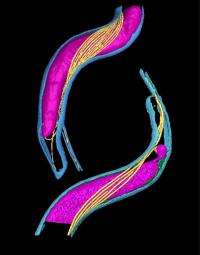
This is a three-dimensional cryo-electron tomogram of two different Borrelia species. Photo: Heidelberg University Hospital
They are borne by ticks and can cause acute and chronic symptoms in joints, muscles and the nervous system - the bacteria that cause Lyme borreliosis, which 80,000 people in Germany contract every year. Heidelberg researchers have now succeeded in identifying their structure more accurately. Using a cryo-tomography microscope, the previously unknown detailed structure of the spirochete bacteria can be shown in three dimensions. One finding - that borrelia types in North America more often affect the joints and in Europe the skin and nervous system as well - seems to stem from the characteristics of their motility system.
The research group headed by Professor Reinhard Wallich, Institute of Immunology, and Dr. Friedrich Frischknecht, Department of Parasitology at the Hygiene Institute of Heidelberg University Hospital has published its findings in cooperation with colleagues from Munich and Freiburg in "Molecular Microbiology". Among other things, the researchers hope to gain new insights into the various clinical symptoms of the disease.
In cryo-electron tomography the organism is shock frozen so that its original condition is retained. Chemical pretreatment, which is often associated with modifying structures and properties, is no longer necessary. Resolution of five to seven nm allows tiniest structures to be viewed. "The new technology is a quantum leap for research, comparable with the step from simple x-ray images to three-dimensional computer tomography in clinical diagnostics," stated Dr. Frischknecht.
The bacteria have developed many strategies to avoid the immune response of humans. Borrelias, like the syphilis pathogens, are spirochetes bacteria. The spiral-shaped, actively motile bacteria have flexible, pliable bodies that are moved with the aid of complex organs, flagella. A correlation between the motility and infectiousness of the pathogen has long been presumed.
The Heidelberg researchers have now for the first time compared the characteristics of the three human pathogenic species that cause Lyme borreliosis that occur in Europe and cause varying symptoms. While in North America, the major symptom is joint inflammation, in Europe, the skin or nervous system may also be affected. With the aid of cryo-tomographic microscopy, they have successfully shown that the three pathogen types have varying numbers of flagella. In addition, structures were identified for the first time that could play an important role in the reproduction of the bacteria.
More information: Comparative cryo-electron tomography of pathogenic Lyme disease spirochetes, Mikhail Kudryashev, Marek Cyrklaff, Wolfgang Baumeister, Markus M. Simon, Reinhard Wallich, Friedrich Frischknecht, Published Online: Feb 4 2009 7:27AM, DOI: 10.1111/j.1365-2958.2009.06613.x
Source: University Hospital Heidelberg
-
Making the worms turn
Feb 03, 2012 |
not rated yet |
0
-
Study points to therapy for radiation sickness
Jan 25, 2012 |
5 / 5 (3) |
0
-
How immune cells move against invaders
Jan 19, 2012 |
5 / 5 (1) |
0
-
Quantitative imaging application to gut and ear cells
Jan 15, 2012 |
4 / 5 (1) |
0
-
Pill some day may prevent serious foodborne illness, scientist says
Jan 09, 2012 |
not rated yet |
0
-
Engineers build first sub-10-nm carbon nanotube transistor
Feb 01, 2012 |
4.9 / 5 (31) |
30
-
Something old, something new: Evolution and the structural divergence of duplicate genes
Jan 31, 2012 |
4.6 / 5 (7) |
1
-
The hidden nanoworld of ice crystals: Revealing the dynamic behavior of quasi-liquid layers
Jan 30, 2012 |
5 / 5 (3) |
1
-
Stock market network reveals investor clustering
Jan 27, 2012 |
3.9 / 5 (23) |
8
-
Of microchemistry and molecules: Electronic microfluidic device synthesizes biocompatible probes
Jan 26, 2012 |
5 / 5 (1) |
0
More news stories
Entire genome of extinct human decoded from fossil
(PhysOrg.com) -- In 2010, Svante Pääbo and his colleagues presented a draft version of the genome from a small fragment of a human finger bone discovered in Denisova Cave in southern Siberia. The ...
Feb 07, 2012 |
4.7 / 5 (58) |
48
|
Why are there so few fish in the Earth's oceans?
(PhysOrg.com) -- A Stony Brook University researcher has found that, contrary to popular belief, there are not plenty of fish in the sea.
Feb 08, 2012 |
4.3 / 5 (17) |
27
|
Miami battling invasion of giant African snails
No one knows how they got there. But an invasion of African giant snails has southern Florida in a panic over potential crop damage, disease and general yuckiness surrounding the slimy gastropods.
Feb 10, 2012 |
4.7 / 5 (3) |
5
Deciding to go left or right: Researchers use device to determine that lower animals can navigate too
For decades, scientists have associated binary decision making opting to go left or right with higher-ranking animals, including humans. A team of Harvard researchers, however, is rewriting that ...
Feb 09, 2012 |
4 / 5 (1) |
4
|
Study shows chimps able to understand needs of others
(PhysOrg.com) -- By setting up a unique experiment, a small team of researchers has found that chimpanzees are able to understand need in other chimps, despite their general disinclination to offer aid when ...
Injured boomers beware: Know when to see doctor
(AP) -- It happened to nurse Jane Byron years after an in-line skating fall, business owner Haralee Weintraub while doing "men's" push-ups, and avid cyclist Gene Wilberg while lifting a heavy box.
Google might launch Drive for cloud storage soon
(PhysOrg.com) -- Google's next big move, according to the Wall Street Journal, is a cloud storage service called Drive. Hardly first to the plate, Google is simply catching up to introducing its cloud reposi ...
Latin America mining boom clashes with conservation
Latin America is experiencing a mining boom as prices rise fuelled by a hike in global demand, but the region is also being hit by a wave of violent protests, strikes and rallies by environmentalists.
Love a click away in Indonesia's Twitter Republic
He was a geeky kid from Yogyakarta, she a glamorous city girl in Jakarta. In a country with one of the world's most vibrant social networking scenes they fell in love on Twitter.
Europeans protest controversial Internet pact
Tens of thousands of people marched in protests in more than a dozen European cities Saturday against a controversial anti-online piracy pact that critics say could curtail Internet freedom.
Walney offshore wind farm is world's biggest (for now)
(PhysOrg.com) -- The Walney wind farm on the Irish Sea--characterized by high tides, waves and windy weather--officially opened this week. The farm is treated in the press as a very big deal as the Walney ...