How a cometary boulder lit up the Spanish sky
February 13, 2009 How a cometary boulder lit up the Spanish sky

Enlarge

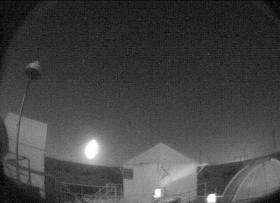
A frame of the bolide sequence recorded from Huelva. Credit: Alberto J. Castro-Tirado from station BOOTES-1. (INTA-CEDEA).

(PhysOrg.com) -- Last July, people in Spain, Portugal and France watched the brilliant fireball produced by a boulder crashing down through the Earth’s atmosphere. In a paper to be published in the journal Monthly Notices of the Royal Astronomical Society, astronomers Josep M. Trigo-Rodríguez (Institute of Space Sciences, CSIC-IEEC, Spain), José M. Madiedo (University of Huelva-CIECEM, Spain) and Iwan P. Williams (Queen Mary, University of London) present dramatic images of this event. The scientists go on to explain how the boulder may originate from a comet which broke up nearly 90 years ago and suggest the tantalising possibility that chunks of the boulder (and hence pieces of the comet) are waiting to be found on the ground.

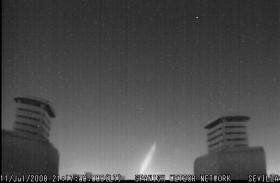
Fireballs (or bolides) are the name given by astronomers to the brightest meteors (popularly referred to as ‘shooting stars’). On 11th July 2008, at 2117 GMT, a brilliant fireball was recorded. At maximum intensity, the object was more than 150 times as bright as the full Moon. It was first picked up at a height of 98.3 km and disappeared from view 21.5 km above the surface of the Earth, tracked by three stations of the Spanish Fireball Network (SPMN) above Bejar, near Salamanca in Spain. At the same time a professional photographer took a picture of the bolide from the north of Madrid.

From these images, the astronomers can deduce the trajectory and properties of the incoming boulder. The team think it was a dense object, about 1 metre across and with a mass of 1.8 tonnes, large enough that some fragments probably survived intact and fell to the ground as meteorites.

The astronomers demonstrate that before its fiery demise, the boulder travelled on an unusual orbit around the Sun, on a path which took it from beyond the orbit of Jupiter to the vicinity of the Earth. This orbit is very similar to that of a cloud of dusty particles (meteoroids) known as the Omicron Draconids, which on rare occasions produces a minor meteor shower and probably originates from the breakup of Comet C/1919 Q2 Metcalf in 1920. This strongly suggests that the boulder was once embedded in the nucleus of that comet.
How a cometary boulder lit up the Spanish sky
Enlarge

A frame of the bolide sequence recorded by SPMN video station located in Sevilla Credit: Jos M. Madiedo. Universidad de Huelva-CIECEM).

In the mid-1980s the astronomers Tamas I. Gombosi and Harry L.F. Houpis first suggested that the nuclei of comets consist of relatively large boulders cemented together by a ‘glue’ of smaller particles and ice. If the rocky and icy nucleus of a comet disintegrates, then these large boulders are set loose into space. If the Bejar bolide was formed in this way, then it confirms the glue model for at least some comets.

And if fragments of the bolide can be recovered, then for the first time, scientists will be able to study large pieces from a comet in a laboratory. Dr Trigo-Rodríguez comments “If we are right, then by monitoring future encounters with other clouds of cometary debris, we have the chance to recover meteorites from specific comets and analyse them in a lab. Handling pieces of comet would fulfil the long-held ambitions of scientists - it would effectively give us a look inside some of the most enigmatic objects in the Solar System."

More information: The paper will be published in Monthly Notices of the Royal Astronomical Society. The abstract is available online at http://www3.interscience.wiley.com/journal/122196993/abstract?CRETRY=1&SRETRY=0

Provided by Royal Astronomical Society


print this article email this article download pdf blog this article bookmark this article     Stumble it Digg this share on Facebook retweet share on Reddit add to delicious
Rate this story - 4.8 /5 (4 votes)


February 13, 2009 all stories

Comments: 0

4.8 /5 (4 votes)
  • Stumble this up

  • Digg this

  • share this

  • hide
  • Related Stories

  • Our Sun: A Little Slow On the Uptake for Cycle 24
    created Apr 27, 2009 | popularity not rated yet | comments 0
  • Scientists explain mystery of observed turbulent density fluctuations in interplanetary space
    created Oct 28, 2009 | popularity not rated yet | comments 0
  • Detecting Life-Friendly Moons
    created Oct 26, 2009 | popularity not rated yet | comments 0
  • Invading black holes explain cosmic flashes
    created Sep 18, 2009 | popularity not rated yet | comments 0
  • Will Kepler find habitable moons?
    created Sep 03, 2009 | popularity not rated yet | comments 0


  • hide
  • Relevant PhysicsForums posts

  • The shape of our solar system's orbits.
    created Nov 07, 2009
  • Above or Below the Line of Nodes
    created Nov 07, 2009
  • Supernova vs. Nova?
    created Nov 07, 2009
  • Supernova's Gamma Rays and Comets
    created Nov 06, 2009
  • More from Physics Forums - General Astronomy

Other News

Deep creep means milder, more frequent earthquakes along Southern California's San Jacinto fault

Deep creep means milder, more frequent earthquakes along Southern California's San Jacinto fault

Space & Earth / Earth Sciences

created 16 hours ago | popularity 4.5 / 5 (4) | comments 0

With an average of four mini-earthquakes per day, Southern California's San Jacinto fault constantly adjusts to make it a less likely candidate for a major earthquake than its quiet neighbor to the east, the ...


Success in 'space elevator' competition (AP)

Success in 'space elevator' competition (Update 3)

Space & Earth / Space Exploration

created Nov 05, 2009 | popularity 4.3 / 5 (33) | comments 50

(AP) -- A robot powered by a ground-based laser beam climbed a long cable dangling from a helicopter on Wednesday to qualify for prize money in a $2 million competition to test the potential reality of the ...


In a Galaxy Far, Far Away...

In a Galaxy Far, Far Away...

Space & Earth / Astronomy

created Nov 06, 2009 | popularity 4.8 / 5 (5) | comments 17

(PhysOrg.com) -- Astronomers have published the discovery of the farthest known object in the cosmos: a star that exploded when the universe was only 630 million years old -- only 4.6% of its current age. ...


'Dropouts' pinpoint earliest galaxies

'Dropouts' pinpoint earliest galaxies

Space & Earth / Astronomy

created Nov 06, 2009 | popularity 4.2 / 5 (10) | comments 13

Astronomers, conducting the broadest survey to date of galaxies from about 800 million years after the Big Bang, have found 22 early galaxies and confirmed the age of one by its characteristic hydrogen signature ...


Space hotel taking bookings for 2012 opening

Space hotel taking bookings for 2012 opening

Space & Earth / Space Exploration

created Nov 05, 2009 | popularity 4.4 / 5 (21) | comments 11

(PhysOrg.com) -- The first orbiting space hotel is on track to open for its first customers in 2012, but hurry, as bookings are filling fast.