When it comes to elephant love calls, the answer lies in a bone-shaking triangle
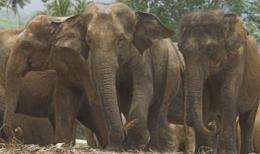
(PhysOrg.com) -- Many a love-besotted soul has declared they would move the world for their true love, but how many actually accomplish that task in their quest to unite with a lover?
Poets and romantics may argue the point, but research has shown that elephants issuing calls, including those of love more precisely, females in estrus produce not only audible sounds, but also low-frequency seismic vibrations that can travel through the near-surface soils for distances up to several kilometers.
And though we humans may claim to feel our lover's call in our heart, soul or other organs of either physical or philosophical origin, most of us need said love call to caress the hair cells of our inner ears for it to register in what is arguably our most important love/sex organ our brain.
Elephants, however, have two highly developed additional sensory systems at their disposal, both of which can be used for detecting the potential mate's seismic signals (humans have both, too, just not tuned to using vibrations as communication). One system is bone conduction, in which the vibrations travel from the toe tips into the foot bones, then up the leg and into the middle ear. The other, somatosensory reception, involves vibration-sensitive cells in the bottom of the foot that send signals to the brain via nerves.
Caitlin O'Connell-Rodwell, an ecologist and consulting assistant professor in otolaryngology at Stanford University School of Medicine, has been studying elephant communication for more than 15 years. During that time she's puzzled over which seismic sensing system elephants use most often in locating the source of a call. In her most recent field season last summer, she finally got an answer.
"They are placing themselves in a way that best suits bone conduction, rather than somatosensory reception," she said.
O'Connell-Rodwell came to her conclusion by conducting a study of how male elephants respond to estrus calls from females. She played recorded calls through a speaker coupled with the ground and concealed in a pile of brush near a watering hole in Etosha National Park in Namibia. The speaker emitted both an acoustic and seismic signal.
"The bulls would come in and then we would test them as they headed out of the water hole in different directions. They would always place themselves perpendicular to the direction the sound had traveled," she said.
That orientation maximizes the difference in the distance between each of the elephantís ears and the sound source, enhancing their ability to distinguish the point of origin. This position was assumed whether the signal was only seismic or both acoustic and seismic, suggesting that bone-conducted detection was preferable in the seismic channel to somatosensory reception, in which elephants would more likely line their front and back feet at the greatest distance from the source (i.e., in parallel). But perhaps thatís where the trunk comes in.
Every time the estrus recording was played, the bullsí behavior was the same, O'Connell-Rodwell said. "They stop, press their trunk on the ground and position themselves and turn the other way and place their trunk on the ground and do it again," she said.
Pressing their trunk against the ground may improve the elephant's ability to use triangulation to locate a sound source, as using the trunk along with their (front) feet gives them the multiple (three) sensors needed for triangulating, or even front and back, which would create a five-sensor array.
O'Connell-Rodwell had observed both male and female listening behavior in previous years but hadn't focused on the bone-conduction versus somatosensory-reception question. Although she had noticed that both males and females often oriented themselves in a manner that seemed more conducive to employing bone conduction, until this most recent study she hadnít tested how they responded when the sound effectively came from different locations.
But she also noted differences in how bulls and cows behaved when listening. "The males seem to use their trunk in detecting vibrations much more than females," she said. "We donít know why that is yet."
OíConnell-Rodwell used her observations of female behavior from previous field seasons as a basis for comparison with the males.
She also noticed some behavioral differences in the bullsí reactions to the estrus calls. The bulls who responded in the characteristic fashion were all either males in musthóa condition in which levels of reproductive hormones skyrocketóor subadult males, as well as juveniles who were too young to go into musth. But adult males who were not in musth showed very little interest in the love calls of the cows and simply walked away from the water hole.
The behavior of the adult males not in musth seemed to confuse any subadult males who were with them, O'Connell-Rodwell said.
"The subadults would be torn between whether to go toward the estrus call or follow the adult male out," she said. "And they would end up following the adult out, but they kept turning back. The adult male wouldnít pay attention at all."
O'Connell-Rodwell said more work remains to be done to unravel the social behavior of elephants, but she hopes to have more insights to offer soon. She has submitted a paper detailing aspects of male elephant society that is currently under review.
But even with the uncertainties that remain - and really, shouldn't there always be an element of mystery when it comes to romance - it seems clear that the key to finding love for those male elephants that want it lies in bone-jarring eternal triangulation.
Provided by Stanford University


