NASA Spacecraft Falling For Mars
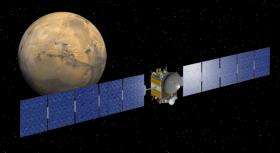
(PhysOrg.com) -- Launched in September of 2007, and propelled by any one of a trio of hyper-efficient ion engines, NASA's Dawn spacecraft passed the orbit of Mars last summer. At that time, the asteroid belt (where Dawn's two targets, asteroid Vesta and the dwarf planet Ceres reside), had never been closer. In early July the spacecraft began to lose altitude, falling back towards the inner solar system. Then on October 31, 2008, after 270 days of almost continuous thrusting, the ion drive turned off.
"Not only are our thrusters off and we are dropping in altitude, we are plunging toward Mars," said Marc Rayman, the Dawn project's chief engineer from NASA's Jet Propulsion Laboratory in Pasadena, Calif. "And everybody here on Dawn could not be happier."
The team's joy at plummeting towards a planet named for the Roman god of war is not unfounded. Mars, the final stop for many a NASA spacecraft, was always an important, and weighty, waypoint for the Dawn mission. It all has to do with one of the heavy subjects of rocket science, gravity assists.
A gravity assist is the use of the relative movement and gravity of a planet or other celestial body to alter the path and speed of a spacecraft, typically in order to save fuel, time and expense. A spacecraft traveling to an outer planet (or in this case asteroid) will decelerate because the incessant tug of the sun's gravity slows it down. By flying a spacecraft close by a large planet and its large gravity field, some of the planet's speed as it orbits the sun is transferred to the spacecraft. In Dawn's case, it is using the Red Planet's tremendous angular momentum (the speed at which Mars orbits the sun) to give it a little extra oomph.
"A big oomph actually," said Rayman. "The gravity of Mars will change Dawn's path about the sun, enlarging its elliptical orbit and sending the probe farther from the sun. It will also change Dawn's orbital plane by more than 5 degrees. This is important because Dawn has to maneuver into the same plane in which Vesta orbits the sun."
If Dawn had to perform these orbital adjustments on its own with no Mars gravitational deflection, it would have required the spacecraft to fire up its engines and change velocity by more than 5,800 miles per hour (9,330 kilometers per second). Such velocity changes would have required Dawn to carry an extra 230 pounds (104 kilograms) of xenon fuel.
"Without the gravity assist, our mission would not have been affordable, even with the extraordinary capability of the ion propulsion system," said Rayman. "That's why we are happy Dawn is now plunging toward Mars."
Also happy for the opportunity to fly past the fourth rock from the sun is Dawn's science team. With asteroid Vesta still more than two-and-a-half years away, Mars provides the perfect opportunity to give their highly-tuned instruments a workout.
"It is fortuitous that we need Mars to get out to Vesta and Ceres," said Carol Raymond, Dawn's deputy principal investigator, from JPL. "Since there are other spacecraft currently operating at Mars with similar instrumentation, we will be able to check our measurements against their knowledge of Mars, and carry that information farther out into the solar system."
But the Mars gravity assist is not the final hurdle on Dawn's road to the asteroid belt. The subsequent 30 months include more than 27 months of blue-green tinged ion thrusting to successfully rendezvous with Dawn's first target -Vesta.
While an accurately flown encounter with the planet Mars makes a big difference in the life of NASA's asteroid pioneer, the planet itself does not come out unscathed. Weighing in at all of 2,500 pounds (1,134 kilograms), Dawn has its own mass and thereby its own gravitational field. In contrast, the somewhat more massive planet is almost 600 million-million-million times more substantial than that of the spacecraft.
"The laws of physics tell us that Mars will pay a price for helping Dawn," said Rayman. "The flyby will cause Mars to slow in its orbit enough that after one year, its position will be off by about the width of an atom. If you add that up, it will take about 180 million years for Mars to be out of position by one inch (2.5 centimeters). We appreciate Mars making that sacrifice so Dawn can conduct its exciting mission of discovery in the asteroid belt."
Dawn's 4.8-billion-kilometer (3-billion-mile) odyssey includes orbiting asteroid Vesta in 2011 and the dwarf planet Ceres in 2015. These two giants of the asteroid belt have been witness to much of our solar system's history. By using Dawn's instruments to study both objects for several months, scientists can more accurately compare and contrast the two. Dawn's science instrument suite will measure geology, elemental and mineral composition, shape, surface topography, geomorphology and tectonic history, and will also seek water-bearing minerals. In addition, the Dawn spacecraft's orbit characteristics around Vesta and Ceres will be used to measure the celestial bodies' masses and gravity fields.
The Dawn mission to Vesta and Ceres is managed by JPL, a division of the California Institute of Technology in Pasadena, for NASA's Science Mission Directorate, Washington. The University of California, Los Angeles, is responsible for overall Dawn mission science. Other scientific partners include Planetary Science Institute, Tucson, Ariz.; Max Planck Institute for Solar System Research, Katlenburg-Lindau, Germany; DLR Institute for Planetary Research, Berlin; Italian National Institute for Astrophysics, Rome; and the Italian Space Agency. Orbital Sciences Corporation of Dulles, Va., designed and built the Dawn spacecraft.
To learn more about Dawn and its mission to the asteroid belt, visit: www.nasa.gov/dawn
Provided by NASA


