Mixed population provides insights into human genetic makeup
February 14, 2009
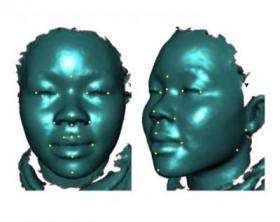
These are three-dimensional images of a face with location points indicated. Credit: Mark Shriver, Penn State
Genetic diseases and genetically mixed populations can help researchers understand human diversity and human origins according to a Penn State physical anthropologist.
"We wanted to get to a strategy to predict what a face will look like," said Mark D. Shriver, associate professor of biological anthropology. "We want to understand the path of evolution that leads to that part of the selection process."
To pinpoint genes that influence the shape of the human face and head, Shriver began with an online database of genes linked to disease -- Online Mendelian Inheritance of Man. If the symptoms of the disease involved the face or skull the gene implicated in the disease became a candidate for those facial traits.
This approach works because although Shriver looked at genes implicated in disease, those same genes in a healthy person may also influence the same physical trait -- length, width, shape, size -- but within the range normal for healthy individuals. Facial traits vary among humans, but do tend to group by population. For example, in general, West Africans have wider faces than Europeans and Europeans have longer faces than West Africans.
"There is a strong relationship between genetic ancestry and facial traits," said Shriver. "Using individuals of combined ancestry, European and African, we can see how the target genes alter facial traits," he told attendees at the 2009 Annual Meeting of the American Association for the Advancement of Science.
The researchers looked at a combined sample of African Americans with West African and European ancestry whose genetic makeup was known through DNA testing. To make it simpler, anyone with Native American ancestry was eliminated so that only two genetic pools were represented -- West African and European. The researchers reported on a sample of 254 individuals using three-dimensional imaging and measured the distances between specific portions of the face. Each individual had provided a DNA sample.
"We started with 22 landmarks on the faces that could be accurately located in all the images," said Shriver.
These landmarks might be the tip of the nose, the tip of the chin, the outer corner of the eye or other repeatable locations. They then recorded the distances between all the points in all directions, so they had a distance map of each of the faces.
From their DNA profiles, Shriver could determine the admixture percentages of each individual, how much of their genetic make up came from each group. He could then compare the genetically determined admixture to the facial feature differences and determine the relative differences from the parental populations.
"This type of study, done on admixed populations shows that each person is a composite of their ancestors and that the range of facial features is a continuum," says Shriver.
Shriver found that there was a very strong statistical correlation between the amounts of admixture and the facial traits.
"We chose to look at African Americans because they were a large enough and available admixed population," said Shriver. "We are trying to solidify our understanding of the origins of humans and the evolutionary processes. Looking at admixed populations shows us the influence genes have and how they relate to physical features."
Source: Penn State
-
Are cancers newly evolved species?
Jul 26, 2011 |
4.7 / 5 (21) |
18
-
Sequencing genome of entire family reveals parents give kids fewer gene mutations than was thought
Mar 10, 2010 |
4.2 / 5 (5) |
0
-
Mammoth Achievement: Researchers at the forefront of molecular biology
Jan 26, 2010 |
4.5 / 5 (13) |
0
-
The Origin of Artificial Species: Creating Artificial Personalities
May 14, 2009 |
3.8 / 5 (10) |
6
-
Sociability traced to particular region of brain
Jan 27, 2009 |
3.7 / 5 (3) |
0
-
Engineers build first sub-10-nm carbon nanotube transistor
Feb 01, 2012 |
4.9 / 5 (32) |
30
-
Something old, something new: Evolution and the structural divergence of duplicate genes
Jan 31, 2012 |
4.6 / 5 (7) |
1
-
The hidden nanoworld of ice crystals: Revealing the dynamic behavior of quasi-liquid layers
Jan 30, 2012 |
5 / 5 (4) |
1
-
Stock market network reveals investor clustering
Jan 27, 2012 |
3.9 / 5 (23) |
8
-
Of microchemistry and molecules: Electronic microfluidic device synthesizes biocompatible probes
Jan 26, 2012 |
5 / 5 (2) |
0
More news stories
A mitosis mystery solved: How chromosomes align perfectly in a dividing cell
Although the process of mitotic cell division has been studied intensely for more than 50 years, Whitehead Institute researchers have only now solved the mystery of how cells correctly align their chromosomes during symmetric ...
1 hour ago |
5 / 5 (2) |
0
|
The proteins ensuring genome protection
Researchers from the University of Geneva (UNIGE), Switzerland, have discovered the crucial role of two proteins in developing a cell 'anti-enzyme shield'. This protection system, which operates at the level of molecular ...
1 hour ago |
5 / 5 (2) |
0
|
Researchers find extensive RNA editing in human transcriptome
In a new study published online in Nature Biotechnology, researchers from BGI, the world's largest genomics organization, reported the evidence of extensive RNA editing in a human cell line by analysis of RNA-seq data, demons ...
1 hour ago |
5 / 5 (3) |
0
|
Entire genome of extinct human decoded from fossil
(PhysOrg.com) -- In 2010, Svante Pääbo and his colleagues presented a draft version of the genome from a small fragment of a human finger bone discovered in Denisova Cave in southern Siberia. The ...
Feb 07, 2012 |
4.7 / 5 (58) |
48
|
Why are there so few fish in the Earth's oceans?
(PhysOrg.com) -- A Stony Brook University researcher has found that, contrary to popular belief, there are not plenty of fish in the sea.
Feb 08, 2012 |
4.3 / 5 (17) |
27
|
Lab study raises questions over nano-particle impact
Tests involving chickens have raised questions about the impact on health from engineered nano-particles, the ultra-fine grains commonly used in drugs and processed foods, scientists said on Sunday.
Iran blocks email, restricts net access: reports
Iran has further restricted access to the Internet and blocked popular email services for the past few days, in a move a top lawmaker said could "cost the regime dearly," media reports said on Sunday.
Salvage workers begin pumping fuel from Italian shipwreck
Salvage workers Sunday began pumping fuel from the shipwrecked Italian cruise liner Costa Concordia, a day ahead of schedule, officials said.
Scientists discover molecular secrets of 2,000-year-old Chinese herbal remedy
For roughly two thousand years, Chinese herbalists have treated Malaria using a root extract, commonly known as Chang Shan, from a type of hydrangea that grows in Tibet and Nepal. More recent studies suggest that halofuginone, ...
New method to examine batteries -- MRI from the inside
There is an ever-increasing need for advanced batteries for portable electronics, such as phones, cameras, and music players, but also to power electric vehicles and to facilitate the distribution and storage of energy derived ...
Starve a virus, feed a cure? Findings show how some cells protect themselves against HIV
A protein that protects some of our immune cells from the most common and virulent form of HIV works by starving the virus of the molecular building blocks that it needs to replicate, according to research published online ...