Artificial cells, simple model for complex structure
A simple, chemical materials model may lead to a better understanding of the structure and organization of the cell according to a Penn State researcher.
"Cells are interesting because they show organization even at the level of the cytoplasm, and while it is thought to be important for cell functions, it is not always clear how this organization is achieved," said Christine Keating, associate professor of chemistry. "We are taking a materials chemistry approach in developing simple experimental models for cytoplasm organization," she told attendees at the 2009 Annual Meeting of the American Association for the Advancement of Science.
Cytoplasm is the material that fills the cell and is crowded with very large molecules. It surrounds the organelles -- tiny organs like mitochondria and the nucleus. Unlike organelles, the cytoplasm is a fundamental feature of all cells. Many important biochemical processes take place here, and so cytoplasm is interesting as a major player in cell function.
Creating a cell with organelles would be a monumental task, but creating one that exhibits molecular crowding and heterogeneity -- unevenness of composition -- is possible using large polymeric molecules and a lipid membrane.
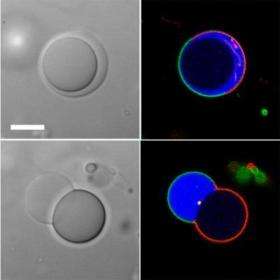
Keating uses lipids to create vesicles, tiny cell-sized bubbles of lipid membrane in an aqueous solution of two large polymers. In one case she used poly(ethyleneglycol) (PEG) -- a common polymer -- and dextran -- a polymerized sugar to create the cell.
"Neither of these compounds is important in a cell, but they illustrate the possibility of partitioning large molecules within a cell without internal membranes," said Keating. Cytoplasm is usually filled with macromolecules of proteins, nucleic acids and carbohydrates.
A mixture of a small amount of PEG, a small amount of dextran, water and dried lipid allowed the lipid to rehydrate and form the vesicles. The PEG and dextran filled the vesicles to the same concentration as the surrounding liquid. The lipid membrane encapsulated a mixture of PEG and dextran in water, but, the material separated to form two visibly distinct areas, one with a higher percentage of PEG and one with a higher percentage of dextran.
"The materials do not separate completely with one type of macromolecule in one section and the other completely apart," says Keating. "But the two aqueous phases are different enough that additional molecules, such as proteins or nucleic acids, prefer one over the other and will become concentrated there."
In bulk materials, researchers have been able to cause aqueous phase separation of up to 15 different compounds. Similar, multiple separations might even take place in a cell's cytoplasm. Biologists know that enzymes and other proteins tend to clump together or collocate in certain parts of the cell at certain times.
This collocalization would make the chemical reactions in metabolic pathways occur more rapidly because the chemicals necessary for the next step would be located nearby.
The application of heat, or a change in osmotic pressure can cause the separated materials to mix. However, upon cooling or reversion to the initial pressure, the materials again separate.
"It should be possible to collocalize materials in an artificial cell and then have the process be reversible," said Keating. "We could then bring together molecules we want at a certain time and separate them to control their activity."
Keating believes that some of the chemical reactions in cells may be controlled by collocation. If she can reproduce this type of collocation in her artificial cells, the systems can be more easily studied.
"The answer to whether or not collocalization can play this role is probably yes," said Keating. "However, proving it is not easy. With a simple reversible model system, we could test this idea and learn how large an effect is possible."
These primitive cells also model macromolecular crowding of cytoplasm, which happens because very large molecules, like proteins, are all competing for the same space. Macromolecules have long chains of atoms, sometimes branching and within their structures remains a lot of empty space. When faced with another large molecule, these macromolecules cannot occupy the same area and so they draw inward, filling some of the empty space and making themselves smaller.
Compacted macromolecules act differently than uncompacted molecules. The rates of reaction of crowded macromolecules can differ dramatically from those of the same molecules in unlimited space. These artificial cells with artificial cytoplasm may allow researchers to study the effects of macromolecular crowding in a controlled way.
The researchers are also looking at the effects of polarization and other types of compounds on these heterogeneous cells.
"One of the things we are looking into is how ions behave in the model cells," said Keating. "We want to take advantage of the effect common ions like potassium and magnesium can have on protein and nucleic acid structures and function."
These polymer containing primitive artificial cells may offer a very simple experimental system for investigating what goes on in the much more complex environment of biological cells.
Source: Penn State


