X-rays used to reveal secrets of famous fossil
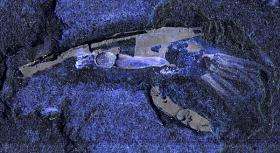
(PhysOrg.com) -- About 150 million years ago, an evolutionarily hybrid creature, a dinosaur on its way to becoming a bird, died in what is now Germany, and become fossilized in limestone.
About 150 years ago, the fossil of this "dinobird" was discovered and celebrated as proof of Charles Darwin's new theory of evolution.
Now fast word to a few weeks ago: The famous fossil, the Thermopolis specimen of Archaeopteryx lithographica, made its way by truck from the Wyoming Dinosaur Center to the Stanford Synchrotron Radiation Lightsource in California, where it was meticulously scanned by one of the world's most powerful X-ray machines, a building-sized device created for physics research.
By looking for traces of specific elements left in the slab of limestone as the bird decomposed, the researchers hope to uncover heretofore-unseen details of the soft tissue that once surrounded the well-preserved bones.
The X-rays, generated by SSRL's high-speed electrons as they race around a 260-foot-diameter ring, cause the elements to glow, revealing the ghost of soft tissue or feathers.
"If you want to find a single fossil which is a missing link in the evolution of dinosaurs into birds, this is it," said University of Manchester paleontologist Phil Manning, a member of the research team. "It's a bird with sharp teeth, claws and a long bony tail. If you were to freeze-frame evolution, you would end up with Archaeopteryx."
"What you normally can't see are the chemical elements from the original organism that might still be present in the fossil," said SSRL scientist Uwe Bergmann. "Using X-ray fluorescence imaging, we can bring these elements to light, getting a better look at the fossil and learning more about the original animal."
"These X-rays work a thousand time better than what you could do with a commercial X-ray machine. Only a synchrotron can do this," Bergmann said. SSRL is part of SLAC National Accelerator Laboratory, which is operated by Stanford University for the Department of Energy.
In addition to offering a new view of a long-extinct animal, this work may also reveal more about fossilization itself. By understanding how fossilization occurs and what exactly is preserved in the process, researchers will be able to deduce much more about ancient organisms and evolution.
The Archaeopteryx fossil holds a unique place in history. It was brought to London soon after Darwin published his stunning On the Origin of Species in 1859. With perfect timing, the old bones played a major roll in the controversy Darwin had stirred up.
"This fossil was the savior of Darwin," Manning said. "As soon as it arrived in London, all of Darwin's supporters realized that this was an intermediate animal, an evolutionary freak that they needed to study. It was half way between dinosaur and bird. This is the single most important fossil in paleontology for that simple reason.
" It was used to beat the living daylights out of the nonsense which had been put forward as to the reason for why animals were present on this planet. Here, Darwin's theory of descendent with modification was hammered home with this one example of transitionary form, of an animal between dinosaur and bird."
The fossil research is one example of how the SSRL is shining new light on fields as diverse as paleontology, medicine, and the history of mathematics. The SSRL's hair-thin X-ray beam has been used, for example, to make visible the hidden writing in a medieval copy of a mathematical treatise from the Greek mathematician Archimedes. Tuned to specific energies, the X-rays produced images of phosphorus and calcium from the ink used on the papyrus document, which had been covered with paint.
Earlier this year, at the request of Stanford library officials and an academic researcher, the laser-like X-ray beam was used to scan a score by the Italian composer Luigi Cherubini (1760 - 1842). Portions of the work had been covered over with carbon-black ink, but after the scan, "The researcher was able to look right through the ink and read the score," said Mary Miller, a Stanford preservation librarian. "I think he was thrilled."
"This is the very infancy of this new scientific method," said paleontologist Peter Larson of the Black Hills Institute in South Dakota. "We don't even know enough about this to know the right questions to ask yet. All of a sudden, we can look at fossils in a very different and new way."
Source: Stanford University


