Scientists prove graphene's edge structure affects electronic properties
February 15, 2009 Scientists prove graphene's edge structure affects electronic properties

Enlarge

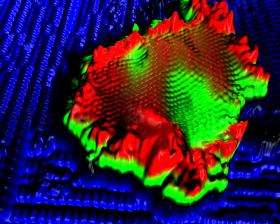
Atomic resolution scanning tunneling microscope image of a nanometer scale piece of graphene on silicon. Photo courtesy Joseph Lyding

(PhysOrg.com) -- Graphene, a single-atom-thick sheet of carbon, holds remarkable promise for future nanoelectronics applications. Whether graphene actually cuts it in industry, however, depends upon how graphene is cut, say researchers at the University of Illinois.

Graphene consists of a hexagonal lattice of carbon atoms. While scientists have predicted that the orientation of atoms along the edges of the lattice would affect the material's electronic properties, the prediction had not been proven experimentally.

Now, researchers at the U. of I. say they have proof.

"Our experimental results show, without a doubt, that the crystallographic orientation of the graphene edges significantly influences the electronic properties," said Joseph Lyding, a professor electrical and computer engineering. "To utilize nanometer-size pieces of graphene in future nanoelectronics, atomically precise control of the geometry of these structures will be required."

Lyding and graduate student Kyle Ritter (now at Micron Technology Inc. in Boise, Idaho) report their findings in a paper accepted for publication in Nature Materials. The paper is to be posted on the journal's Web site on Sunday (Feb. 15).

To carry out their work, the researchers developed a method for cutting and depositing nanometer-size bits of graphene on atomically clean semiconductor surfaces like silicon.

Then they used a scanning tunneling microscope to probe the electronic structure of the graphene with atomic-scale resolution.

"From this emerged a clear picture that edges with so-called zigzag orientation exhibited a strong edge state, whereas edges with armchair orientation did not," said Lyding, who also is affiliated with the university's Beckman Institute and the Micro and Nanotechnology Laboratory.

"We found that pieces of graphene smaller than about 10 nanometers with predominately zigzag edges exhibited metallic behavior rather than the semiconducting behavior expected from size alone," Lyding said. "This has major implications in that semiconducting behavior is mandatory for transistor fabrication."

Unlike carbon nanotubes, graphene is a flat sheet, and therefore compatible with conventional fabrication processes used by today's chipmakers. But, based on the researchers' experimental results, controlled engineering of the graphene edge structure will be required for obtaining uniform performance among graphene-based nanoelectronic devices.

"Even a tiny section of zigzag orientation on a 5-nanometer piece of graphene will change the material from a semiconductor into a metal," Lyding said. "And a transistor based on that, will not work. Period."

Provided by University of Illinois at Urbana-Champaign


print this article email this article download pdf blog this article bookmark this article     Stumble it Digg this share on Facebook retweet share on Reddit add to delicious
Rate this story - 4.3 /5 (6 votes)

Rank Filter

Move the slider to adjust rank threshold, so that you can hide some of the comments.


Display comments: newest first

  • Ant - Feb 15, 2009
    • Rank: not rated yet
    the last section has an interesting comment quote "Even a tiny section of zigzag orientation on a 5-nanometer piece of graphene will change the material from a semiconductor into a metal" is this what makes a metal a metal the edge structure of their molicules?
  • poi - Feb 15, 2009
    • Rank: 5 / 5 (2)
    the last section has an interesting comment quote "Even a tiny section of zigzag orientation on a 5-nanometer piece of graphene will change the material from a semiconductor into a metal" is this what makes a metal a metal the edge structure of their molicules?

    look at your periodic table. C is non-metal.
    In the article, what is referred to is only so for graphene in the nano scale. Carbon under different molecular structures takes on different forms: graphite or diamond (organic or inorganic). Both of course are not metals, but when in 2D, i.e. graphene, may take either a semiconductor or metallic characteristic depending on orientation.
  • ZeroDelta - Feb 16, 2009
    • Rank: not rated yet
    It seems that, as far as the electric field from atomic orbitals is concerned, the whole is more than the sum of it's parts.

February 15, 2009 all stories

Comments: 3

4.3 /5 (6 votes)
  • Stumble this up

  • Digg this

  • share this

  • hide
  • Related Stories


  • hide
  • Relevant PhysicsForums posts

  • tonometer experiment
    created 3 hours ago
  • Radiation heat transfer between air or wall
    created 3 hours ago
  • Hi ,new here and have a question! :)
    created 4 hours ago
  • Hydrostatic pressure in a submerged pipe
    created 6 hours ago
  • More from Physics Forums - General Physics

Other News

Fast, easy, and highly sensitive arsenic detection with gold nanoparticles

Nanotechnology / Nanomaterials

created 3 hours ago | popularity not rated yet | comments 0

(PhysOrg.com) -- Mention of arsenic poisoning usually brings to mind underhanded murder. However, the danger of arsenic poisoning from contaminated drinking water is far greater. Low concentrations of arsenic are found in ...


Nanotech in Space: Experiment To Weather the Trials of Orbit

Nanotech in Space: Experiment To Weather the Trials of Orbit

Nanotechnology / Nanomaterials

created 15 hours ago | popularity 4 / 5 (2) | comments 0

Novel nanomaterials developed at Rensselaer were sent into orbit on Nov. 16 aboard Space Shuttle Atlantis.


Water droplets direct self-assembly process in thin-film materials

Nanotechnology / Nanomaterials

created Nov 23, 2009 | popularity 5 / 5 (4) | comments 2

You can think of it as origami - very high-tech origami. Researchers at the University of Illinois have developed a technique for fabricating three-dimensional, single-crystalline silicon structures from thin films by coupling ...


Nanotube defects equal better energy and storage systems

Nanotube defects equal better energy and storage systems

Nanotechnology / Nanomaterials

created Nov 19, 2009 | popularity 4.4 / 5 (10) | comments 2

(PhysOrg.com) -- Most people would like to be able to charge their cell phones and other personal electronics quickly and not too often. A recent discovery made by UC San Diego engineers could lead to carbon ...


Peptides control crystal growth with 'switches, throttles and brakes'

Peptides control crystal growth with 'switches, throttles and brakes'

Nanotechnology / Bio & Medicine

created Nov 23, 2009 | popularity 5 / 5 (3) | comments 0

(PhysOrg.com) -- By producing some of the highest resolution images of peptides attaching to mineral surfaces, scientists have a deeper understanding how biomolecules manipulate the growth crystals. This research ...