Cosmologists aim to observe first moments of universe
February 16, 2009 Pole Position

Enlarge

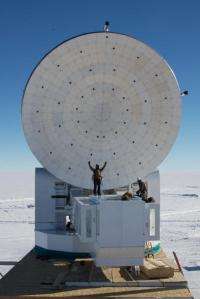
The South Pole Telescope takes advantage of the clear, dry skies at the National Science Foundation's South Pole Station to study the cosmic background radiation, the afterglow of the big bang. The SPT measures eight meters (26.4 feet) in diameter. Photo by Jeff McMahon

During the next decade, a delicate measurement of primordial light could reveal convincing evidence for the popular cosmic inflation theory, which proposes that a random, microscopic density fluctuation in the fabric of space and time gave birth to the universe in a hot big bang approximately 13.7 billion years ago.

Among the cosmologists searching for these weak signals will be John Carlstrom, the S. Chandrasekhar Distinguished Service Professor in Astronomy & Astrophysics at the University of Chicago. Carlstrom operates the South Pole Telescope (SPT) with a team of scientists from nine institutions in their search for evidence about the origins and evolution of the universe.

Now on their agenda is putting cosmic inflation theory to its most stringent observational test so far. The test: detecting extremely weak gravity waves, which Einstein's theory of general relativity predicts that cosmic inflation should produce.

"If you detect gravity waves, it tells you a whole lot about inflation for our universe," Carlstrom said. It also would rule out various competing ideas for the origin of the universe. "There are fewer than there used to be, but they don't predict that you have such an extreme, hot big bang, this quantum fluctuation, to start with," he said. Nor would they produce gravity waves at detectable levels.

Carlstrom and his colleague Scott Dodelson will be on panel of cosmologists discussing these and related issues on Monday, Feb. 16 at the American Association for the Advancement of Science annual meeting in Chicago.

Fellow panelists will include Alan Guth of the Massachusetts Institute of Technology. In 1979, Guth proposed the cosmic inflation theory, which predicts the existence of an infinite number of universes. Unfortunately, cosmologists have no way of testing this prediction.

"Since these are separate universes, by definition that means we can never have any contact with them. Nothing that happens there has any impact on us," said Dodelson, a scientist at Fermi National Accelerator Laboratory and a Professor in Astronomy & Astrophysics at the University of Chicago.

But there is a way to probe the validity of cosmic inflation. The phenomenon would have produced two classes of perturbations. The first, fluctuations in the density of subatomic particles happen continuously throughout the universe, and scientists have already observed them.

"Usually they're just taking place on the atomic scale. We never even notice them," Dodelson said. But inflation would instantaneously stretch these perturbations into cosmic proportions. "That picture actually works. We can calculate what those perturbations should look like, and it turns out they are exactly right to produce the galaxies we see in the universe."

The second class of perturbations would be gravity waves—Einsteinian distortions in space and time. Gravity waves also would get promoted to cosmic proportions, perhaps even strong enough for cosmologists to detect them with sensitive telescopes tuned to the proper frequency of electromagnetic radiation.

"We should be able to see them if John's instruments are sensitive enough," Dodelson said.

Carlstrom and his associates are building a special instrument, a polarimeter, as an attachment to the SPT, to search for gravity waves. The SPT operates at submillimeter wavelengths, between microwaves and the infrared on the electromagnetic spectrum.

Cosmologists also use the SPT in their quest to solve the mystery of dark energy. A repulsive force, dark energy pushes the universe apart and overwhelms gravity, the attractive force exerted by all matter. Dark energy is invisible, but astronomers are able to see its influence on clusters of galaxies that formed within the last few billion years.

The SPT detects the cosmic microwave background (CMB) radiation, the afterglow of the big bang. Cosmologists have mined a fortune of data from the CMB, which represent the forceful drums and horns of the cosmic symphony. But now the scientific community has its ears cocked for the tones of a subtler instrument—gravitational waves—that underlay the CMB.

Source: University of Chicago


print this article email this article download pdf blog this article bookmark this article     Stumble it Digg this share on Facebook retweet share on Reddit add to delicious
Rate this story - 4.3 /5 (6 votes)

Rank Filter

Move the slider to adjust rank threshold, so that you can hide some of the comments.


Display comments: newest first

  • CuriousinSylvania - Feb 16, 2009
    • Rank: not rated yet
    Given universe approx 15 B years old, Hubble has shown us galaxies approx 13 B light years away. Those galaxies appear to be evenly spread around the heavens.
    Why aren't they grouped in a much smaller area where they must have been 13 B light years ago?
  • jonnyboy - Feb 17, 2009
    • Rank: not rated yet
    You are making the "possible" mistake of thinking that what we can see is what there is, whereas most researchers believe that what we can see is a small part of the whole.

    Picture us as the center of the core of a golf ball(what we see) while the golf ball itself is somewhere inside the solar system(what there possibly is).
  • jonnyboy - Feb 17, 2009
    • Rank: not rated yet
    What really intrigues me is whether or not these "gravity waves" could explain the appearance that the universal expansion is accelerating (think sine wave) as opposed to temporarily speeding up only to slow down again sometime in the near future as we pass the bottoming point of the wave and lift upwards towards the crest of the next wave.
  • yep - Feb 22, 2009
    • Rank: 1 / 5 (2)
    " the big bang theory is false-not because I our others claim it to be false-but because it has been scientifically falsified"
    http://www.electr.../arp.htm

February 16, 2009 all stories

Comments: 4

4.3 /5 (6 votes)
  • Stumble this up

  • Digg this

  • share this

  • hide
  • Related Stories

  • QUIET team to deploy new gravity-wave probe in June
    created May 15, 2009 | popularity not rated yet | comments 0
  • Gravity waves could hold key to supersymmetry
    created Nov 05, 2008 | popularity not rated yet | comments 0
  • Joint Dark Energy Mission a Top Priority for NASA, Says NRC
    created Sep 06, 2007 | popularity not rated yet | comments 0
  • Galaxy survey reveals missing cosmic link
    created Jan 11, 2005 | popularity not rated yet | comments 0
  • Galaxy cluster smashes distance record
    created Oct 22, 2009 | popularity not rated yet | comments 0


  • hide
  • Relevant PhysicsForums posts

  • Question about 2-body gravity
    created 15 hours ago
  • life on Mars
    created 18 hours ago
  • Semi-major axis from cartesian co-ordinates
    created Nov 23, 2009
  • Primary Mirror grinding
    created Nov 23, 2009
  • dark energy can escape black holes.
    created Nov 23, 2009
  • Are there green, purple and pink stars?
    created Nov 22, 2009
  • More from Physics Forums - General Astronomy

Other News

Cassini Captures Ghostly Dance of Saturn's Northern Lights

Cassini Captures Ghostly Dance of Saturn's Northern Lights (w/ Video)

Space & Earth / Space Exploration

created 8 hours ago | popularity 5 / 5 (3) | comments 0

(PhysOrg.com) -- In the first video showing the auroras above the northern latitudes of Saturn, Cassini has spotted the tallest known "northern lights" in the solar system, flickering in shape and brightness ...


First black holes may have incubated in giant, starlike cocoons, says CU-Boulder study

First black holes may have incubated in giant, starlike cocoons

Space & Earth / Astronomy

created 11 hours ago | popularity 4.4 / 5 (10) | comments 7

(PhysOrg.com) -- The first large black holes in the universe likely formed and grew deep inside gigantic, starlike cocoons that smothered their powerful x-ray radiation and prevented surrounding gases from ...


Infrared Image of Circumstellar Disk Illuminates Massive Star Formation Process

Infrared Image of Circumstellar Disk Illuminates Massive Star Formation Process

Space & Earth / Astronomy

created 6 hours ago | popularity 4.5 / 5 (2) | comments 0

(PhysOrg.com) -- A team of astronomers from Ibaraki University, Japan Aerospace Exploration Agency, Kanagawa University, University of Tokyo, Academica Sinica, and National Astronomical Observatory of Japan ...


ET: Check your voicemail

ET: Check your voicemail

Space & Earth / Space Exploration

created 8 hours ago | popularity 3.4 / 5 (5) | comments 5

(PhysOrg.com) -- Alien beings on faraway planets may not have noticed, but it’s been 35 years since human beings made the first deliberate effort to send them a message.


U.S. losing its lead in space, experts warn Congress

Space & Earth / Space Exploration

created 5 hours ago | popularity 2.5 / 5 (2) | comments 1

America's once clear dominance in space is eroding as other nations, including China, Iran and North Korea, step up their activities, a panel of experts told the House subcommittee on Space and Aeronautics Thursday.