Scientists investigate role of stem cells in adult brain cell production
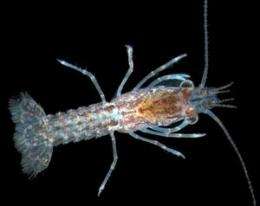
February 16, 2009 Procambarus clarkii

Enlarge

Procambarus clarkii

(PhysOrg.com) -- Georgia State researchers in the university’s Neuroscience Institute and the department of biology are investigating how stem cells create new brain cells in adulthood.

The scientists are looking at how new neurons — the basic cellular elements of the nervous system — are made during a process called neurogenesis in a species of crayfish called Procambarus clarkii.

“To drive the permanent production of cells in any given tissue, you need stem cells to support it,” said Manfred Schmidt, a Georgia State research scientist who led the project that was performed in the labs of professors Don Edwards and Charles Derby, mainly by Cha-Kyong Song, a graduate student and Laurel M. Johnstone, a research technician.

Decades ago, scientists believed that addition of new neurons stopped at adulthood, but they now recognize that neurogenesis continues, for both crustaceans and mammals alike. It continues because neuronal stem cells, which create different types of brain cells, continue to exist into adulthood, though not in as great of numbers as in embryos.

Neuronal stem cells take different forms depending on the type of animal. In crustaceans, relatively large cells called neuroblasts are responsible for neurogenesis, located in a part of the brain responsible for processing odor information, called the olfactory midbrain.

In other crustaceans, the neuroblasts are located near to where the new neurons are generally located. But Schmidt and his colleagues found that the neuroblasts in crayfish brains are located farther from where the new neurons are needed — forcing them to travel down pathways to get to their destinations.

“In essence, these are similar organisms, except the stem cells are further away from the action,” Schmidt said. “Now you have to ship out the cells that the stem cells are producing, through a long path to finally reach their target.”

Schmidt said this might be due to the way crayfish have evolved to live in freshwater environments, rather than in saltwater.

“That is a big evolutionary step, and in making this step, they might have lost some of their olfactory capacity,” he explained.
In order for stem cells — legacies of embryonic development — to live in adult body tissues, the cells need particular areas that are suitable environments for them to live, or niches. In crayfish, the niches surrounding neuroblasts are unique structures that can be distinctly identified as being clumps of cells associated with the stem cells.

“It seems that the mechanism of making a neuron in an adult animal is an extension of how this is done in the embryo,” Schmidt said, adding that he and other researchers hope to better understand these niches and how they support stem cells throughout adult life.

Provided by Georgia State University


print this article email this article download pdf blog this article bookmark this article     Stumble it Digg this share on Facebook retweet share on Reddit add to delicious
Rate this story - 5 /5 (3 votes)


February 16, 2009 all stories

Comments: 0

5 /5 (3 votes)
  • Stumble this up

  • Digg this

  • share this

  • hide
  • Related Stories

  • Physician-scientist proves stem cells heal lungs of newborn animals
    created 18 hours ago | popularity not rated yet | comments 0
  • When is a stem cell really a stem cell?
    created Nov 24, 2009 | popularity not rated yet | comments 0
  • Polyphenols and polyunsaturated fatty acids boost the birth of new neurons
    created Nov 24, 2009 | popularity not rated yet | comments 0
  • Tissue tension regulates tumor progression
    created Nov 23, 2009 | popularity not rated yet | comments 0
  • New discovery about the formation of new brain cells
    created Nov 23, 2009 | popularity not rated yet | comments 0


Other News

Hammerhead shark

Wide heads give hammerheads exceptional stereo view

Biology / Plants & Animals

created 49 minutes ago | popularity 4 / 5 (3) | comments 1

Hammerhead sharks are some of the Ocean's most distinctive residents. 'Everyone wants to understand why they have this strange head shape,' says Michelle McComb from Florida Atlantic University. One possible ...


Tough yet stiff deer antler is materials scientist's dream

Biology / Plants & Animals

created 52 minutes ago | popularity not rated yet | comments 0

Prized for their impressive antlers, red deer have been caught in the hunters' sights for generations. But a deer's antlers are much more than decorative. They are lethal weapons that stags crash together when duelling. John ...


Ecologists sound out new solution for monitoring cryptic species

Biology / Ecology

created 1hour ago | popularity not rated yet | comments 0

Ecologists have at last worked out a way of using recordings of birdsong to accurately measure the size of bird populations. This is the first time sound recordings from a microphone array have been translated into accurate ...


The six elephants in Sierra Leone were shot and "crudely butchered"

S.Leone elephants 'wiped out' by poachers: official

Biology / Ecology

created 19 hours ago | popularity 5 / 5 (5) | comments 6

Poachers "wiped out" the entire elephant herd in Sierra Leone's only wildlife park, wildlife managers said Thursday after police said they had arrested a gang of 10 poachers.


First-ever blueprint of a minimal cell is more complex than expected

First-ever blueprint of a minimal cell is more complex than expected

Biology / Cell & Microbiology

created 17 hours ago | popularity 5 / 5 (14) | comments 3

What are the bare essentials of life, the indispensable ingredients required to produce a cell that can survive on its own? Can we describe the molecular anatomy of a cell, and understand how an entire organism ...