Novel diamond-like films on board NASA satellite
February 16, 2009 Novel diamond-like films on board NASA satellite

Thirty Sandia films are in the low-energy sensor (IBEX-Lo) on board NASA’s Interstellar Boundary Explorer (IBEX), which lifted off in October on a mission to study the farthest fringes of the solar system. (Photo by Randy Montoya)

(PhysOrg.com) -- Diamond-like carbon films created at Sandia National Laboratories are helping probe the far boundaries of the solar system as part of a NASA mission to study how the sun's solar wind interacts with the interstellar medium - the matter that exists between the stars within a galaxy.

The films are in the low-energy sensor (IBEX-Lo) on board NASA’s Interstellar Boundary Explorer (IBEX), which lifted off in October on a mission to study the farthest fringes of the solar system. IBEX’s two bucket-sized sensors, covering high and low energy ranges, are designed to capture particles bouncing back toward Earth from the distant boundary between the hot wind from the sun and the cold wall of interstellar space.

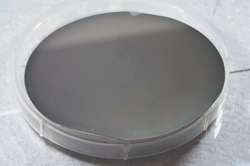
The active conversion surface of the low-energy neutral atom detector is coated with Sandia’s diamond-like films created by Tom Friedmann.

“The primary purpose of the diamond-like carbon films is to provide a surface that will ‘efficiently’ ionize energetic neutral atoms,” Friedmann says, “so they can then be detected. Smooth surfaces are required so that the scattered particles can be efficiently collected. If the surface is rough, scattered particles are lost, decreasing efficiency. The diamond-like carbon films have an average surface roughness that is about one angstrom. This is less than the diameter of a carbon atom.”

To create the 30 films aboard the system, Friedmann used pulsed-laser deposition to deposit the films on the conversion surfaces. Carbon was used because it has relatively high conversion efficiency, low sputter yield, and is very smooth, he says. Single crystal diamond has the highest efficiency but is too expensive to grow over large areas and difficult to polish to the extremely low surface roughness needed. The diamond-like carbon films naturally grow smooth and require no polishing.

Friedmann says the project took about one and a half months to complete and he says he was pleased with the outcome. Now the IBEX team is awaiting the results from the mission.

Eric Hertzberg, from Lockheed Martin Advanced Technology Center, approached Friedmann to create the films. Hertzberg is the lead engineer for the IBEX-Lo Sensor. Bob Nemanich, Arizona State University, also played a key role in passivating the films. Friedmann says Sandia uses similar films in studies of electron field emission and in microelectromechanical Systems (MEMS) devices.

Voyager 1, launched in 1977, made the first direct measurements of this boundary (the heliopause) as it was the first spacecraft to leave the inner solar system and head toward interstellar space. Voyager 2, launched the same year, will also relay observations of the boundary, but these measurements are of only one place and time.

IBEX is designed to provide a three-dimensional map of the boundary. IBEX is the latest in NASA’s series of low-cost, rapidly developed Small Explorers spacecraft. The IBEX mission was developed by Southwest Research Institute, led by Principal Investigator David McComas, with a national and international team of partners. NASA’s Goddard Space Flight Center manages the Explorers Program for NASA’s Science Mission Directorate.

Provided by Sandia National Laboratories


print this article email this article download pdf blog this article bookmark this article     Stumble it Digg this share on Facebook retweet share on Reddit add to delicious
Rate this story - 3.3 /5 (4 votes)


February 16, 2009 all stories

Comments: 0

3.3 /5 (4 votes)
  • Stumble this up

  • Digg this

  • share this

  • hide
  • Related Stories

  • ZnO nanowires may lead to better chemical sensors, high-speed electronics
    created Sep 12, 2006 | popularity not rated yet | comments 0
  • Cheaper materials could be key to low-cost solar cells
    created Feb 18, 2009 | popularity not rated yet | comments 0
  • Association marks 20 years of greening Hollywood
    created Oct 26, 2009 | popularity not rated yet | comments 0
  • It Takes a Solar Village
    created Oct 19, 2009 | popularity not rated yet | comments 0
  • New nanostructure technology provides advances in eyeglass, solar energy performance
    created Sep 16, 2009 | popularity not rated yet | comments 0


  • hide
  • Relevant PhysicsForums posts

Other News

Stars Fueled by Dark Matter Could Hold Secrets to the Universe

Stars Fueled by Dark Matter Could Hold Secrets to the Universe

Physics / General Physics

created Nov 03, 2009 | popularity 4.5 / 5 (51) | comments 41

(PhysOrg.com) -- The first stars in the universe may have been very different from the stars we see today, yet they may hold clues to understanding some of the mysterious features of the universe. These "dark ...


Second Law of Thermodynamics May Explain Economic Evolution

Second Law of Thermodynamics May Explain Economic Evolution

Physics / General Physics

created Nov 02, 2009 | popularity 4.3 / 5 (30) | comments 28

(PhysOrg.com) -- Terms such as the "invisible hand," laissez-faire policy, and free-market principles suggest that economic growth and decline in capitalist societies seem to be somehow self-regulated. Now, ...


High-performance plasmas may make reliable, efficient fusion power a reality

High-performance plasmas may make reliable, efficient fusion power a reality

Physics / Plasma Physics

created Nov 02, 2009 | popularity 4.7 / 5 (40) | comments 33

In the quest to produce nuclear fusion energy, researchers from the DIII-D National Fusion Facility have recently confirmed long-standing theoretical predictions that performance, efficiency and reliability ...


'Teapot effect' solved

Solving Teapot Effect

Physics / General Physics

created Nov 02, 2009 | popularity 4.9 / 5 (11) | comments 10

(PhysOrg.com) -- A team of scientists from France have worked out why teapots dribble at low flow rates, and how to stop them. The effect is called the "teapot effect", and solving it could finally put an ...


Laser accelerated protons to the highest energies so far

Researchers use trident laser to accelerate protons to record energies

Physics / General Physics

created Nov 02, 2009 | popularity 4.7 / 5 (6) | comments 10

An international team of physicists at Los Alamos National Laboratory has succeeded in using intense laser light to accelerate protons to energies never before achieved. Using this technique, scientists can ...