Image pinpoints all 5 million atoms in viral coat
February 16, 2009 Spherical Capsid

Enlarge

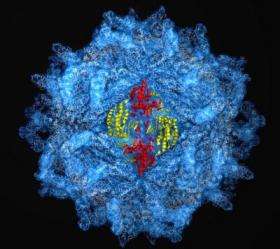
High-energy X-ray diffraction was used to pinpoint some 5 million atoms in the protective protein coat used by hundreds of viruses. Credit: J. Pan & Y.J. Tao/Rice University

(PhysOrg.com) -- If a picture is worth a thousand words, then Rice University's precise new image of a virus' protective coat is seriously undervalued. More than three years in the making, the image contains some 5 million atoms -- each in precisely the right place -- and it could help scientists find better ways to both fight viral infections and design new gene therapies.

The stunning image, which appears online this week in the Proceedings of the National Academy of Sciences, reveals the structure of a type of protein coat shared by hundreds of known viruses containing double-stranded RNA genomes. The image was painstakingly created from hundreds of high-energy X-ray diffraction images and paints the clearest picture yet of the viruses' genome-encasing shell called a "capsid."

"When these viruses invade cells, the capsids get taken inside and never completely break apart," said lead researcher Jane Tao, assistant professor of biochemistry and cell biology at Rice.

Capsids come into play because viruses can reproduce themselves only by invading a host cell and highjacking its biochemical machinery. But when they invade, viruses need to seal off their genetic payload to prevent it from being destroyed by the cell's protective mechanisms.

Though there are more than 5,000 known viruses, including whole families that are marked by wide variations in genetic payload and other characteristics, most of them use either a helical or a spherical capsid.

In their attempt to map precisely the spherical variety, Tao and lead author Junhua Pan, a postdoctoral fellow at Rice, first had to create a crystalline form of the capsid that could be X-rayed. They chose the oft-studied Penicillium stoloniferum virus F, or PsV-F, a virus that infects the fungus that makes penicillin. PsV-F uses the spherical capsid; although it does not infect humans, it is similar to a rotavirus and others that do.

"Spherical viruses like this have symmetry like a soccer ball or geodesic dome," Pan said. "The whole capsid contains exactly 120 copies of a single protein."

Previous studies had shown that spherical capsids contain dozens of copies of the capsid protein, or CP, in an interlocking arrangement. The new research identified the sphere's basic building block, a four-piece arrangement of CP molecules called a tetramer, which could also be building blocks for other viruses' protein coats. By deciphering both the arrangement and the basic building block, the research team hopes to learn more about the capsid-forming process.

"Because many viruses use this type of capsid, understanding how it forms could lead to new approaches for antiviral therapies," Tao said. "It could also aid researchers who are trying to create designer viruses and other tools that can deliver therapeutic genes into cells."

The research team used X-ray crystallography to decipher the structure of the capsid. Pan first spent several months creating hundreds of crystal samples of PsV-F. He then collected hundreds of high-intensity, high-energy X-ray diffraction images at the Cornell High Energy Synchotron Source, or CHESS, in Ithaca, N.Y. By analyzing the way the X-rays scattered when they struck the crystals, Pan and the team created a precise three-dimensional image of the spherical capsid.

Source: Rice University


print this article email this article download pdf blog this article bookmark this article     Stumble it Digg this share on Facebook retweet share on Reddit add to delicious
Rate this story - 4.9 /5 (15 votes)

Rank Filter

Move the slider to adjust rank threshold, so that you can hide some of the comments.


Display comments: newest first

  • AdseculaScientiae - Feb 16, 2009
    • Rank: not rated yet
    The detail is astonishing!

    To me this is a genuine form of art. And science of course.

    Great stuff.
  • RaMoNaD - Feb 16, 2009
    • Rank: not rated yet
    aaah, the inherent beauty of nature..........

February 16, 2009 all stories

Comments: 2

4.9 /5 (15 votes)
  • Stumble this up

  • Digg this

  • share this

  • hide
  • Related Stories

  • Jet-propelled Imaging for an Ultrafast Light Source
    created Aug 04, 2009 | popularity not rated yet | comments 0
  • Jet-propelled imaging for an ultrafast light source
    created Jul 29, 2009 | popularity not rated yet | comments 0
  • Scientists discover DNA knot keeps viral genes tightly corked inside shell
    created Jun 17, 2008 | popularity not rated yet | comments 0
  • Detecting Single Viruses, Nanoparticles in Real-Time
    created Dec 05, 2005 | popularity not rated yet | comments 0
  • Google apologizes for offensive first lady image
    created Nov 24, 2009 | popularity not rated yet | comments 0


Other News

Research sheds light on workings of anti-cancer drug

Chemistry / Analytical Chemistry

created 5 hours ago | popularity not rated yet | comments 0

(PhysOrg.com) -- The copper sequestering drug tetrathiomolybdate (TM) has been shown in studies to be effective in the treatment of Wilson disease, a disease caused by an overload of copper, and certain metastatic cancers. ...


New chemical reaction offers opportunities for drug development

Chemistry / Biochemistry

created 9 hours ago | popularity not rated yet | comments 0

Researchers led by Conway Fellow, Professor Pat Guiry have solved a chemistry problem that has stumped researchers worldwide for more than a decade. The results have earned the group the cover story of the leading scientific ...


Sandia CR5

Machine Converts CO2 into Gasoline, Diesel, and Jet Fuel

Chemistry / Biochemistry

created Nov 23, 2009 | popularity 4.6 / 5 (30) | comments 19

(PhysOrg.com) -- Researchers at Sandia National Laboratories have built a machine that uses the sun's energy to convert carbon dioxide waste from power plants into transportation fuels such as gasoline, diesel, ...


New hydrogen-storage method discovered

New hydrogen-storage method discovered

Chemistry / Materials Science

created Nov 22, 2009 | popularity 4.3 / 5 (42) | comments 15

Scientists at the Carnegie Institution have found for the first time that high pressure can be used to make a unique hydrogen-storage material. The discovery paves the way for an entirely new way to approach ...


New on-off 'switch' triggers and reverses paralysis in animals with a beam of light

New on-off 'switch' triggers and reverses paralysis in animals with a beam of light (w/ Video)

Chemistry / Biochemistry

created Nov 18, 2009 | popularity 4.8 / 5 (5) | comments 4

In an advance with overtones of Star Trek phasers and other sci-fi ray guns, scientists in Canada are reporting development of an internal on-off "switch" that paralyzes animals when exposed to a beam of ultraviolet ...