Apple peel appeal: Using software to measure variances in 'honeycrisp' apple peels
Apples have long been associated with good health, including lower risks of cancer and cardiovascular disease. Apples also contain anthocyanins, important antioxidants that give the peels their red coloring. Redness is one of the most important factors consumers consider when buying apples.
One variety of apple called 'Honeycrisp' has peel pigment that takes on one of two patterns—"striped" or "blushed." A single 'Honeycrisp' tree can produce both striped and blushed apples, a phenomenon unique to this variety. In terms of marketability, consumers in some regions prefer striped apples, while others prefer blushed, but overall redder is better.
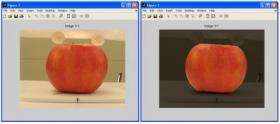
Adriana Telias, Emily Hoover, and Diego Rother of the University of Minnesota published a research study in the American Society for Horticultural Science journal HortScience comparing the coloring of 'Honeycrisp' apples. From 2005 the team studied the fruit of trees grown from buds on branches with exclusively striped or blushed fruit. The apples were separated as either striped or blushed, and color and stripe intensity were measured, and then the fruits were photographed. The researchers developed color-analyzing software to automatically separate the apples from the background in the photos and measure statistics such as mean color in large areas of the fruit peel.
It was found that blushed trees produced more blushed fruit than striped trees. Likewise, the markings on striped fruit were more intense on striped trees than blushed trees.
Position on the tree may also be related to the pattern, as it was observed that northeast-facing branches produced 13% blushed fruit compared to only 6% on southwest-facing branches. Southwest branches also produced more intensely striped fruit than northeast branches. And, within clusters of fruit, the apples were more likely to have similar coloring.
Each year, blushed fruit was found to be redder than striped fruit. "Given that blushed fruit are redder than striped ones, the goal should be to increase blushed fruit production when target markets prefer redder fruit," stated the researchers. They added; "This may prove difficult given that even the top blushed-producing trees never yielded more than 50% blushed fruit over all 3 years."
Because higher crop loads were associated with lower percentage of blushed fruit, the study suggests regulating the crop load to increase the number of blushed fruits, and that growing trees from buds of blushed fruit branches, should result in higher blushed fruit yields. This is based on indications that both genetic and environmental factors affect peel pigmentation.
The software developed to evaluate peel color in the study is available for community use.
More information: The complete study and abstract are available on the ASHS HortScience electronic journal web site: hortsci.ashspublications.org/c … t/abstract/43/5/1441 .
Source: American Society for Horticultural Science


