Cells with double vision: How one and the same nerve cell reacts to two visual areas
(PhysOrg.com) -- In comparison to many other living creatures, flies tend to be small and their brains, despite their complexity, are quite manageable. Scientists at the Max Planck Institute of Neurobiology in Martinsried have now ascertained that these insects can make up for their low number of nerve cells by means of sophisticated network interactions.
The neurobiologists examined nerve cells that receive motion information in their input region from only a narrow area of the fly's field of vision. Yet, thanks to their linking with neighbouring cells, the cells respond in their output regions to movements from a much wider field of vision. This results in a robust processing of information. (Nature Neuroscience, February 8, 2009.)
The complexity of the human brain is remarkable: It contains billions of nerve cells, each of which is connected with its neighbours via many thousands of contacts. The result is a multifaceted network which stores and processes many types of information. In comparison, the brain of a fly seems fairly simple with its 250 000 nerve cells. For example, a small network of only 60 nerve cells in each cerebral hemisphere suffices the blowfly to integrate visual motion information. The resulting information is then used in the control and correction of the fly's flight manoeuvres. However, flies clearly demonstrate just how efficient these 60 cells actually are when they dodge obstacles while flying at high speed and land upside-down on the ceiling. No wonder neurobiologists find the brain of the fly so fascinating!
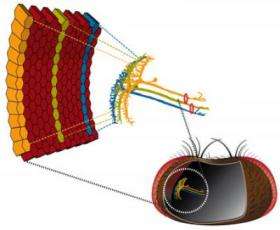
Thanks to the comparatively small number of nerve cells in the fly's visual flight control centre, the connections and functions of the cells involved can be examined in greater detail. It soon became apparent that the 60 nerve cells are further sub-divided into several individual cell groups, each of which is responsible for the processing of certain patterns of movement. A group of ten cells, known as the VS-cells, respond to rotational movements of the fly, for example. Each of these ten cells receives its visual information from only a narrow vertical strip of the fly's eye - the cell's "receptive field". Since the VS-cells are arranged parallel to each other, the fly's field of vision is completely covered by the vertical strips of the ten cells on each side of the fly's brain (the figure shows three of the ten VS-cells).
"However, the most fascinating aspect of these VS-cells is that the closer we examined the network, the more complex it appeared", group leader Alexander Borst reports. He and his group at the Max Planck Institute of Neurobiology are devoted to investigating the motion vision of flies. Only recently, Borst's co-worker Jürgen Haag showed that VS-cells are connected on two different levels. It was well known that in their input regions, the cells collect incoming signals from nerve cells which represent local motion information coming from the eye. Yet, it came as a surprise that the cells had a second source of information. The scientists found electrical connections between neighbouring VS-cells in the cells' output regions. Computer simulations of this network led to the following assumption: Information received from a VS-cell's "own" receptive field is first compared with the information received by its neighbouring cells. Only then is the information relayed to cells further downstream in the network for the purpose of flight control.
The immediate prediction from this work was somewhat of a surprise. Could a single cell have two different receptive fields, depending on which part of the cell is taken into consideration? In Martinsried, the neurobiologist Yishai Elyada now looked at this question. He examined the reactions of the VS-cells to moving stimuli using a large variety of techniques. The breakthrough came when he used a special microscopy technique which visualizes changes in the concentrations of calcium within the cells. The calcium concentration in many kinds of nerve cells, including VS cells, changes when the cell becomes active. Changes in the calcium level therefore reveal when and where a nerve cell reacts to a stimulus.
In order to determine the receptive field of each VS-cell, Elyada presented moving stripe patterns to the flies while simultaneously monitoring the changes in the calcium levels within the cells. The results correlated well with the scientist's predictions. In their input region, VS-cells do indeeed respond to movement in only a narrow area of the visual field. In contrast, in the cells' output region, each cell also responds to movement in the receptive fields of its neighbouring cells. The prior assumption that the receptive field of a nerve cell is a single unit must therefore be re-evaluated. In future, such statements need to distinguish between the input and the output regions of the cell - at least when referring to VS-cells. Such spatial separation within a single cell took the scientists by surprise. However, as far as the fly is concerned, it is a very useful attribute. Model simulations demonstrated that a network that is comprised of such "double input cells" can process visual motion information much more efficiently.
"With these results, the VS-cell network is now one of the best understood circuits in the fly's nervous system", Alexander Borst recapitulates the group's work of the last few years. The scientists' next goal is to ascertain whether a malfunction of the VS network has any direct bearing on the fly's flight skills. "For when it comes down to influencing a certain pattern of behaviour, cells and networks that were not taken into account up to now may gain importance", Borst speculates. Little by little, the scientists thus approach ever more complex networks until, one day, we can hopefully also comprehend human visual processing - right down to the single nerve cell.
More information: Yishai M. Elyada, Jürgen Haag, Alexander Borst, Different receptive fields in axons and dendrites underlie robust coding in motion-sensitive neurons, Nature Neuroscience, February 8th, 2009
Provided by Max-Planck-Gesellschaft


