Historical photographs expose decline in Florida's reef fish, study finds
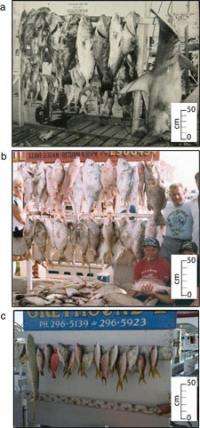
A unique study by a scientist at Scripps Institution of Oceanography at UC San Diego has provided fresh evidence of fishing's impact on marine ecosystems. Scripps Oceanography graduate student researcher Loren McClenachan accessed archival photographs spanning more than five decades to analyze and calculate a drastic decline of so-called "trophy fish" caught around coral reefs surrounding Key West, Florida.
In a paper published online in January and printed in an upcoming issue of the journal Conservation Biology, McClenachan describes a stark 88 percent decline in the estimated weight of large predatory fish imaged in black-and-white 1950s sport fishing photos compared to the relatively diminutive catches photographed in modern pictures. In a companion paper being published in the Endangered Species Research journal, McClenachan employs similar methods to document the decline of the globally endangered goliath grouper fish.
"These results provide evidence of major changes over the last half century and a window into an earlier, less disturbed fish community…" McClenachan said in the Conservation Biology paper.
McClenachan's studies are part of an emerging field called historical marine ecology, in which scientists study photographs, archives, news accounts and other records to help understand changes in the ocean ecosystem over time and establish baselines for future ecosystem restoration.
McClenachan believes that historical ecology can not only help describe the structure of ecosystems that existed in the recent past, but can be used to establish goals for restoration of large predators, both on land and in the water.
While conducting research for her doctoral thesis on coral reef ecosystems of the Florida Keys, McClenachan came across what she describes as a gold mine of photographic data at the Monroe County Library in Key West. Hundreds of archived photographs, snapped by professional photographer Charles Anderson, depict sport fishing passengers posing next to a hanging board used to determine the largest "trophy fish" catches of the day. All of the photographs document sport fishing trips targeting coral reef fishes around the Florida Keys. McClenachan supplemented the study with her own photographs and observations on sport fishing trips in 2007.
In all, she measured and analyzed some 1,275 fish from photographs.
McClenachan calculated the mean size of the prize catches—including sharks, large groupers and other hefty fish in early photographs—and their decline from nearly two meters (6.5 feet) in length in the 1950s to contemporary catches of small fish such as snappers measuring a mere 34 centimeters (approximately one foot) on average. The fishes' average estimated weight dropped from nearly 19.9 kilograms (43.8 pounds) to 2.3 kilograms (5 pounds) from 1956 to 2007. The average length of sharks declined by more than 50 percent in 50 years, the photographs revealed.
"While the photographs in this study do not provide a direct measurement… they clearly demonstrate that large fish were more abundant in the past," said McClenachan.
Yet while McClenachan's study depicts significant changes over the last 50 years, she indicates in the paper that evidence exists showing that even the Florida Keys ecosystems of the 1950s were not pristine. Commercial fishing in the 1930s and 40s reduced populations of sharks, while numbers of large groupers declined through commercial fishing since at least the 1880s.
"The ongoing debate about the status of fisheries in the Florida Keys is a classic problem of the Shifting Baselines syndrome," says Scripps Professor Jeremy Jackson. "Managers mistakenly assume that what they saw in the 1980s was pristine, but most prized fish species had been reduced to a small fraction of their pristine abundance long before. Historical ecology provides the critical missing data to evaluate what we lost before modern scientific surveys began."
"I think the photos in this very original paper will make lots of people change their mind," said Daniel Pauly, a professor at the University of British Columbia Fisheries Centre and Zoology Department.
In separate studies, Scripps researchers recently uncovered fishing damages to coral reefs in the middle of the Pacific Ocean. Scientists studying at the Central Pacific Ocean's Line Islands archipelago have shown that coral reef ecosystems experience drastic changes, including evidence of bacteria-infested corals, when large fish are extracted from an island reef through overfishing, as compared with healthy coral ecosystems off islands that are not fished.
As an interesting side note, McClenachan mentions in her paper that the price of sport fishing trips has not declined in conjunction with the size and weight of the caught fish. Although trophy fish dropped more than 88 percent in average fish weight, the trip costs remained steady, ranging from $40 to $48 per person (adjusted for inflation), per day between 1956 and 2007.
"… The continued viability of sport fishing based on increasingly small individuals in a degraded reef environment indicates a decoupling of the health of the marine environment from the value of the marine-based tourism industry," McClenachan noted in the paper.
Source: University of California - San Diego


