Robots that monitor emotions of ASD children
(PhysOrg.com) -- The day that robot playmates help children with autism learn the social skills that they naturally lack has come a step closer with the development of a system that allows a robot to monitor a child's emotional state.
"There is a lot of research going on around the world today trying to use robots to treat children with autism spectrum disorders, or ASD. It has shown that the children are attracted to robots, raising the promise that appropriately designed robots could play an important role in their treatment,” says Nilanjan Sarkar, associate professor of mechanical engineering at Vanderbilt University. "However, the efforts so far have been quite limited because they haven't had a way to monitor the emotional state of the children, which would allow the robot to respond automatically to their reactions.”
If these limitations can be overcome, the use of robots to treat children with ASD could have a significant social and financial impact. One baby in every 150 born today in the United States is diagnosed with ASD, making it more common than pediatric cancer, diabetes and AIDS combined. Currently, treatment of these children involves a combination of behavioral, educational, physical, occupational and speech therapies, sometimes accompanied by medication for co-occurring conditions such as anxiety, irritability, bi-polar and other disorders. The average cost of caring for one person with autism for life is $3.2 million. In total, autism currently costs the U.S. more than $90 billion per year, and that cost is projected to double by 2017 due to the growing population of those affected. More autism information
Over the last five years, Sarkar has developed a method that uses physiological measurements, including heart rate, changes in the electrical properties of the skin (galvanic skin response), temperature and muscle response, to monitor the emotional state of individuals. His original motivation was to improve human-robot interactions. When his nephew was diagnosed with autism, however, Sarkar got the idea of applying the technique to aid children with ASD. So he sought out one of the leading authorities on the subject, Wendy Stone, a professor of pediatrics and investigator at the Vanderbilt Kennedy Center, and they formed a partnership to develop this new approach.
"I'm always interested in creative ways to study and treat autism, so, when Nilanjan approached me, I was willing to listen” says Stone. "He had clearly done his homework and his proposal sounded like a great idea”
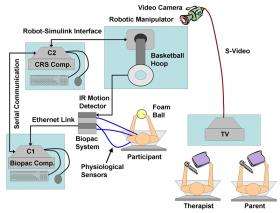
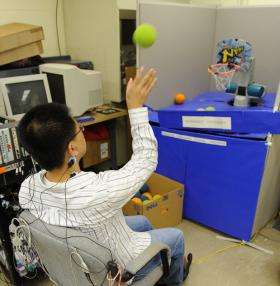
This fall, Sarkar and Stone published two papers: one in the IEEE Transactions on Robotics and one in the International Journal of Human-Computer Studies that describe the results of their first set of experiments, which were conducted with six children 13 to 16 years old diagnosed with ASD. A battery of physiological sensors was attached to the participants and they were asked to play two games. One was the computer game Pong. The other was a variant of Nerf basketball with the hoop and backboard attached to the end of a robotic arm that moves it back and forth or up and down. Graduate students Changchun Liu and Karla Conn participated in the studies.
The researchers report that the physiological data they gathered can be used to develop mathematical models for each individual that can predict his or her emotional states of liking, anxiety and engagement with an accuracy of better than 80 percent. Furthermore, they showed that this information can be used in real time to alter the game configuration in ways that significantly increase the children's degree of engagement.
That's the part that really nailed me,” says Stone, "that the robot can read the physiological cues of the person playing the game, control the distance and angle of the hoop, and that the person reported a more positive mood when the computer was responsive to his needs.”
The ability to accurately monitor a child's emotional state is particularly important in treating ASD, Stone says: "Children with autism are not necessarily giving the kind of emotional cues that we know how to read. They are not necessarily good reporters of their inner feelings. If we know that the child is becoming upset or anxious, then we can help the child identify his or her own emotional state and implement strategies for monitoring and control. It is a concrete way to help them identify their own feelings."
One of the most encouraging results of their preliminary research was discovering that the affective model works accurately in different settings. The model was based on the readings they took as the children played Pong. The game was changed in several ways: Ball and paddle speeds were varied, and computer-based opponents of different skill levels were introduced. This allowed the researchers to induce emotions of interest, boredom, anxiety and engagement in each of the participants. The model was then used to predict how each child would react to changes in the computer game. When they switched to robot basketball, they found that the model predictions were equally accurate.
The model is about as good at identifying a child's emotional state as an experienced therapist. When a child gets a new therapist, as often happens, there is a learning curve as the new therapist gets to know the child, whereas the accuracy of the model should continue to improve over time, Sarkar points out.
A robot's ability to provide consistent and predictable responses should be particularly useful for treating ASD. Each child has individual triggers. For example, one child may not like direct eye contact. Another might be upset by loud voices and sounds. Yet another may react when people get too close. Once a particular trigger is identified, a robot could be programmed to increase the stimulus at such a gradual rate that the child doesn't notice it. The robot could also be programmed to back off when it senses that its responses are beginning to bother the child. In this fashion, it could build up the child's tolerance to the problem stimulus. Robots can be programmed to respond with a consistency that is difficult for humans to achieve, Sarkar adds.
According to the autism expert, something that robots lack may also be an advantage in this setting. "I've always been interested in the idea of teaching social skills in a non-social situation that is less threatening. The children can be distracted by a lot of sensory stimuli coming at them. Social stimuli are particularly complex and can confuse them. So alternative methods of teaching that can subtract the social component could be very helpful as a beginning step," Stone says.
In the future, the researchers foresee technologies like robots and virtual reality environments as taking over some of the burden of the behavioral therapy that is one of the most time-consuming and expensive aspects of ASD treatment.
This approach holds great promise, says Stone. It will involve many steps and this is just the beginning. There are lots of different possible applications. So it is just a matter of finding the resources to explore them all.
Provided by Vanderbilt University


