Link between unexploded munitions in oceans and cancer-causing toxins determined
February 18, 2009 by Anisa S. Jimenez Link between unexploded munitions in oceans and cancer-causing toxins determined

Enlarge

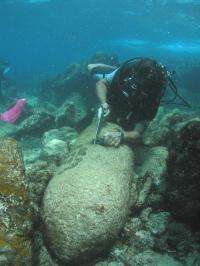
During a research trip to Puerto Rico, ecologist James Porter took samples from underwater nuclear bomb target USS Killen, expecting to find evidence of radioactive matter - instead he found a link to cancer. Data revealed that the closer corals and marine life were to unexploded bombs from the World War II vessel and the surrounding target range, the higher the rates of carcinogenic materials.

"Unexploded bombs are in the ocean for a variety of reasons - some were duds that did not explode, others were dumped in the ocean as a means of disposal," said Porter. "And we now know that these munitions are leaking cancer-causing materials and endangering sea life."

These findings will be presented at the Second International Dialogue on Underwater Munitions on February 25-27 in Honolulu. Data has been gathered since 1999 on the eastern end of the Isla de Vieques, Puerto Rico - a land and sea area that was used as a naval gunnery and bombing range from 1943-2003. Research revealed that marine life including reef-building corals, feather duster worms and sea urchins closest to the bomb and bomb fragments had the highest levels of toxicity. In fact, carcinogenic materials were found in concentrations up to 100,000 times over established safe limits. This danger zone covered a span of up to two meters from the bomb and its fragments.

According to research conducted in Vieques, residents here have a 23% higher cancer rate than do Puerto Rican mainlanders. Porter said a future step will be "to determine the link from unexploded munitions to marine life to the dinner plate."

While Porter believes every nation with a coastline has problems with unexploded munitions, there is a solution.

"With the creation of the Ordinance Recovery System, we now have a way to safely remove unexploded munitions," he said.

The machine picks up unexploded bombs off the sea floor and delivers them safely to a lift basket for surface disposal or deep sea burial. It is operated remotely with proportional toggle switches that allow much more fine control of the delicate undersea operation than an on/off button. The system relies on an underwater hydraulic system designed James Barton, president of Underwater Ordinance Recovery, Inc., with the technical expertise of machinists at the UGA instrument shop.

"When you remove the bomb, you remove the problem - but you've got to pick it up," said Porter.

Source: University of Georgia


print this article email this article download pdf blog this article bookmark this article     Stumble it Digg this share on Facebook retweet share on Reddit add to delicious
Rate this story - 3.5 /5 (15 votes)

Rank Filter

Move the slider to adjust rank threshold, so that you can hide some of the comments.


Display comments: newest first

  • Modernmystic - Feb 18, 2009
    • Rank: 2.6 / 5 (5)
    Sorry, I'm just a TAD incredulous here. The ocean is HUGE and the number of unexploded munitions along coastlines is beyond TINY in comparison.

    I'd look for the link to higher cancer rates elsewhere...
  • RFC - Feb 18, 2009
    • Rank: 2.6 / 5 (5)
    Yeah, cuz you know the first thing about aquatic habitats or munitions for that matter. "The ocean is HUGE..." That takes care of everything, doesn't it?

    So if someone puts a small garbage dump near your home, no problem right? Cuz our atmosphere is even MORE HUGE than the oceans! Couldn't possibly affect you or make you sick, could it?

    So you kept your job at the EPA even with the change of administration, did you?
  • Modernmystic - Feb 18, 2009
    • Rank: 2.3 / 5 (6)
    Yeah, cuz you know the first thing about aquatic habitats or munitions for that matter. "The ocean is HUGE..." That takes care of everything, doesn't it?


    Yeah it does, I'm glad you got the point.

    So if someone puts a small garbage dump near your home, no problem right? Cuz our atmosphere is even MORE HUGE than the oceans! Couldn't possibly affect you or make you sick, could it?


    Probably not from the smell, no. If things were leaching into the ground water and staying still then quite possibly.

    But then we're talking about different mediums here aren't we.

    You see apples are red shiny things, and oranges are orange and textured....

    So you kept your job at the EPA even with the change of administration, did you?


    No I've never had a workfare job in my life, but if your interested I'm under the impression all you have to do to get on there under the current administration is flap your arms about and squawk at the top of your lungs that the sky is falling...
  • vivcollins - Feb 18, 2009
    • Rank: 3 / 5 (5)
    Well interesting as that argument is, it would beg the question as to what is the water renewal rate in a semi enclosed reef environment, or for that matter what is the open sea rate of change for the local conditions were these bombs are located,
  • Modernmystic - Feb 18, 2009
    • Rank: 3.7 / 5 (3)
    Well interesting as that argument is, it would beg the question as to what is the water renewal rate in a semi enclosed reef environment, or for that matter what is the open sea rate of change for the local conditions were these bombs are located,


    Indeed and since we aren't given these facts, or other pertinent ones like concentration levels at various USEFUL (as opposed to two METERS) distances from said munitions, or the levels necessary to pose a significant health risk to humans at those USEFUL distances makes the article basically useLESS...actually worse than useless.
  • mobiledemocracy - Feb 18, 2009
    • Rank: 3 / 5 (2)
    The point to me is that this waste needs to be removed, relocated, and dealt with in a more responsible way.

    Jason
    www.earth-intelligence.net
    http://twitter.co...intelnet
  • Modernmystic - Feb 18, 2009
    • Rank: 2.6 / 5 (5)
    The point to me is that this waste needs to be removed, relocated, and dealt with in a more responsible way.

    Jason
    www.earth-intelligence.net
    http://twitter.co...intelnet


    If you pay for it you got a deal, otherwise count me out.
  • fixer - Feb 19, 2009
    • Rank: 1 / 5 (1)
    so what about cancer, some of these munitions are still live and very unstable now.
    those old battleships carried over a megaton of H.E.
    BOOM!
  • gmurphy - Feb 19, 2009
    • Rank: 1 / 5 (3)
    Modernmystic, you made a stupid statement and got called on it, take it on the chin instead of acting like this woman http://www.youtub...IwNGu_qQ
  • Modernmystic - Feb 19, 2009
    • Rank: 5 / 5 (2)
    Modernmystic, you made a stupid statement and got called on it, take it on the chin instead of acting like this woman http://www.youtub...IwNGu_qQ


    Yeah really stupid to want to know how concentrated these eeewwwvviiiiilll particulates are more than TWO METERS away from right on top of them...pfft...
  • E_L_Earnhardt - Feb 19, 2009
    • Rank: 1 / 5 (1)
    We have people wanting to dump tons of iron in the ocean to disolve CO. Give them the coordinates and kill two birds with one stone! Lead would be better, but it too has problems. 'Need any more proof that ELECTRONS cause cancer?
  • VOR - Feb 22, 2009
    • Rank: not rated yet
    are they suggesting the residents cancer might be from eating the local sealife? Did I miss something?

    On a different note, I have a strange hypothetical question (I'd imagine its been discussed somewhere). Could the ocean be used (once again) to dispose of nuclear waste, but instead of in piles or dumps, evenly dispersed into the entire ocean? I'm curious what levels of radiation you would get if you could magically evenly disperse all the world's nuclear waste evenly into all the oceans. Not that Im suggesting it, I just think its interesting to think about.

February 18, 2009 all stories

Comments: 12

3.5 /5 (15 votes)
  • Stumble this up

  • Digg this

  • share this

  • hide
  • Related Stories

  • Divers find new species in Aleutians
    created Nov 02, 2007 | popularity not rated yet | comments 0
  • Next generation anti-land mine device
    created Mar 29, 2005 | popularity not rated yet | comments 0
  • Simple test could offer cheap solution to detecting landmines
    created 13 hours ago | popularity not rated yet | comments 0
  • Electronic Nose to Return from Space Station (w/ Video)
    created Sep 11, 2009 | popularity not rated yet | comments 0
  • New Nanotube Coating Enables Novel Laser Power Meter
    created May 06, 2009 | popularity not rated yet | comments 0


  • hide
  • Relevant PhysicsForums posts

Other News

Close-up movie shows hidden details in the birth of super-suns

Close-up movie shows hidden details in the birth of super-suns (w/ Video)

Space & Earth / Astronomy

created 12 hours ago | popularity 4.8 / 5 (5) | comments 0

(PhysOrg.com) -- The constellation of Orion is a hotbed of massive star formation, most prominently in the Great Nebula that sits in Orion's sword. The glowing gas of the Nebula is powered by a group of young ...


Ghostly 'Spokes' Puff Out From Saturn's Ring's

Ghostly 'Spokes' Puff Out From Saturn's Ring's (w/ Video)

Space & Earth / Space Exploration

created 8 hours ago | popularity 4.5 / 5 (2) | comments 0

(PhysOrg.com) -- Massive, bright clouds of tiny ice particles hover above the darkened rings of Saturn in an image captured by the Cassini spacecraft on Sept. 22, 2009, around the time of Saturn's equinox. ...


NASA 'Drops' Next Generation Robotic Lander During Autonomous Tests

NASA 'Drops' Next Generation Robotic Lander During Autonomous Tests

Space & Earth / Space Exploration

created 8 hours ago | popularity 4.7 / 5 (3) | comments 1

(PhysOrg.com) -- NASA has successfully completed a series of autonomous "drop" tests of a robotic lander test article - in a record 10 months - to demonstrate the ability to perform a controlled landing on ...


Volatile gas could turn Rwandan lake into a freshwater time bomb

Space & Earth / Earth Sciences

created 10 hours ago | popularity 4.5 / 5 (6) | comments 3

A dangerous level of carbon dioxide and methane gas haunts Lake Kivu, the freshwater lake system bordering Rwanda and the Republic of Congo.


Space shuttle Atlantis lifts off on supply mission (AP)

Space shuttle Atlantis lifts off on supply mission

Space & Earth / Space Exploration

created 8 hours ago | popularity 3.5 / 5 (2) | comments 0

(AP) -- With 100 Internet-savvy NASA fans cheering on the shuttle and churning out constant Twitter updates, Atlantis sailed smoothly into orbit Monday with six astronauts and a full load of spare parts for ...