Researchers determined huge pressures that melt diamond on planet Neptune

(PhysOrg.com) -- The enormous pressures needed to melt diamond to slush and then to a completely liquid state have been determined ten times more accurately by Sandia National Laboratories researchers than ever before.
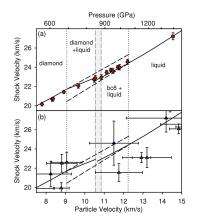
As a bonus to science, researchers Marcus Knudson, Mike Desjarlais, and Daniel Dolan discovered a triple point at which solid diamond, liquid carbon, and a long-theorized but never-before-confirmed state of solid carbon called bc8 were found to exist together.
Accurate knowledge of these changes of state are essential in simulating behaviors of celestial bodies, and to the effort to produce nuclear fusion at Lawrence Livermore National Laboratory's National Ignition Facility in California.
The changes resemble those undergone by ice as it melts into water, but under much more extreme conditions.
Granted, it's not immediately obvious why accelerating a projectile about the size of a stick of gum to 25 times the speed of a rifle bullet and smashing it into a target in central New Mexico would say anything about nuclear fusion or the state of diamonds on Neptune (the eighth planet from the sun).
It does because on Neptune, for example, much of the atmosphere is composed of methane (CH4). Under high pressure, methane decomposes, liberating its carbon. One question for astrophysicists in theorizing the planet's characteristics is knowing the form that carbon takes in the planet's interior. At what precise pressure does simple carbon form diamond? Is the pressure eventually great enough to liquefy the diamond, or form bc8, a solid that has yet other characteristics?
"Liquid carbon is electrically conductive at these pressures, which means it affects the generation of magnetic fields," says Desjarlais. "So, accurate knowledge of phases of carbon in planetary interiors makes a difference in computer models of the planet's characteristics. Thus, better equations of state can help explain planetary magnetic fields that seem otherwise to have no reason to exist."
At NIF in 2010, 192 laser beams are expected to focus on isotopes of hydrogen contained in a little spherical shell that may be made of diamond. The idea is to bring enough heat and pressure to bear to evenly squeeze the shell, which serves as a containment capsule. The contraction is expected to fuse the nuclei of deuterium and tritium within.
The success of this reaction would give more information about the effects of a hydrogen bomb explosion, making it less likely the U.S. would need to resume nuclear weapons tests. It could also be a step in learning how to produce a contained fusion reaction that could produce electrical energy for humanity from seawater, the most abundant material on Earth.
For the reaction to work, the spherical capsule must compress evenly. But at the enormous pressures needed, will the diamond turn to slush, liquid, or even to the solid bc8? A mixture of solid and liquid would create uneven pressures on the isotopes, thwarting the fusion reaction, which to be effective must offer deuterium and tritium nuclei no room to escape.
That problem can be avoided if researchers know at what pressure point diamond turns completely liquid. One laser blast could bring the diamond to the edge of its ability to remain solid, and a second could pressure the diamond wall enough that it would immediately become all liquid, avoiding the slushy solid-liquid state. Or a more powerful laser blast could cause the solid diamond to jump past the messy triple point, and past the liquid and solid bc8 mixture, to enter a totally liquid state. This would keep coherent the pressure on the nuclei being forced to fuse within.
The mixed phase regions, says Dolan, are good ones to avoid for fusion researchers. The Sandia work provides essentially a roadmap showing where those ruts in the fusion road lie.
Sandia researchers achieved these results by dovetailing theoretical simulations with laboratory work.
Simulation work led by Desjarlais used theory to establish the range of velocities at which projectiles, called flyer plates, should be sent to create the pressures needed to explore these high pressure phases of carbon and how the triple point would reveal itself in the shock velocities.
(The theory, called density functional theory, is a powerful method for solving Schrödinger's equation for hundreds to thousands of atoms using today's large computers.)
Using these results as guides, experimental results from fifteen flyer-plate flights — themselves powered by the extreme magnetic fields of Sandia's Z machine — in work led by Knudson, then determined more exact change-of-state transition pressures than ever before determined. Even better, these pressures fell within the bounds set by theory, thus showing that the theory was accurate.
"These experiments are much more accurate than ones previously performed with laser beams," says Knudson. "Our flyer plates, with precisely measured velocities, strike several large diamond samples, which enables very accurate shock wave velocity measurements."
Laser beam results, he says, are less accurate because they shock only very small quantities of material, and must rely on an extra step to infer the shock pressure and density.
Sandia's magnetically driven plates measure about 4 cm by 1.7 cm cross section, are hundreds of microns thick, and impact three samples on each firing. Z's target diamonds are each about 1.9 carats, while laser experiments use about 1/100 of a carat.
"No, they're not gemstones," says Desjarlais about the Sandia targets.
The diamonds in fact are created through industrial processes and have no commercial value, says Dolan, though their scientific value has been large.
The work was reported in a paper in the Dec. 19 issue of the journal Science.
Provided by Sandia National Laboratories


