Sophisticated nano-structures assembled with magnets (Video)
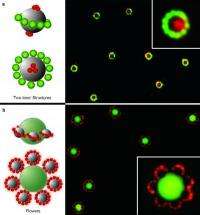
(PhysOrg.com) -- What do Saturn and flowers have in common? As shapes, both possess certain symmetries that are easily recognizable in the natural world. Now, at an extremely small level, researchers from Duke University and the University of Massachusetts have created a unique set of conditions in which tiny particles within a solution will consistently assemble themselves into these and other complex shapes.
By manipulating the magnetization of a liquid solution, the researchers have for the first time coaxed magnetic and non-magnetic materials to form intricate nano-structures. The resulting structures can be "fixed," meaning they can be permanently linked together. This raises the possibility of using these structures as basic building blocks for such diverse applications as advanced optics, cloaking devices, data storage and bioengineering.
Changing the levels of magnetization of the fluid controls how the particles are attracted to or repelled by each other. By appropriately tuning these interactions, the magnetic and non-magnetic particles form around each other much like a snowflake forms around a microscopic dust particle.
"We have demonstrated that subtle changes in the magnetization of a fluid can create an environment where a mixture of different particles will self-assemble into complex superstructures," said Randall Erb, fourth-year graduate student. He performed these experiments in conjunction with another graduate student Hui Son, in the laboratory of Benjamin Yellen, assistant professor of mechanical engineering and materials science and lead member of the research team.
The results of the Duke experiments appear in Feb. 19 issue of the journal Nature.
The nano-structures are formed inside a liquid known as a ferrofluid, which is a solution consisting of suspensions of nanoparticles composed of iron-containing compounds. One of the unique properties of these fluids is that they become highly magnetized in the presence of external magnetic fields. The unique ferrofluids used in these experiments were developed with colleagues Bappaditya Samanta and Vincent Rotello at the University of Massachusetts.
"The key to the assembly of these nano-structures is to fine-tune the interactions between positively and negatively magnetized particles," Erb said. "This is achieved through varying the concentration of ferrofluid particles in the solution. The Saturn and flower shapes are just the first published examples of a range of potential structures that can be formed using this technique."
According to Yellen, researchers have long been able to create tiny structures made up of a single particle type, but the demonstration of sophisticated structures assembling in solutions containing multiple types of particles has never before been achieved. The complexity of these nano-structures determines how they can ultimately be used.
"It appears that a rich variety of different particle structures are possible by changing the size, type and or degree of magnetism of the particles," Yellen said.
In the Duke experiments, the nano-structures were created by applying a uniform magnetic field to a liquid containing various types of magnetic and non-magnetic colloidal particles contained between transparent glass slides to enable real-time microscopic observations of the assembly process. Because of the unique nature of this "bulk" assembly technique, Yellen believes that the process could easily be scaled up to create large quantities of custom-designed nano-structures in high-volume reaction vessels. However, the trick is to also be able to glue the structures together, because they will fall apart when the external field is turned off, he said.
"The magnetic forces assembling these particles are reversible," Yellen said. "We were able to lock these nano-structures in their intended shapes both by using chemical glues and by simple heating."
The Duke team plans to test different combinations of particles and ferrofluids developed by the University of Massachusetts team to create new types of nano-structures. They also want to try to make even smaller nano-structures to find the limitations of the assembly process, and study the interesting optical properties which are expected from these structures.
"While we have shown that we can get small magnetic particles to form complex and beautiful structures, we believe that based on theory and the results of preliminary experiments, we should be able manipulate even smaller particles by using other magnetic particles and ferrofluids," Yellen said.
Source: Duke University


