Four rockets launch from Poker Flat Research Range
February 19, 2009 Turbopause Rocket

Enlarge

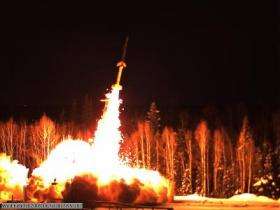
A remote control camera captures the launch of one of the Turbopause rockets during the early morning hours of Feb. 18, 2009. Photo by Lee Wingfield, LJT & Associates

Four NASA rockets launched from Poker Flat Research Range during a three-hour span on the morning of Feb. 18, 2009. The rockets, carrying payloads that emitted glowing vapor trails that help scientists study turbulence in the upper atmosphere, launched at 12:59 a.m., 1:29 a.m., 1:59 a.m., and 2:49 a.m. Alaska Standard Time. The whitish trails, some resembling corkscrews in the sky, were visible in many parts of interior and northern Alaska.

"There were four trails on the up-leg (of the rocket trajectory), four on the down-leg," said Gerald Lehmacher of Clemson University, principal investigator for the experiment. "The instruments worked well."

The experiment featured four rockets—35-foot, two-stage Terrier Orions—that released two trails each of trimethyl aluminum nearly 87 miles up into the night sky.

"They pretty much filled up a big part of the sky," Lehmacher said.

The harmless vapor trails of the first rocket dissipated in about 20 minutes, after which Lehmacher and the launch crew sent following rockets into the same portion of the sky, which was clear with a faint arc of the aurora to the north. Researchers at ground stations in Fort Yukon, Coldfoot, and Toolik Lake captured images of the trails for later analyses.

With the experiment, known as "Turbopause," Lehmacher wants to learn more about turbulence in the upper atmosphere about 50 to 80 miles above our heads. Winds there can be much faster than those in the jet stream.

"We want to measure the region where turbulence reaches its largest values and then stops acting," Lehmacher said.

Lehmacher's experiment was one of two set for February at Poker Flat. Next to launch is an experiment named Cascades II. Kristina Lynch of Dartmouth College is the principal investigator for the Cascades experiment, in which one 58-foot, four-stage Black Brant XII sounding rocket will blast off from Poker Flat into an active aurora display when the weather is clear above Chatanika and at camera sites in Toolik Lake and Kaktovik.

Source: University of Alaska Fairbanks


print this article email this article download pdf blog this article bookmark this article     Stumble it Digg this share on Facebook retweet share on Reddit add to delicious
Rate this story - 4 /5 (1 vote)


February 19, 2009 all stories

Comments: 0

4 /5 (1 vote)
  • Stumble this up

  • Digg this

  • share this

  • hide
  • Related Stories

  • Scientists launch rockets to test atmospheric conditions
    created Feb 26, 2009 | popularity not rated yet | comments 0
  • HEX2 a success: 4-rocket aurora experiment launches from Poker Flat
    created Feb 15, 2007 | popularity not rated yet | comments 0
  • Final rocket launches, measures aurora movement
    created Mar 24, 2009 | popularity not rated yet | comments 0
  • Two rockets fly through auroral arc
    created Jan 30, 2009 | popularity not rated yet | comments 0
  • 6 aurora-research rockets to launch from Poker Flat
    created Feb 09, 2007 | popularity not rated yet | comments 0


  • hide
  • Relevant PhysicsForums posts

  • The shape of our solar system's orbits.
    created Nov 07, 2009
  • Above or Below the Line of Nodes
    created Nov 07, 2009
  • Supernova vs. Nova?
    created Nov 07, 2009
  • Supernova's Gamma Rays and Comets
    created Nov 06, 2009
  • More from Physics Forums - General Astronomy

Other News

L-R: Chiwetel Ejiofor, Amanda Peet and John Cusack at the premiere of "2012"

NASA on crusade to debunk 2012 apocalypse myths

Space & Earth / Space Exploration

created 1hour ago | popularity not rated yet | comments 0

The world is not coming to an end on December 21, 2012, the US space agency insisted Monday in a rare campaign to dispel widespread rumors fueled by the Internet and a new Hollywood movie.


NASA satellites make a movie and get rainfall, wind info on Ida

NASA satellites make a movie and get rainfall, wind info on Ida (w/ Video)

Space & Earth / Earth Sciences

created 1hour ago | popularity not rated yet | comments 0

NASA satellites are amazing examples of technology. The TRMM satellite peers into tropical cyclones and can tell how much rain is falling per hour and where. QuikScat uses microwave technology to measure Ida's ...


Antarctica glacier retreat creates new carbon dioxide store

Antarctica glacier retreat creates new carbon dioxide store

Space & Earth / Earth Sciences

created 6 hours ago | popularity 4.3 / 5 (3) | comments 0

Large blooms of tiny marine plants called phytoplankton are flourishing in areas of open water left exposed by the recent and rapid melting of ice shelves and glaciers around the Antarctic Peninsula. This ...


NASA's GOES Project offers real-time hurricane alley movies

NASA's GOES Project offers real-time hurricane alley movies

Space & Earth / Earth Sciences

created 1hour ago | popularity not rated yet | comments 0

People love to get the big picture of hurricane alleys, and thanks to the GOES Project at NASA's Goddard Space Flight Center in Greenbelt, Md., they can now get real-time satellite animations of the eastern ...


NASA's TRMM Satellite sees most of Ida's heaviest rain stayed off coasts

NASA's TRMM Satellite sees most of Ida's heaviest rain stayed off coasts

Space & Earth / Earth Sciences

created 2 hours ago | popularity not rated yet | comments 0

NASA and the Japanese Space Agency's Tropical Rainfall Measuring Mission (TRMM) satellite flew over Ida and captured her rainfall when she passed by Nicaragua, Honduras and Belize this weekend. TRMM data revealed ...