Fruit flies sick from mating
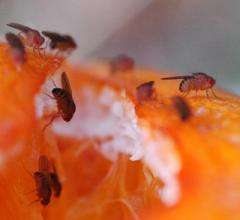
February 19, 2009 Fruit Fly (Drosophila melanogaster)

Enlarge

Fruit flies. Credit: Ted Morrow

Mating can be exhausting. When fruit flies mate, the females' genes are activated to roughly the same extent as when an immune reaction starts. This is shown in a study at Uppsala University that is now appearing in the scientific publication, Journal of Evolutionary Biology.

Using a combination of behavioral studies and genomic technology, so-called microarrays, researchers at Uppsala University can show how fruit fly females are affected by mating.

"We monitor how genetic expression is impacted by mating and show that the most common process that is affected is the immune defense system," says Ted Morrow at the Department of Ecology and Evolution, Uppsala University.

What's more, the cost of mating turns out to be rather high.

"Previous research findings show that if this cost were not a factor, females would produce 20 percent more offspring," says Ted Morrow.

It is costly for females to mate because competition among males has led to behaviours and adaptations in males that are injurious to females, such as harassment during mating rituals and toxic proteins in their sperm fluid.

"Our results are the strongest evidence that the cost to females is probably tied to the cost of starting an immune reaction. In other words, the males are like a 'sickness' to females," says Ted Morrow.

We can thus conclude the following from the study: the immune defence has developed to combat not only pathogens but also substances produced by males. This lends new meaning to the term 'lovesick.'

More information: "Immunogenic males: a genome-wide analysis of reproduction and the cost of mating in Drosophila melanogaster females" P. INNOCENTI & E. H. MORROW Department of Animal Ecology, Evolutionary Biology Center, Uppsala University, Uppsala, Sweden DOI: 10.1111/j.1420-9101.2009.01708.x
http://www3.interscience.wiley.com/journal/119880717/issue

Source: Wiley


print this article email this article download pdf blog this article bookmark this article     Stumble it Digg this share on Facebook retweet share on Reddit add to delicious
Rate this story - not rated yet


February 19, 2009 all stories

Comments: 0

not rated yet
  • Stumble this up

  • Digg this

  • share this

  • hide
  • Related Stories


Other News

The six elephants in Sierra Leone were shot and "crudely butchered"

S.Leone elephants 'wiped out' by poachers: official

Biology / Ecology

created 17 hours ago | popularity 5 / 5 (5) | comments 6

Poachers "wiped out" the entire elephant herd in Sierra Leone's only wildlife park, wildlife managers said Thursday after police said they had arrested a gang of 10 poachers.


First-ever blueprint of a minimal cell is more complex than expected

First-ever blueprint of a minimal cell is more complex than expected

Biology / Cell & Microbiology

created 15 hours ago | popularity 5 / 5 (14) | comments 1

What are the bare essentials of life, the indispensable ingredients required to produce a cell that can survive on its own? Can we describe the molecular anatomy of a cell, and understand how an entire organism ...


Ecological speciation by sexual selection on good genes: Is speciation adaptive?

Biology / Ecology

created 15 hours ago | popularity 5 / 5 (1) | comments 0

Darwin suggested that the action of natural selection can produce new species, but 150 years after the publication of his famous book, 'On the Origin of Species', debate still continues on the mechanisms of speciation. New ...


Whiteflies sabotage alarm system of plant in distress

Whiteflies sabotage alarm system of plant in distress

Biology / Plants & Animals

created 19 hours ago | popularity 5 / 5 (2) | comments 0

(PhysOrg.com) -- When spider mites attack a bean plant, the plant responds by producing odours which attract predatory mites. These predatory mites then exterminate the spider mite population, thus acting ...


Knockouts in human cells point to pathogenic targets

Knockouts in human cells point to pathogenic targets

Biology / Cell & Microbiology

created 18 hours ago | popularity not rated yet | comments 0

(PhysOrg.com) -- Whitehead researchers have developed a new approach for genetics in human cells and used this technique to identify specific genes and proteins required for pathogens.