How Volvox got its groove
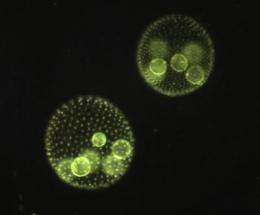
February 19, 2009 Volvox Tertius

Enlarge

The colonial alga Volvox tertius has about 2,000 cells and a complete division of labor: cells either swim or reproduce, but not both. The few large cells within these colonies are the reproductive cells, while the many tiny cells do the swimming. Copyright 2009 Matthew Herron.

Some algae have been hanging together rather than going it alone much longer than previously thought, according to new research.

Ancestors of Volvox algae made the transition from being a single-celled organism to becoming a multicellular colony at least 200 million years ago, during the Triassic Period.

At that time, Earth was a hot-house world whose inhabitants included tree ferns, dinosaurs and early mammals. Previous estimates had suggested Volvox's ancestors arose only 50 million years ago.

The algae switched to a communal lifestyle in only 35 million years -- "a geological eyeblink," said lead researcher Matthew D. Herron of The University of Arizona in Tucson.
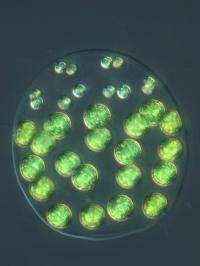
Pleodorina Starrii
Enlarge

Pleodorina starrii has an incomplete division of labor. Although the 12 small cells near the top of this colony only swim, the 20 larger cells both swim and reproduce. Copyright 2008 Matthew Herron

Figuring out how algae made the leap can provide clues to how multicellular organisms such as plants and animals evolved from single cells.

Cooperating successfully is the key, Herron said.

"All the macroscopic organisms we see around us trace back to unicellular ancestors," said Herron, a doctoral candidate in the UA's department of ecology and evolutionary biology. "Each of those groups had to go through a transition like this one.

"We think the early changes in this process were related to cooperation among cells and conflicts among cells -- and finally to the resolution of those conflicts," he said.

The researchers used DNA sequences from about 45 different species of Volvox and related species to reconstruct the group's family tree and determine how long ago the first colonial ancestor arose.

The team's article "Triassic origin and early radiation of multicellular volvocine algae," is in this week's online Early Edition of the Proceedings of the National Academy of Sciences.

Herron's co-authors Jeremiah D. Hackett and Richard E. Michod are members of the UA's department of ecology and evolutionary biology. Co-author Frank O. Aylward was at the UA when the research was conducted and is now at the University of Wisconsin in Madison. The Society of Systematic Biologists and Sigma Xi helped fund the research.

Volvox and its relatives live in freshwater ponds all over the world. Some of the species are unicellular, while others live in colonies of up to 50,000 cells.

Many of the colonial algae species are visible to the eye and appear to be little green spheres rolling through the water. The most complex species have a division of labor -- some cells do the swimming, others do the reproducing.

Although an earlier estimate suggested the algae's ancestors banded together 50 million years ago, Herron wanted to check the estimate using 21st-century genetic and molecular techniques.

In addition to constructing the Volvox family tree, the team determined how long ago the group's oldest common ancestor lived by comparing the amount of genetic differences between species.

One of the earliest traits to evolve is the clear jelly-like substance visible between the cells of the spherical Volvox colonies, Herron said. "We think that stuff is what held the earliest multicellular colonies together."

Banding together in a larger mass can provide protection from predators, he said. "Some things can't eat you if you're bigger."

But producing the goo, called extracellular matrix, takes resources and is one of the costs of cooperation.

"So now there's a temptation to cheat," Herron said. "Let's say I'm in a four-cell colony. I'm going to let the other three guys make the extracellular matrix, and I'm going to focus on growing and reproducing. That's the conflict."

Overcoming that conflict is essential to becoming a multicellular organism, he said. The benefits of cheating have to be reduced for the cells to cooperate successfully.

Some traits the team studied are genetic traits that mediate conflict.

Genetic control of cell number is one of those, he said. "If my number of offspring is fixed at four, now there's no reason for me to cheat. I can't have eight offspring when everyone else is having only four."

Herron is now studying whether the size of the colony affects the degree to which there are different types of cells within the colony.

Source: University of Arizona


print this article email this article download pdf blog this article bookmark this article     Stumble it Digg this share on Facebook retweet share on Reddit add to delicious
Rate this story - 4.2 /5 (5 votes)

Rank Filter

Move the slider to adjust rank threshold, so that you can hide some of the comments.


Display comments: newest first

  • Velanarris - Feb 19, 2009
    • Rank: 5 / 5 (1)
    NeilF is gonna be mad. Algae stole his company name.
  • nano999 - Feb 19, 2009
    • Rank: not rated yet
    Haha! That's what I was thinkin'! Is that guy for real or what?
  • earls - Feb 19, 2009
    • Rank: 1 / 5 (1)
    "what"
  • el_gramador - Feb 19, 2009
    • Rank: 1 / 5 (1)
    You guys do realize that it's Vulvox, not Volvox right? I may not care about the site too much, but at the very least I know they sound different.
  • Velanarris - Feb 20, 2009
    • Rank: not rated yet
    You guys do realize that it's Vulvox, not Volvox right? I may not care about the site too much, but at the very least I know they sound different.

    It's a joke made at the expense of a con artist who can't scratch together the $4 a year it costs for a proper domain registration. Comedic liberty.
  • Roach - Feb 20, 2009
    • Rank: not rated yet
    What is the deal with people on here taking all the jokes too seriously, first someone gets angry at me over praising our Hamster overlords, now a pun? I can't imagine how much fun these guys are over a beer.
  • Velanarris - Feb 20, 2009
    • Rank: 1 / 5 (1)
    What is the deal with people on here taking all the jokes too seriously, first someone gets angry at me over praising our Hamster overlords, now a pun? I can't imagine how much fun these guys are over a beer.
    They don't drink beer due to it's excessive CO2 outgassing when opened.
  • Birger - Feb 21, 2009
    • Rank: not rated yet
    Maybe simple algae living in clusters like this will be more tractable tools for genetic engineering ?
    -Say you want an organism that absorbs pollutants, big plants have more complex genomes, making GM harder, and single unicellular algae are more vulnerable.
  • el_gramador - Feb 23, 2009
    • Rank: not rated yet
    I should've probably said this earlier but, what are we two-year olds? Snickering over a difference in spelling?
  • Velanarris - Feb 24, 2009
    • Rank: 5 / 5 (1)
    I should've probably said this earlier but, what are we two-year olds? Snickering over a difference in spelling?
    So how is working for Neil?

February 19, 2009 all stories

Comments: 10

4.2 /5 (5 votes)
  • Stumble this up

  • Digg this

  • share this

  • hide
  • Related Stories


Other News

The indefinite self-renewal of specialized cells without the need for stem cell intermediates

The indefinite self-renewal of specialized cells without the need for stem cell intermediates

Biology / Cell & Microbiology

created 5 hours ago | popularity 3 / 5 (2) | comments 0

(PhysOrg.com) -- Is the indefinite expansion of adult cells possible without recourse to stem cell intermediates? The team led by Michael Sieweke at the Centre d'immunologie de Marseille Luminy, France has ...


Birds 'See' Earth's Magnetic Field

Birds 'See' Earth's Magnetic Field

Biology / Plants & Animals

created 12 hours ago | popularity 4.3 / 5 (4) | comments 1

When birds migrate over long distances -- sometimes thousands of miles -- they usually end up in exactly the same place year after year. Such accurate feats of navigation, accomplished by millions of birds ...


Plants prefer their kin, but crowd out competition when sharing a pot with strangers

Biology / Plants & Animals

created 11 hours ago | popularity 4 / 5 (1) | comments 0

Plants don't mind sharing space with their kin but when they're potted with strangers of the same species they start invigorating their leaves, a study by McMaster University reveals.


Simple test could offer cheap solution to detecting landmines

Biology / Cell & Microbiology

created 12 hours ago | popularity 5 / 5 (4) | comments 0

Scientists have developed a simple, cheap, accurate test to find undetected landmines.


Investigating muscle repair, scientists follow their noses

Investigating muscle repair, scientists follow their noses

Biology / Cell & Microbiology

created 13 hours ago | popularity 3.7 / 5 (3) | comments 0

When muscle cells need repair, they use odor-detecting tools found in the nose to start the process, researchers have discovered.