New research could help predict red tide
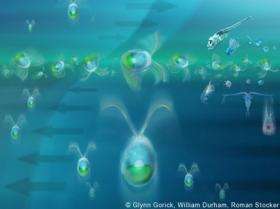
(PhysOrg.com) -- Not far beneath the ocean's surface, tiny phytoplankton swimming upward in a daily commute toward morning light sometimes encounter the watery equivalent of Rod Serling's Twilight Zone: a sharp variation in marine currents that traps billions of these single-celled organisms and sends them tumbling until a shift in wind or tide alters the currents and sets them free.
Scientists are aware of these thin layers of single-celled creatures and their enormous ecological ramifications, but until now, they knew little about the mechanisms responsible for their formation.
The explanation by researchers in MIT's Department of Civil and Environmental Engineering of how these common, startlingly dense layers of photosynthetic phytoplankton form, moves the scientific community a step closer to being able to predict harmful algal blooms, a well-known example of which is red tide. The work also opens new perspectives on other phenomena, like predatory feeding by larger organisms at these ecological hotspots.
"Phytoplankton are incredibly small. You would have to stack about 10 back to back to equal the width of a single human hair," said PhD student William Durham, co-author on a paper appearing in the Feb. 20 issue of Science. "But despite their small size, they play an outsized role in the environment: they form the base of the marine food web and cumulatively produce half the world's oxygen. Many species can swim, but this fact is often neglected by researchers because phytoplankton are slow compared to ocean currents. However, we have shown that their motility can play a crucial role by concentrating them into dense assemblages, known as thin layers."
In the Science paper, Durham, Professor Roman Stocker and University of Arizona physics Professor John Kessler explain how adjacent layers of water moving at different speeds produce a "shear" flow that traps the phytoplankton as they swim into it. These layers form in the top 50 meters of the ocean and can be anywhere from a few centimeters to a couple of meters thick, span several kilometers horizontally and last hours, days or weeks.
"Our research pinpoints a mechanism for the formation of these thin layers of phytoplankton, which are analogous to watering holes in a savanna — localized areas of concentrated resources that draw a wide range of organisms and thus play a disproportionate role in the ecological landscape," said Stocker, the Doherty Assistant Professor of Ocean Utilization at MIT.
Because motile phytoplankton have different morphologies and swimming abilities, one species may be able to swim through a layer of shear that will capture another. This means that each species could be trapped in a different level of shear, creating a sort of oceanic layered-cake effect, a boon for zooplankton or young fish that feed on specific species.
And when a toxic species of phytoplankton gets trapped in a thin layer, that layer can spawn a harmful algal bloom — an explosion in the population of toxic phytoplankton that sickens or kills the larger animals that ingest the cells. Harmful algal blooms are a major source of social and economic concern, particularly near coastal areas, because they are becoming more frequent and cause billions of dollars in annual losses to fishing and recreational industries worldwide.
In a perspective piece accompanying the paper in Science, scientist Daniel Grünbaum of the University of Washington writes: "The authors demonstrate a sort of Peter Principle for algae migrating in shear: cells swim up until they reach their level of instability. At this critical shear level, cells can swim in, but they cannot swim out. The resulting aggregation, in what is arguably an unfavorable microenvironment, may have widespread consequences, as harmful blooms of toxic algae often take the form of thin layers."
Using video-microscopy, Durham and Stocker were able to track the movements of individual cells as they become trapped in the layers of shear. They also modeled the movements of the swimming cells mathematically and proved that they cannot escape these layers. Once trapped, they're at the mercy of the flow, and must wait for the shear to decrease before they can swim out and exit the Twilight Zone.
Provided by Massachusetts Institute of Technology


