250 DVDs on a quarter: New method of self-assembling nanoscale elements could transform data storage industry
February 19, 2009
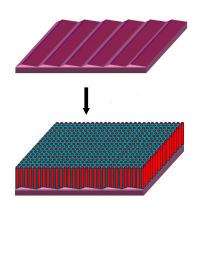
The sawtooth ridges formed by cutting and heating a sapphire crystal, shown at top, serves to guide the self-assembly of nanoscale elements into an ordered pattern over arbitrarily large surfaces. Researchers say the new, easy-to-implement technique may transform the data storage industry. Image by Dong Hyun Lee, UMass Amherst
(PhysOrg.com) -- An innovative and easily implemented technique in which nanoscale elements precisely assemble themselves over large surfaces could soon open doors to dramatic improvements in the data storage capacity of electronic media, according to scientists at the University of California, Berkeley, and the University of Massachusetts Amherst (UMass Amherst).
"I expect that the new method we developed will transform the microelectronic and storage industries, and open up vistas for entirely new applications," said co-lead investigator Thomas Russell, director of the Materials Research Science and Engineering Center at UMass Amherst, visiting Miller Professor at UC Berkeley's Department of Chemistry, and one of the world's leading experts on the behavior of polymers. "This work could possibly be translated into the production of more energy-efficient photovoltaic cells, for instance."
Russell conceived of this new approach with co-lead investigator Ting Xu, a UC Berkeley assistant professor with joint appointments in the Department of Material Sciences and Engineering and the Department of Chemistry. They describe their work in the Feb. 20 issue of the journal Science.
"The density achievable with the technology we've developed could potentially enable the contents of 250 DVDs to fit onto a surface the size of a quarter," said Xu, who is also a faculty scientist at Lawrence Berkeley National Laboratory.
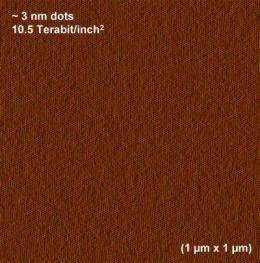
Shown is an atomic force microscope image of ultra-dense, highly ordered nanoscale elements, looking down from the top. The dots, only 3 nanometers in size and each equidistant from the other, are spaced at a density of 10 terabits per square inch. Researchers say the density achievable with this new technology could one day enable the contents of 250 DVDs to fit onto a surface the size of a quarter. Image by Soojin Park, UMass Amherst
Xu explained that the molecules in the thin film of block copolymers - two or more chemically dissimilar polymer chains linked together - will self-assemble into an extremely precise, equidistant pattern when spread out on a surface, much like a regiment of disciplined soldiers lining up in formation. For more than a decade, researchers have been trying to exploit this characteristic for use in semiconductor manufacturing, but they have been constrained because the order starts to break down as the size of the area increases.Once the formation breaks down, the individual domains cannot be read or written to, rendering them useless as a form of data storage.
To overcome this size constraint, Russell and Xu conceived of the elegantly simple solution of layering the film of block copolymers onto the surface of a commercially available sapphire crystal. When the crystal is cut at an angle - a common procedure known as a miscut - and heated to 1,300 to 1,500 degrees Centigrade (2,372 to 2,732 degrees Fahrenheit) for 24 hours, its surface reorganizes into a highly ordered pattern of sawtooth ridges that can then be used to guide the self-assembly of the block polymers.
With this technique, the researchers were able to achieve defect-free arrays of nanoscopic elements with feature sizes as small as 3 nanometers, translating into densities of 10 terabits per square inch. One terabit is equal to 1 trillion bits, or 125 gigabytes.
Because crystals come in a variety of sizes, there are few limitations to how large this block copolymer array can be produced, the researchers said. They also noted that the angle and depth of the sawtooth ridges can be easily varied by changing the temperature at which the crystal is heated to fine tune the desired pattern.
"We can generate nearly perfect arrays over macroscopic surfaces where the density is over 15 times higher than anything achieved before," said Russell. "With that order of density, one could get a high-definition picture on a screen the size of a JumboTron."
"It's one thing to get dozens of soldiers to stand in perfect formation in an area the size of a classroom, each person equidistant from the other, but quite another to get tens of trillions of individuals to do so on the field in a football stadium," Xu added. "Using this crystal surface as a guide is like giving the soldiers a marker so they know where to stand."
Other research teams across the country are engaged in similar efforts to break the size barrier of self-assembled block copolymers, but this new project by the UMass Amherst-UC Berkeley scientists differs in that it does not rely upon advances in lithography to achieve its goals.
In the semiconductor industry, optical lithography is a process in which light passes through a mask with a desired circuit pattern onto a photosensitive material, or photoresist, that undergoes a chemical change. Several steps of chemical treatment are then used to develop the desired pattern for subsequent use.
To keep up with Moore's Law and the demand for increasingly smaller features for semiconductors and microprocessors, industry has turned to nanolithography and the use of ever-shorter wavelengths of light at greater cost.
"The challenge with photolithography is that it is rapidly approaching the resolution limits of light," said Xu. "In our approach, we shifted away from this 'top down' method of producing smaller features and instead utilized advantages of a 'bottom up' approach. The beauty of the method we developed is that it takes from processes already in use in industry, so it will be very easy to incorporate into the production line with little cost."
An added benefit, said Xu, is that "our technique is more environmentally friendly than photolithography, which requires the use of harsh chemicals and acids."
Source: University of California - Berkeley
-
Scientists illuminate cancer cells' survival strategy
Jan 26, 2012 |
5 / 5 (3) |
0
-
Uncovering Da Vinci's rule of the trees
Nov 30, 2011 |
4.7 / 5 (15) |
19
-
Los Alamos instrument to shine light on Mars habitability
Nov 29, 2011 |
5 / 5 (1) |
0
-
Forget exomoons. Let’s talk exorings
Nov 25, 2011 |
5 / 5 (7) |
0
-
NASA launching `dream machine' to explore Mars
Nov 22, 2011 |
5 / 5 (4) |
3
-
Engineers build first sub-10-nm carbon nanotube transistor
Feb 01, 2012 |
4.9 / 5 (31) |
30
-
Something old, something new: Evolution and the structural divergence of duplicate genes
Jan 31, 2012 |
4.6 / 5 (7) |
1
-
The hidden nanoworld of ice crystals: Revealing the dynamic behavior of quasi-liquid layers
Jan 30, 2012 |
5 / 5 (3) |
1
-
Stock market network reveals investor clustering
Jan 27, 2012 |
3.9 / 5 (23) |
8
-
Of microchemistry and molecules: Electronic microfluidic device synthesizes biocompatible probes
Jan 26, 2012 |
5 / 5 (1) |
0
-
How to calculate theoretical initial velocity?
54 minutes ago
-
Question about Gravity?
2 hours ago
-
Wearing black in a desert
3 hours ago
-
Did space exist before mass?
3 hours ago
-
How can E&M Waves be polarized?
3 hours ago
-
Does light travel for ever?
4 hours ago
- More from Physics Forums - General Physics
More news stories
What lies beneath: Mapping hidden nanostructures
The ability to diagnose and predict the properties of materials is vital, particularly in the expanding field of nanotechnology. Electron and atom-probe microscopy can categorize atoms in thin sheets of material, ...
14 hours ago |
5 / 5 (2) |
1
New kind of solar cell could capture significantly more energy than current cells
New solar cells could increase the maximum efficiency of solar panels by over 25%, according to scientists from the University of Cambridge.
Feb 08, 2012 |
4.5 / 5 (12) |
14
|
Nanoshell whispering galleries improve thin solar panels
Visitors to Statuary Hall in the U.S. Capitol Building may have experienced a curious acoustic feature that allows a person to whisper softly at one side of the cavernous, half-domed room and for another on ...
Nanotechnology / Nanomaterials
Feb 07, 2012 |
4.3 / 5 (6) |
6
|
'Dark plasmons' transmit energy
Microscopic channels of gold nanoparticles have the ability to transmit electromagnetic energy that starts as light and propagates via "dark plasmons," according to researchers at Rice University.
Feb 09, 2012 |
4.7 / 5 (7) |
1
|
Revealing how a battery material works
Since its discovery 15 years ago, lithium iron phosphate (LiFePO4) has become one of the most promising materials for rechargeable batteries because of its stability, durability, safety and ability to deliver ...
Nanotechnology / Nanomaterials
Feb 08, 2012 |
5 / 5 (5) |
0
|
Google users warned of threat to smartphone wallets
Users of Google smartphone wallets were being warned on Friday that there is a way to crack pass codes intended to thwart thieves from going on illicit shopping sprees.
Anonymous knocks CIA website offline (Update)
The website of the Central Intelligence Agency was inaccessible on Friday after the hacker group Anonymous claimed to have knocked it offline.
New error-correcting codes guarantee the fastest possible rate of data transmission
Error-correcting codes are one of the triumphs of the digital age. Theyre a way of encoding information so that it can be transmitted across a communication channel such as an optical fiber o ...
Complex wiring of the nervous system may rely on a just a handful of genes and proteins
Researchers at the Salk Institute have discovered a startling feature of early brain development that helps to explain how complex neuron wiring patterns are programmed using just a handful of critical genes. ...
Humans may have helped the decline of African rainforests 3000 years ago
(PhysOrg.com) -- Large areas of rainforests in Central Africa mysteriously disappeared over three thousand years ago, to be replaced by savannas. The prevailing theory has been that the cause was a change ...
New power source discovered
(PhysOrg.com) -- Researchers at the Massachusetts Institute of Technology (MIT) and RMIT University have made a breakthrough in energy storage and power generation.

Feb 19, 2009
Rank: 3 / 5 (1)
Feb 19, 2009
Rank: 3 / 5 (1)
Feb 19, 2009
Rank: 5 / 5 (2)
Nice improvement on reliability in manufacturing though! Usability is another story it seems.
Feb 20, 2009
Rank: not rated yet
It mentions light lithography seems to indicate this will be used for printing chips... personally i would not mind 500 GB of Ram might be the minimum for running windows 8. Or this may be intel's way of printing a 500 core CPU ... I can see the ad now ... "A super computing cluster in the palm of your hand". Ubiquitous computing here we come.
~We don't know who struck first us or them, but we do know it was us that scorched the sky.
Feb 20, 2009
Rank: not rated yet
Feb 24, 2009
Rank: 1 / 5 (1)
Feb 24, 2009
Rank: 1 / 5 (1)
It wont work. Nanotubes are not like polymer strands you can squirt from a hole. Catalytic nanoparticles organize the carbon atoms into the hexagonal patterns characteristic of nanotubes.
Mar 06, 2009
Rank: 1 / 5 (1)
May 08, 2009
Rank: not rated yet
125 gigaBYTES.. 1 BYTE = 8 bits... so the math is correct.