Cannabis compound can help cells
February 19, 2009 Cannabis compound can help cells

Enlarge

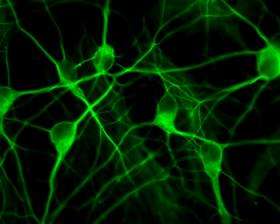
Neurones which have been labelled with a fluorescent marker.

(PhysOrg.com) -- Cannabis has been used recreationally and for medicinal purposes for centuries, yet its 60 plus active components are only partly understood. Now scientists have discovered how a compound in cannabis can help cells to function in our bodies, and aid recovery after a damaging event.

In a paper published in the Journal of Neuroscience, the researchers report on their studies into cannabidiol - a naturally occurring molecule found in cannabis.

Also known as CBD, it is not the constituent that gives the high - that compound is called tetrahydrocannabinol or THC - and so may be more acceptable as a drug treatment.

Both compounds are currently used in a pharmaceutical medicine to help patients relieve pain and other symptoms of Multiple Sclerosis.

Now researchers have discovered how CBD actually works within brain cells.

By interacting with mitochondria - which are the power generators of all cells - it can help maintain normal levels of calcium allowing cells to function properly and providing a greater resistance to damage.

Disturbance of calcium levels has long been associated with a number of brain disorders. So the finding could have implications for the development of new treatments for disorders related to malfunctioning mitochondria.

Dr Bettina Platt, from the University's School of Medical Sciences, said: "Scientists have known for a long time that cannabidiol can help with pain relief but we never really knew how it worked.

"However we have discovered what it actually does at the cellular level.

"We are hoping that our findings can instruct the development of cannabidiol based treatments for disorders related to mitochondrial dysfunction such as Parkinson's disease or Huntington's disease."

Nevertheless, Dr Platt warned that smoking cannabis would not necessarily have the same effect.

"There are different strains of cannabis out there and many no longer contain cannabidiol. In fact, these have been deliberately bred out to enhance the THC content," she said.

"As a result, smoking cannabis would not necessarily have the same beneficial effect, and could even exacerbate neuronal damage."

Provided by University of Aberdeen


print this article email this article download pdf blog this article bookmark this article     Stumble it Digg this share on Facebook retweet share on Reddit add to delicious
Rate this story - 4.6 /5 (8 votes)

Rank Filter

Move the slider to adjust rank threshold, so that you can hide some of the comments.


Display comments: newest first

  • WolfAtTheDoor - Feb 19, 2009
    • Rank: not rated yet
    ...on the other hand... It's far out, man.
  • Mercury_01 - Feb 19, 2009
    • Rank: not rated yet
    Cbd DOES get you high. Its the part of weed that causes whats known in the industry as "couch lock".
  • El_Nose - Feb 20, 2009
    • Rank: not rated yet
    no the article is correct CDB does not induce the effect of high -- that is THC -- but many people claim that while THC makes you high CDB makes it last. THC gets you there CDB keeps you there.
  • rubberman - Feb 20, 2009
    • Rank: not rated yet
    So....good weed is good for you, bad weed is bad for you....naaaahhh all weed is still good.
  • Quik98 - Feb 21, 2009
    • Rank: not rated yet
    I have been doing intense Cannabis research for 2 years now and I have found; CBD is psychoactive but is not psychedelic, CBD produces that couchlock effect, releaves pain, reduces anxiety, reduces nausea. High levels of CBD are found in Cannabis Indica plants and Cannabis Sativa plants contain less CBDs and more THC. Sativa = High THC Low THC Indica = Low THC High CBD. Indica plants on the contrary are VERY common due to their ability to grow and mature faster than sativas. Most dealers deal indica strains but Sativas arent hard to find.
  • jhoeh77 - Feb 23, 2009
    • Rank: not rated yet
    I knew it all the time.

February 19, 2009 all stories

Comments: 6

4.6 /5 (8 votes)
  • Stumble this up

  • Digg this

  • share this

  • hide
  • Related Stories


  • hide
  • Relevant PhysicsForums posts

  • nesfatin
    created Nov 22, 2009
  • Obsessive Compulsive Disorder
    created Nov 20, 2009
  • West's zone 2 starling resistor respiratory physiology
    created Nov 18, 2009
  • 50-0-50 rule
    created Nov 18, 2009
  • More from Physics Forums - Medical Sciences

Other News

Stable plaque or heart attack plaque? USC researcher builds new sensor to tell which is which

Stable plaque or heart attack plaque? Researcher builds new MEMS sensor to tell which is which

Medicine & Health / Research

created 58 minutes ago | popularity not rated yet | comments 0

University of Sourthern California biomedical engineer and cardiologist Tzung "John" Hsiai hopes to develop a new tool to help clinicians distinguish cardiac emergencies requiring immediate surgery from chronic ...


Multiple health concerns surface as winter, vitamin D deficiences arrive

Medicine & Health / Health

created 53 minutes ago | popularity 5 / 5 (1) | comments 0

A string of recent discoveries about the multiple health benefits of vitamin D has renewed interest in this multi-purpose nutrient, increased awareness of the huge numbers of people who are deficient in it, spurred research ...


Fat around the middle increases the risk of dementia

Medicine & Health / Neuroscience

created 13 minutes ago | popularity not rated yet | comments 0

Women who store fat on their waist in middle age are more than twice as likely to develop dementia when they get older, reveals a new study from the Sahlgrenska Academy.


Amid the flu epidemic, don't forget RSV in young children

Medicine & Health / Diseases

created 29 minutes ago | popularity not rated yet | comments 0

Influenza, particularly H1N1, has understandably captured the attention of public health officials, the media and the public. However, an analysis from Children's Hospital Boston, based on patients seen in its emergency department ...


Flaxseed oil and osteoporosis

Medicine & Health / Health

created 3 minutes ago | popularity not rated yet | comments 0

Animal studies suggest that adding flaxseed oil to the diet could reduce the risk of osteoporosis in post-menopausal women and women with diabetes, according to a report to be published in the International Journal of Fo ...