Spectacular Photo-op on Saturn
February 19, 2009 Spectacular Photo-op on Saturn

Enlarge

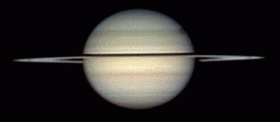
Titan transits Saturn on Feb. 8, 2009. Credit: Christopher Go of Cebu City, the Philippines.

Something is about to happen on Saturn that's so pretty, even Hubble will pause to take a look.

"On Feb. 24th, there's going to be a quadruple transit of Saturn's moons," says Keith Noll of the Hubble Space Telescope Science Institute. "Titan, Mimas, Dione and Enceladus will pass directly in front of Saturn and we'll see their silhouettes crossing Saturn's cloudtops—all four at the same time."

Hubble won't be the only one looking. Amateur astronomers will be able to see it, too. The timing favors observers along the Pacific coast of North America, Alaska, Hawaii, Australia and east Asia.

On Feb. 8th, astrophotographer Christopher Go of the Philippines got a preview when Titan transited Saturn all by itself. He recorded this movie using an 11-inch telescope:

"I woke up at one o'clock in the morning to photograph Titan's passage across the disk of Saturn," says Go. "The sky was overcast, but I was fortunate to see the end of the transit through a break in the clouds. The emergence of Titan was really stunning because it gave the moon a 3D appearance!"

Transits like these are rare. "They only happen every 14 to 15 years when the orbits of Saturn's moons are nearly edge-on to Earth," says Noll. In 1995-96, the last time the geometry was right, Hubble photographed two (Titan and Tethys) and three (Mimas, Enceladus, Dione) moons transiting Saturn. This will be the first time the great telescope captures four.

The event begins on Tuesday morning, Feb. 24th at 10:54 UT (2:54 a.m. PST) when Titan's circular shadow falls across Saturn's cloudtops. About forty minutes later, the ruddy disk of Titan itself moves over the clouds.

"Titan is so big, you can see it just by looking through the eyepiece of a small telescope—no special camera is required," says Go.

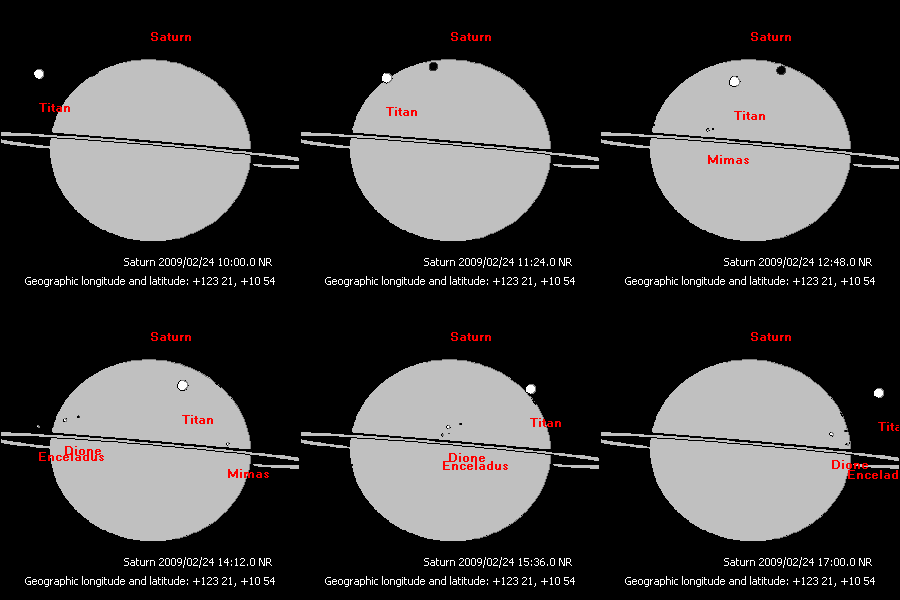
One by one, the smaller moons Mimas, Dione and Enceladus will follow Titan. At 14:24 UT, all four satellites and their shadows will simultaneously dot Saturn's disk:
Spectacular Photo-op on Saturn

An animation of the quadruple transit prepared by amateur astronomer Christopher Go using the program Winjupos.

"To photograph the smaller moons, you'll need a mid-sized backyard telescope equipped with a good CCD camera," notes Go.

Hubble's observations are part of the Hubble Heritage Project, a 10-year outreach effort aimed at producing images of exceptional beauty for the general public. "Only 0.5% of Hubble's observing time is devoted to Heritage work," says Noll, one of the project's leaders, "so we're picky about our targets." He thinks the quadruple transit could rank among the best planet-shots in Hubble's archive.

The images could yield hard science, too.

"The transit of Titan will be of particular interest," says Noll. "Researchers plan to use Saturn as a backlight to probe the size and transparency of the giant moon's atmosphere." Hubble will also capture a rare view of the rings almost edge-on, a point of view that can reveal ring-warps, undiscovered satellites, and new information about the reflectivity of ring particles.

"Hard science can be beautiful."

To find Saturn on Feb. 24th, look southwest before sunrise. The planet is easy to see shining like a golden first-magnitude star in the constellation Leo: sky map. By cosmic coincidence, Feb. 24th is also the date Comet Lulin makes its closest approach to Earth--and the comet is right beside Saturn! Using a small telescope you can catch a comet, a ringed planet and a quadruple transit; it's a nice way to begin the day.

Source: by Dr. Tony Phillips, Science@NASA


print this article email this article download pdf blog this article bookmark this article     Stumble it Digg this share on Facebook retweet share on Reddit add to delicious
Rate this story - 4.1 /5 (7 votes)


February 19, 2009 all stories

Comments: 0

4.1 /5 (7 votes)
  • Stumble this up

  • Digg this

  • share this

  • hide
  • Related Stories

  • Less than 1 in 3 Toronto bystanders who witness a cardiac arrest try to help: Study
    created Nov 06, 2009 | popularity not rated yet | comments 0
  • Old method of heart bypass better than 'off-pump'
    created Nov 04, 2009 | popularity not rated yet | comments 0
  • 'Moonlighting' molecules discovered
    created Oct 29, 2009 | popularity not rated yet | comments 0
  • Adding ezetimibe to atorvastatin improves lipid control
    created Oct 27, 2009 | popularity not rated yet | comments 0
  • US has no good system to track medical implants
    created Oct 05, 2009 | popularity not rated yet | comments 0


  • hide
  • Relevant PhysicsForums posts

  • The shape of our solar system's orbits.
    created Nov 07, 2009
  • Above or Below the Line of Nodes
    created Nov 07, 2009
  • Supernova vs. Nova?
    created Nov 07, 2009
  • Supernova's Gamma Rays and Comets
    created Nov 06, 2009
  • Our Moon
    created Nov 06, 2009
  • Question about a Carl Zeiss lens
    created Nov 05, 2009
  • More from Physics Forums - General Astronomy

Other News

Deep creep means milder, more frequent earthquakes along Southern California's San Jacinto fault

Deep creep means milder, more frequent earthquakes along Southern California's San Jacinto fault

Space & Earth / Earth Sciences

created 14 hours ago | popularity 4.7 / 5 (3) | comments 0

With an average of four mini-earthquakes per day, Southern California's San Jacinto fault constantly adjusts to make it a less likely candidate for a major earthquake than its quiet neighbor to the east, the ...


Success in 'space elevator' competition (AP)

Success in 'space elevator' competition (Update 3)

Space & Earth / Space Exploration

created Nov 05, 2009 | popularity 4.3 / 5 (33) | comments 50

(AP) -- A robot powered by a ground-based laser beam climbed a long cable dangling from a helicopter on Wednesday to qualify for prize money in a $2 million competition to test the potential reality of the ...


In a Galaxy Far, Far Away...

In a Galaxy Far, Far Away...

Space & Earth / Astronomy

created Nov 06, 2009 | popularity 4.8 / 5 (5) | comments 17

(PhysOrg.com) -- Astronomers have published the discovery of the farthest known object in the cosmos: a star that exploded when the universe was only 630 million years old -- only 4.6% of its current age. ...


'Dropouts' pinpoint earliest galaxies

'Dropouts' pinpoint earliest galaxies

Space & Earth / Astronomy

created Nov 06, 2009 | popularity 4.2 / 5 (10) | comments 13

Astronomers, conducting the broadest survey to date of galaxies from about 800 million years after the Big Bang, have found 22 early galaxies and confirmed the age of one by its characteristic hydrogen signature ...


Space hotel taking bookings for 2012 opening

Space hotel taking bookings for 2012 opening

Space & Earth / Space Exploration

created Nov 05, 2009 | popularity 4.4 / 5 (21) | comments 11

(PhysOrg.com) -- The first orbiting space hotel is on track to open for its first customers in 2012, but hurry, as bookings are filling fast.