CU-Boulder students to be at controls for NASA planet-hunting mission
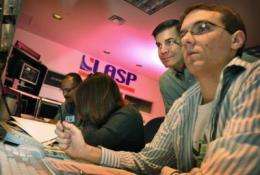
University of Colorado at Boulder students will be at the controls of one of NASA's most intriguing missions in recent years following the scheduled March 5 launch of the Kepler spacecraft to hunt down Earth-like planets in other solar systems.
A team of 20 students and 16 professionals from CU-Boulder's Laboratory for Atmospheric and Space Physics will operate the spacecraft from the LASP Space Technology Building in the CU Research Park following Kepler's launch from Cape Canaveral, Fla. Built by Ball Aerospace Technologies Corp. of Boulder, the spacecraft will point at roughly 100,000 stars in the Milky Way during the mission, looking for extremely faint, periodic dips in starlight signaling the transits of orbiting planets as they pass across the faces of the massive star surfaces.
The CU-Boulder mission operations team is working closely with Ball, which built the primary instrument for Kepler -- a one-meter telescope with a host of light-sensitive microchips -- and is the main mission contractor for the spacecraft, said LASP Mission Operations and Data Systems Director Bill Possel. Ball also developed the Kepler spacecraft flight system and is supporting mission operations.
The Kepler mission is fueling growing excitement among space scientists in the wake of the discovery of more than 300 planets orbiting other stars in the past 15 years. Although most are gas giants the size of Jupiter or larger, the sensitive instruments aboard Kepler will target the identification, location and orbit of small, rocky planets roughly the size of Earth that may indicate possible havens for life.
Researchers will be paying special attention to planets in "habitable zones," or orbits near enough to parent stars to host liquid water at their surfaces, said Possel. "This is a tremendous opportunity for CU-Boulder students to get hands-on experience with a spacecraft that is involved in cutting-edge science," he said. "Even if only 5 or 10 percent of the 100,000 stars have associated planets, it will be of huge interest to the science community and the public."
LASP's Kepler mission operators have been through several grueling rehearsals monitored by NASA and Ball before the Kepler launch, including scenarios involving major spacecraft and instrument anomalies, Possel said. "In some ways it will be like flying in an aircraft simulator for these controllers," he said.
The Kepler launch will be followed by an intensive, 24-hour-a-day checkout of the spacecraft by LASP controllers daily for two months as the spacecraft settles into an "Earth-trailing orbit" as it circles the sun. "This will be very demanding for the students," Possel said. "We are the first line of defense in monitoring the health of the spacecraft, and this check-out period will be critical."
Once Kepler moves into its planet-hunting phase, the LASP control team will contact the spacecraft twice a week to monitor onboard systems, including sensors, batteries positioning control, voltages and temperatures, and to upload commands. The spacecraft will be directed to point toward Earth once a month to "dump" its science data to NASA's Deep Space Network, a collection of antennas around the globe that support planetary and astronomical missions. The data then will be transmitted to LASP during individual sessions lasting from 36 to 48 hours, Possel said.
LASP will send the data on to the Space Telescope Science Institute in Baltimore. Science data analysis will be carried out by the NASA' Ames Research Center in Moffett Field, Calif. "It's exciting to know our controllers are the first people to see the data from Kepler, even if we are not involved in the analysis," said Possel.
LASP currently controls four other NASA spacecraft, including the Aeronomy of Ice in the Mesosphere, or AIM; the Solar Radiation and Climate Experiment, or SORCE; the Ice, Cloud and land Elevation, or ICEsat; and the Quick Scatterometer, or QuikSCAT. With the addition of Kepler, the missions are now probing Earth's surface, ice sheets, land, clouds, winds and solar radiation, as well as distant solar systems. "CU-Boulder will be the only university in the world to control five unique satellites," Possel said.
The $100 million SORCE satellite, launched in 2002 and which measures fluctuations in the sun's radiation and its ties to global change, was designed and built by LASP. Two of the three instruments aboard AIM were designed and built by LASP to study high-altitude clouds above Earth's polar regions thought to be related to human-caused increases in carbon dioxide and methane.
LASP hires 10 to 15 undergraduates annually for training as satellite operators at the conclusion of their sophomore years, said Possel. The students go through an intensive 10-week summer training program followed by practical and written tests leading to certification as satellite controllers by LASP. Starting in the fall, the students work 20 hours per week, including nights, holidays and CU-Boulder's winter and spring breaks.
"It is demanding on these students to juggle their missions operations work with their daily classes," said Possel. Most LASP student controllers are majoring in space science, engineering or computer science, although nothing precludes participation by non-science majors, he said. "It can be tough duty for students, providing care and feeding to these satellites on a Friday night when their friends are out on the town."
Josh Hecht, a sophomore from Lakewood, Colo., and one of the LASP student satellite controllers, spent his freshman year working at the CU-headquartered Colorado Space Grant Consortium, an aerospace engineering program that allows students -- primarily undergraduates -- to design and build satellites. "Before I came to LASP I was building spacecraft and now I'm controlling them," said Hecht. "With this kind of experience I'm hopeful I can eventually go to work for NASA or go directly into the space industry."
LASP also foots the tuition bill for the students in the program going on for master's degrees, Possel said. Upon graduation, the students -- who generally have two to three years of satellite operation experience under their belts -- are in high demand by the aerospace industry and various NASA centers.
Source: University of Colorado at Boulder


