February 20, 2009 feature
Scientists See Smallest-Ever Square Nanotube
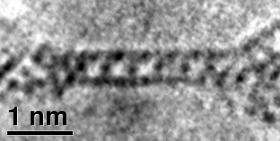
(PhysOrg.com) -- Scientists have observed the smallest reported nanotube that has a square cross-section. The structure formed spontaneously and unexpectedly when silver nanowires were stretched and is a reminder that scientists still have much more to learn about the nanoscale world.
The study was performed by scientists at two Brazilian institutions, the Laboratorio Nacional de Luz Sıncrotron (the Brazilian Synchrotron Light Laboratory) and the Universidade Estadual de Campinas-UNICAMP.
This research illustrates how material behavior at the nanoscale can be vastly and surprisingly different from the macroscopic scale, particularly in the case of applied mechanical stress. In general, the main differences between the behaviors of nanoscale and bulk materials are due to "surface energy." In the physics of solid materials, surfaces must be less energetic than the rest of the material, lest surfaces be constantly created until the material become nothing but a single surface.
For nanostructures, surface energy is more powerful because there is such a small amount of the material. Scientists expect to see certain atomic behaviors, such as how the atoms order themselves, based on predictions of surface energy. But this work has shown that the addition of a mechanical stress, such as pulling, can produced unexpected results.
"We have learned that it is essential to get experimental data in the field of nanomechanics and, if possible, data that is time-resolved with atomic resolution," said Daniel Ugarte, the study's lead scientist, to PhysOrg.com. "Currently, due to the intrinsic difficulties of studying these systems, most knowledge is derived from theoretical simulations, which are mostly not supported by lab work.
"The observed structure was fully unexpected even for us that have been working theoretically and experimentally in the field of mechanical stretching of nanowires for more than 10 years."
Silver naturally has a "face-centered cubic" atomic structure, meaning its basic building block, the "unit cell," is a cube with atoms at each corner and an atom in the center of each of the cube's six square faces. Thus, scientists expect silver nanowires of any given size to be solid (not hollow) and have square cross sections, an assumption they verified before stretching began.
As the wires were mechanically elongated over a period of about 10 seconds -- which is a very short time to complete a mechanical deformation -- the atoms shifted positions. At 3.6 seconds, the rods became hollow silver pillars with a side length of just one unit, which is less than one nanometer. After the 10-second mark, the wires thinned to a single-atom strand and finally severed.
The researchers analyzed the process using a variety of approaches, including high-resolution transmission electron microscope imaging and computer-based molecular simulations. In addition to being able to track the particular movements of the wire's atoms as it was pulled, the group concluded that the final hollow wire deforms under a small amount of force, yet can withstand a very large elongation.
"This work emphasizes the role of surface physics in nanosystems and also how the inclusion of stress and dynamics can generate unexpected exotic structures," said Ugarte. "The next step is to measure the forces involved an try to associate them with the involved atomic arrangements."
This research is reported in the January 25, 2009, online edition of Nature Nanotechnology.
Citation: M. J. Lagos, F. Sato, J. Bettini, V. Rodrigues, D. S. Galvao and D. Ugarte Nature advance online publication 25 January 2009, DOI: 10.1038/nnano.2008.414
Copyright 2009 PhysOrg.com.
All rights reserved. This material may not be published, broadcast, rewritten or redistributed in whole or part without the express written permission of PhysOrg.com.


